The Group 48 battery is a automotive battery specification defined by the BCI (Battery Council International) standards. The "48" does not refer to voltage or capacity, but rather to the battery's physical dimensions, terminal placement, and installation standards.
A standard Group 48 battery measures 306 × 175 × 192 mm (length × width × height). It is typically a 12 V battery with a capacity of approximately 60 Ah to 80 Ah, and a cold cranking amperage (CCA) generally ranging from 600 A to 900 A.
This battery is widely used in European models such as BMW, Mercedes-Benz, Audi, and Volkswagen, and is also commonly referred to as an H6 battery.
Currently, Group 48 batteries on the market include both lead-acid and AGM batteries, as well as a small number of lithium-ion versions. Continue reading to learn more.

What Does Group 48 Mean on a Battery?
Group 48 is a battery specification code primarily used to describe the battery's physical dimensions, terminal placement, and installation compatibility standards; it does not indicate the battery's voltage or capacity. Group 48 batteries are also known as H6 batteries.
Their standard dimensions are approximately 306 × 175 × 192 mm, and they typically operate at 12 V, making them commonly used as automotive starter batteries.
If a battery is labeled as Group 48, it means the battery complies with the Group 48 size and installation standards.
As long as your vehicle's battery compartment, mounting method, terminal orientation, and electrical specifications match these requirements, you can choose a battery of the same specification for replacement.
Group 48 Battery Dimensions, Voltage, and Terminal Layout
Let's take a closer look at Group 48 batteries so you can choose the right one when the time comes.
The standard dimensions of a Group 48 battery are approximately 306 × 175 × 192 mm, which is about 306 mm long, 175 mm wide, and 192 mm high.
However, many people are unaware that Group 48 batteries fall under the medium-to-large automotive starter battery category. The battery compartments of many vehicle models are designed to accommodate this size, such as certain BMW 3 Series models, the Volkswagen Passat, the Audi A4, and the Mercedes-Benz C-Class.
Let's take a closer look at Group 48 batteries so you can make the right choice when purchasing one in the future.
Dimensions:
As we already know, the standard dimensions of a Group 48 battery are approximately 306 × 175 × 192 mm, which is about 306 mm long, 175 mm wide, and 192 mm high.
However, many people are unaware that Group 48 batteries fall under the medium-to-large car starter battery category. The battery compartments of many vehicle models are designed to accommodate this size, such as certain BMW 3 Series models, the Volkswagen Passat, the Audi A4, and the Mercedes-Benz C-Class.
Voltage:
Group 48 batteries operate at 12V, not 48V. The "48" is simply the BCI battery group code, which denotes the size and installation standard, not the voltage.
Capacity:
Group 48 batteries typically have a capacity ranging from 60Ah to 100Ah, though the exact capacity varies depending on the battery type-lead-acid, AGM, or lithium. Among these, LiFePO4 batteries are considered a key direction for the future of automotive batteries.
Starting Performance:
High-quality Group 48 LiFePO4 batteries can deliver cold cranking currents ranging from 1,000A to 2,000A. In comparison, standard lead-acid batteries typically provide cold cranking currents of 600A to 800A.
This represents an increase of approximately 50% to 100%, delivering significantly more powerful starting torque to the engine.
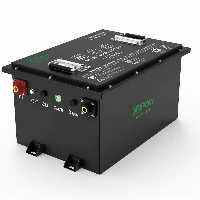
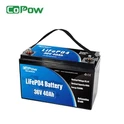
For example, CoPow's 12V 100Ah lithium-ion starter battery delivers a cold-cranking current of up to 2000A, ensuring reliable starting for boats and cars even in sub-zero temperatures.
Terminal Configuration:
Group 48 batteries typically feature SAE cylindrical terminals, a common standard in the automotive industry, with the positive and negative terminals located on opposite sides of the battery's top.
Most Group 48/H6 batteries feature a layout with the positive terminal on the right and the negative terminal on the left; however, when replacing the battery, you must still follow the terminal orientation of the original vehicle battery.
For example, models such as the Volkswagen Passat, Tiguan, Audi A4, and BMW 3 Series all use this layout. If the terminal orientation is selected incorrectly, the original vehicle's cables may be too short, or installation may not be possible at all.
Installation:
Group 48 batteries feature a mounting flange on the bottom that can be secured using clamps or latches on the vehicle's battery tray. When replacing the battery, it is essential to not only consider the dimensions but also verify that the height, terminal orientation, and mounting method match those of the original battery.
For example, some vehicle owners have found that while the replacement battery's length and width perfectly match the original, the battery's height exceeds that of the original battery by more than ten millimeters, preventing the hood from closing properly. This ultimately requires another battery replacement, which is quite troublesome.
Types of Group 48 Batteries
There are six models in the Group 48 battery series, each with its own unique performance characteristics:
Flooded Lead-Acid (FLA) Group 48 Batteries
These are basic lead-acid batteries consisting of lead plates and electrolyte inside. They require frequent topping up or replenishment of the electrolyte, as the battery relies primarily on the electrolyte to facilitate chemical reactions.
These batteries are commonly found in many older models, such as the E-Z-GO TXT (36V), Club Car DS (36V), and Yamaha G14/G16.
Currently, these batteries are gradually being replaced by LiFePO4 batteries.
Advantages: Low purchase cost
Disadvantages:
- Heavy weight
- Requires frequent maintenance
- Contains corrosive liquids
- High environmental costs
- Significant capacity degradation
- Very short service life
Capacity: 60Ah–800Ah
Cold cranking amperage: 500–800A
AGM (Absorbent Glass Mat) Group 48 Batteries
AGM batteries are currently one of the most common upgraded versions of the Group 48 size. They use glass fiber separators to absorb the electrolyte and are classified as sealed, maintenance-free batteries.
Compared to standard lead-acid batteries, AGM batteries offer superior cold-start performance, better vibration resistance, and faster charging speeds, making them widely used in vehicles equipped with start-stop systems.
Advantages:
- Excellent cold-start performance, making it easier to start the vehicle in cold weather.
- Compatible with start-stop systems.
- Sealed and maintenance-free; no need to add distilled water or electrolyte.
- Good shock resistance, suitable for rough road conditions and high-vibration environments.
- Low internal resistance, resulting in faster charging.
Disadvantages:
- Higher price than standard lead-acid batteries, typically 30%–100% more expensive.
- As a lead-acid battery, it is still quite heavy.
- Limited deep discharge capability.
- Cycle life is shorter than that of lithium iron phosphate batteries, typically only 300–800 cycles.
Capacity: 70Ah–95Ah
Cold cranking current: 700–950A
EFB (Enhanced Flooded Battery) Group 48 Batteries
EFB batteries can be considered a transitional product between standard lead-acid batteries and AGM batteries.
They feature a reinforced design based on the structure of traditional lead-acid batteries, typically offering twice the cycle life of standard lead-acid batteries and meeting the requirements of mild start-stop systems.
For consumers on a budget who still want start-stop functionality, EFB batteries are a cost-effective choice.
Capacity: 70Ah–85Ah
Cold Cranking Amps: 650–850A
* Lithium Iron Phosphate (LiFePO4) Group 48 Batteries
Lithium iron phosphate batteries are the fastest-growing type of Group 48 battery in recent years and represent a key development direction for the future automotive auxiliary power and aftermarket sectors.
Compared to lead-acid batteries, lithium iron phosphate Group 48 batteries offer significant advantages:
- 50% to 70% lighter
- 5 to 10 times longer cycle life
- Faster charging
- More stable voltage
- Maintenance-free
Capacity: 60Ah–100Ah
Cold cranking current: 1000A or higher
Dual-Purpose Group 48 Batteries
These batteries combine starting and deep-cycle capabilities, delivering the high current required to start an engine while also supporting extended periods of continuous power supply.
Compared to pure starting batteries, they feature thicker plates, resulting in superior deep-discharge capacity; compared to pure deep-cycle batteries, they retain high cold-start performance.
Applications: RVs, boats, emergency power systems, and specialty vehicles.
Start-Stop Group 48 Batteries
Strictly speaking, this is not a distinct chemical system, but rather a product category designed specifically for start-stop vehicles.
Currently, start-stop Group 48 batteries on the market primarily utilize AGM and EFB technologies.
These batteries can withstand the high cycling loads caused by frequent starting and are suitable for energy-efficient vehicles.
If your vehicle is equipped with an automatic start-stop system, you cannot simply replace the battery with a standard lead-acid battery, as this will cause the start-stop function to fail.
What Are Group 48 Batteries Used For?
As you can see, Group 48 batteries are a very broad category, so they have a wide range of applications.
Passenger Cars and SUVs: The most common application for Group 48 (H6) batteries is as automotive starter batteries, widely used in mid- to high-end sedans, SUVs, and crossovers, such as models from BMW, Mercedes-Benz, Volkswagen, Audi, and Ford.Many vehicles equipped with start-stop systems use Group 48 AGM batteries.
Light Trucks and Commercial Vehicles: Light trucks, vans, and commercial vehicles also utilize Group 48 batteries to provide power for engine starting as well as for onboard electronics and auxiliary systems.
RV: Small RVs and campers use Group 48 deep-cycle AGM batteries or lithium-ion batteries to power lighting systems, refrigerators, water pumps, inverters, and other onboard equipment.
Boats and Yachts: Group 48 batteries are also used in small boats, yachts, and fishing boats, serving both as starter batteries and as auxiliary power sources for navigation equipment, lighting, and electronics.
Backup Power Systems: Due to their standardized dimensions and moderate capacity, Group 48 batteries are commonly used in uninterruptible power supplies (UPS), communication equipment, and emergency backup power systems.
Solar Energy Storage Systems: Group 48 lithium iron phosphate batteries can be used in small-scale solar energy storage projects to provide stable power support for off-grid equipment, monitoring systems, and outdoor power systems.
Construction Equipment and Special-Purpose Vehicles: Some golf carts, landscaping equipment, cleaning equipment, small construction machinery, and special-purpose vehicles use Group 48 batteries as starting batteries or auxiliary power sources.
Group 48 vs Group 47 vs Group 49 Battery
Group 48, Group 47, and Group 49 are all standard sizes for automotive starter batteries (BCI battery groups). The main differences between them lie in the battery size, capacity, and the vehicle models they are compatible with.
Group 47 (H5): The smallest size, with a length of approximately 242 mm and a capacity ranging from 50 Ah to 70 Ah, commonly found in smaller-displacement sedans and compact SUVs.
Group 48 (H6): A medium-sized battery with a length of approximately 306 mm and a capacity ranging from 60 Ah to 100 Ah. This is currently the most common specification, widely used in mid-to-high-end models from BMW, Mercedes-Benz, Volkswagen, Audi, and Ford, as well as in vehicles equipped with start-stop systems.
Group 49 (H8): The largest size, with a length of approximately 354 mm and a capacity of 85 Ah to 120 Ah or more. It offers higher cold-cranking amperage and is primarily used in large SUVs, luxury sedans, diesel vehicles, and vehicles equipped with extensive electronic systems.
Why Are More People Choosing Group 48 Lithium Batteries?
Not only are Group 48 batteries gradually shifting toward lithium-ion technology, but industries across the board are upgrading from lead-acid batteries to lithium-ion batteries, particularly LiFePO4 batteries.
The primary advantages of these batteries lie in their exceptionally long service life and high safety, and they have a wide range of applications.
For example, as a LiFePo4 battery manufacturer, CoPow produces not only lithium-ion batteries for golf carts but also lithium-ion batteries for forklifts, marine applications, and RVs, as well as solar energy storage systems utilizing lithium iron phosphate cells.
All cells used are sourced from renowned companies such as CATL, BYD, and EVE Energy, and are brand-new, first-hand cells.
These cells have a cycle life of up to 6,000 cycles and a service life exceeding 8 years-performance that lead-acid batteries cannot match.
Although the current market for 48-cell battery packs is dominated by lead-acid and AGM batteries, the market share of lithium-ion batteries is expected to continue growing in the coming years as users demand ever-higher performance from their batteries.
Let's take a look at the benefits of using lithium iron phosphate batteries.
- Longer service life
- More powerful and stable performance
- Better range
- Simpler maintenance procedures
- More comprehensive after-sales service
- More environmentally friendly
- Lighter weight
- Smarter features
- Fully charges in just 1–3 hours
- Compatible with a wide range of devices
- Higher protection rating
How Much Does a Group 48 Battery Cost?
In 2026, lithium-ion battery prices fluctuated significantly, while lead-acid battery prices remained relatively stable.
Specifically, standard Group 48 lead-acid batteries ranged in price from $100 to $180; AGM Group 48 batteries ranged from $180 to $350; EFB (Enhanced Flooded Battery) batteries range from $150 to $280; and the highly anticipated Group 48 LiFePO4 batteries are priced higher, ranging from $400 to $1,200.
However, LFP batteries can significantly reduce subsequent maintenance and replacement costs.
The specific choice of battery depends on your usage scenario and requirements.
How to Choose the Best Group 48 Battery?
Getting back to the main point, we've already covered the basic definition, types, and applications of Group 48 batteries, as well as their approximate prices. However, this isn't enough to help you choose the most suitable Group 48 battery. To be absolutely sure, you'll also need to consider the following information:
Select Based on Vehicle Requirements
Check your vehicle's owner's manual or the label on the original battery to confirm whether a Group 48 (H6) size battery is required. In addition to ensuring the battery size matches your vehicle, verify that its voltage, capacity (Ah), and cold cranking amps (CCA) meet your vehicle's specifications.
Select Based on Battery Type.
Standard lead-acid batteries are the most affordable.
AGM batteries offer higher cold-cranking performance, better shock resistance, and faster charging speeds.
LiFePO4 batteries are lighter, have a longer lifespan, and charge faster, with a cycle life exceeding 6,000 cycles. They represent the future trend, but their initial purchase cost is relatively high.
Pay attention to the cold cranking amperage (CCA)
If the vehicle is frequently used in cold climates, pay close attention to the CCA rating.
For standard passenger cars, a CCA of 700A or higher is recommended.
For SUVs, pickup trucks, or diesel vehicles, a CCA of 800A or higher-or even 900A or higher-is recommended to ensure the engine starts reliably in cold winter conditions.
Consider Capacity (Ah)
Group 48 batteries typically have a capacity ranging from 60Ah to 100Ah.
For standard passenger cars, a capacity of 70Ah to 80Ah is generally sufficient.
If the vehicle is equipped with numerous electronic devices (such as a car refrigerator, audio system, parking camera, or auxiliary electrical equipment), it is recommended to choose a high-capacity model of 90Ah or more.
Check Cycle Life
Standard lead-acid batteries typically have a service life of 3 to 5 years.
AGM batteries generally last 4 to 7 years.
Under normal conditions, LiFePO4 batteries can last 8 to 15 years.
Choose Well-Known Brands and High-Quality Cells
High-quality brands typically offer more consistent performance and better after-sales service.
For lithium batteries, pay attention to the cell manufacturer; it is best to choose lithium iron phosphate cells from well-known manufacturers such as CATL or BYD.
Check the Warranty Policy
Before purchasing, pay attention to the battery's warranty period.
Standard lead-acid batteries usually come with a 1- to 3-year warranty.
AGM batteries typically come with a 2- to 5-year warranty.
High-quality lithium iron phosphate batteries usually come with a warranty of five years or more, and some products even offer warranties of eight to ten years.
Group 48 Battery FAQs
How Long Does a Group 48 Battery Last?
Group 48 batteries have a service life of 3–5 years (standard lead-acid batteries) and 4–7 years (AGM batteries), while Group 48 lithium iron phosphate batteries can last up to 8–15 years.
Is a Group 48 the Same as an H6 Battery?
Yes, Group 48 and H6 batteries are the same size. Group 48 is a designation used by the BCI (Battery Council International), while H6 is a designation based on DIN/EN (European standards). Their dimensions are essentially the same-approximately 306 × 175 × 192 mm-so they can be used interchangeably in most vehicles.
Can You Replace a Group 48 Battery With Another Size?
Yes, but only if the replacement battery's size, voltage, terminal layout, mounting method, capacity, and cold cranking amps (CCA) all meet the vehicle's specifications.