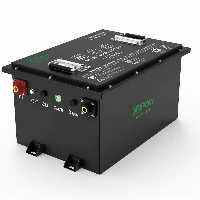
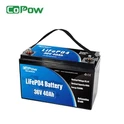
Whether they are lithium-ion or lead-acid batteries, they output direct current (DC), not alternating current (AC). This is because the structure of the positive and negative electrodes inside the battery determines a fixed direction of current flow, which does not periodically reverse like alternating current does.
So, why are some people still confused about whether forklift batteries use AC or DC? This is because many electric forklifts use AC drive systems (AC motors), which can easily lead people to mistakenly believe that forklift batteries also use AC power-but this is not the case.
The direct current (DC) output from the forklift battery first enters the forklift's internal controller or inverter, where the inverter converts the DC to alternating current (AC) for use by the AC drive motor.
The process is reversed during charging. Since the power grid supplies AC, the forklift charger must first convert the AC to DC before feeding it into the battery for charging.
The entire energy flow is as follows: AC from the power grid → converted to DC by the charger → stored as DC in the forklift battery → converted to AC by the inverter → powers the drive motor. It's that simple-don't overcomplicate it.
Next, we'll go into more detail about AC and DC in forklift batteries. If you have time, feel free to keep reading.

Why Do Forklift Batteries Use DC Power?
We briefly mentioned this at the beginning of the article, but to deepen your understanding of this phenomenon, we need to explain it in more detail. Forklift batteries use direct current (DC) because the chemical reactions inside the battery can only produce unidirectional electron flow; they cannot periodically reverse the direction of the current, as alternating current (AC) does.
A key characteristic of alternating current (AC) is that the direction of the current constantly reverses. For example, AC in the power grid changes direction periodically at a fixed frequency, whereas the chemical reactions inside a battery cannot automatically cause the direction of electron flow to switch back and forth.
How Does a Forklift Battery Power an AC Motor?
This is actually quite easy to understand: When the forklift starts, the direct current (DC) output from the battery enters the inverter. The inverter uses high-speed switching control (employing power devices such as IGBTs or MOSFETs) to convert the DC into three-phase alternating current (AC), and adjusts the output voltage and frequency according to the motor's operating requirements.
The converted AC power is fed into the stator windings of the AC motor, generating a rotating magnetic field that drives the rotor to rotate. This produces mechanical power, enabling the forklift to move and powering the hydraulic system to perform lifting operations.
The entire energy transfer process is as follows: Battery (DC) → Inverter (DC to AC conversion) → Motor controller (adjusts voltage/frequency) → AC motor → Mechanical motion.
In addition, AC forklifts feature regenerative braking. When the forklift decelerates or travels downhill, the AC motor can operate in reverse as a generator, converting mechanical energy into electrical energy.
This electrical energy is then converted back to DC by the inverter and stored in the battery, thereby enabling the forklift to recharge while driving. For example, the Toyota 8FBE20 (three-wheel electric counterbalanced forklift) utilizes regenerative braking to recover energy.
Can We Use a Lithium Battery in an AC Forklift?
Based on the explanation above, the answer to this question is clear: lithium-ion batteries can be used in AC forklifts. The term "AC forklift" refers to the type of drive motor, not the type of battery.
The direct current (DC) supplied by lithium-ion batteries can be converted to alternating current (AC) via a controller or inverter to power the motor.
Furthermore, if you have previously used lead-acid batteries and wish to upgrade to lithium-ion batteries in the future, lithium-ion batteries offer a more stable discharge voltage and deliver more powerful performance.
Conclusion
By now, you should already know the answer to this question. Forklift batteries undoubtedly use direct current (DC), but their drive motors operate on alternating current (AC), and lithium-ion batteries can also be used in forklifts equipped with AC motors.
What we really need to focus on is the quality of the DC power-that is, the battery's discharge performance. To power a massive machine like a forklift, a strong and stable current is essential.
As a professional forklift battery manufacturer, CoPow can provide you with a custom-designed lithium forklift battery that supports a continuous discharge rate of 1C and a peak discharge rate of up to 2C. It maintains stable power output even during high-intensity material handling operations across three shifts. Please feel free to contact us for more information.