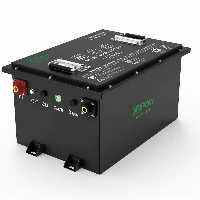
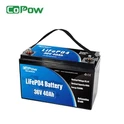
The number of cells required for a forklift battery varies depending on the battery type and voltage capacity. The minimum requirement is 12 lead-acid cells, while the maximum can be more than 75 lithium iron phosphate cells. This article lists the number of cells required for forklift batteries ranging from 24V to 80V, and we hope you find it helpful.

How Many Cells Are in a 24V Forklift Battery?
24V forklift batteries are primarily used in small material-handling equipment such as electric pallet trucks and electric stackers. They are mainly divided into two types: lead-acid batteries and lithium-ion batteries. Because the voltage of the battery cells varies, the number of cells also differs.
24V Lead-Acid: A 24V lead-acid forklift battery is composed of lead-acid cells with a voltage of 2V connected in series. The number of cells is calculated as follows: 24V ÷ 2V = 12 cells. Therefore, a standard 24V lead-acid forklift battery consists of 12 2V lead-acid cells connected in series. These cells contain positive plates, negative plates, electrolyte, and separators; when fully charged, the total voltage is approximately 25.6V.
24V lithium-ion battery: Here, we are referring to 24V LiFePO4 forklift batteries. In fact, lithium iron phosphate batteries now dominate the forklift battery market.
So, how many cells does it actually consist of?
The rated voltage of a LiFePO4 cell is 3.2V; therefore, a 24V battery consists of 8 3.2V cells connected in series (8S).
Common 24V LiFePO4 forklift batteries include 24V 100Ah, 24V 150Ah, 24V 200Ah, 24V 230Ah, and 24V 280Ah. Battery capacity can be freely configured by contacting lithium forklift battery manufacturers based on your needs; there are no fixed restrictions, and lithium batteries can be fully customized.
Ternary Lithium-Ion Batteries: These types of lithium-ion forklift batteries are indeed available on the market, though they are relatively rare. They are characterized by their smaller size while still being able to store more electrical energy. This means you can install a battery with a longer runtime in a limited space, such as in the Linde E-Series light-duty forklifts or the Toyota 8FBE Series three-wheel electric forklifts. The battery has a rated voltage of 3.6–3.7 V, so it consists of approximately seven ternary lithium cells connected in series.

How Many Cells Are in a 36V Forklift Battery?
36V forklift batteries are typically used in 1.5- to 2.5-metric-ton forklifts, such as the Toyota 7FBE series, Crown SC and FC series, and Yale ERP series, though they are not limited to counterbalanced forklifts. In addition, they are suitable for material handling equipment such as electric three-wheel forklifts, electric stackers, electric pallet trucks, and AGV/AMR automated guided vehicles.
These devices are also available with a choice of either lead-acid or lithium-ion batteries.
Number of cells in a 36V lead-acid forklift battery: The 36V lead-acid forklift battery consists of 18 lead-acid cells connected in series, each with a rated voltage of 2V.
Number of cells in a 36V lithium-ion forklift battery: A 36V LiFePO4 forklift battery typically consists of 12 LiFePO4 cells with a rated voltage of 3.2V connected in series (12S), meaning 36V ÷ 3.2V is approximately 11.25.
Interestingly, the number of cells in a 6V lithium-ion battery varies depending on the required capacity. For example, lower-capacity batteries such as 36V 100Ah and 36V 200Ah typically use 12 high-capacity cells connected in series (12S1P).
If a capacity of 400Ah is selected, manufacturers will likely adopt a 12S2P configuration, which uses 24 cells. This is because achieving such a high capacity requires not only series connection but also parallel connection to reasonably assemble a forklift battery pack.
For common capacities of 36V forklift lithium-ion batteries, please refer to the table below:
| Voltage | Common Capacity | Typical Applications |
|---|---|---|
| 36V | 100Ah | Small electric pallet trucks, stackers, and light-duty warehouse equipment |
| 36V | 150Ah | Electric pallet trucks, walkie stackers, and medium-to-low intensity operations |
| 36V | 200Ah | One of the most common configurations, suitable for most warehouse forklifts |
| 36V | 230Ah | Electric forklifts, rider pallet trucks, and long-hour operation equipment |
| 36V | 280Ah | Medium-duty forklifts and high-frequency material handling applications |
| 36V | 300Ah–400Ah | Multi-shift operations and high-load industrial vehicles |

How Many Cells Are in a 48V Forklift Battery?
The 48V forklift battery is currently the most widely used voltage platform in industrial vehicles. Compared to 24V forklift batteries, it delivers higher power output and longer operating times; compared to 72V/80V forklift batteries, it is more cost-effective and offers broader compatibility.
48V forklift batteries are primarily used in 1.5- to 3.5-metric-ton electric forklifts, such as Toyota's 8FBE15, 8FBE18, and 8FBE20 series; Linde's E16, E18, E20, and E25 series; and Hyster's J1.6XNT, J1.8XNT, J2.0XNT, and J2.5XNT series, and are also suitable for other types of material handling equipment.
Number of cells in a 48V lead-acid forklift battery: A 48V lead-acid forklift battery consists of 24 lead-acid cells with a rated voltage of 2V each (24S).
Number of cells in a 48V lithium-ion forklift battery: A 48V LiFePO4 forklift battery consists of 16 lithium iron phosphate cells connected in series, each with a rated voltage of 3.2V. The total voltage is 16 × 3.2V = 51.2V, and the fully charged voltage is 16 × 3.65V = 58.4V.
A standard 48V lithium-ion forklift battery contains at least 16 cells, and the number of cells increases accordingly as capacity increases.
The following is a reference table showing the number of cells for 48V forklift lithium-ion batteries of different capacities:
| Battery Specification | Common Cell Capacity | Cell Configuration | Total Number of Cells |
|---|---|---|---|
| 48V 100Ah | 100Ah LFP Cells | 16S1P | 16 cells |
| 48V 200Ah | 200Ah LFP Cells | 16S1P | 16 cells |
| 48V 280Ah | 280Ah LFP Cells | 16S1P | 16 cells |
| 48V 300Ah | 150Ah Cells | 16S2P | 32 cells |
| 48V 400Ah | 200Ah Cells | 16S2P | 32 cells |
| 48V 560Ah | 280Ah Cells | 16S2P | 32 cells |
| 48V 600Ah+ | 200Ah / 300Ah Cells | 16S3P | 48 cells |

How Many Cells Are in a 72V Forklift Battery?
72V forklift batteries are primarily used in electric forklifts with capacities ranging from 2.5 to 5 metric tons and are commonly found in large warehouses, ports, manufacturing plants, and logistics centers. Their use is not limited to forklifts; they can be used in any vehicle that needs to move heavy loads, such as electric aircraft tugs, heavy-duty tow trucks, and terminal tow trucks.
Returning to the main topic, these batteries are primarily compatible with medium- to large-sized electric forklifts such as the Toyota 8FB35, 8FB40, 8FB45, 8FB50, and Linde E35, as well as the E40, E45, E50, Hyster J3.5XN, J4.0XN, J4.5XN, J5.0XN, and Jungheinrich EFG BC 320, EFG BC 325, and EFG BC 330.
Number of cells in a 72V lead-acid forklift battery: A 72V lead-acid forklift battery consists of 36 lead-acid cells with a rated voltage of 2V each connected in series; that is, 72V ÷ 2V = 36 individual cells.
Number of cells in a 72V lithium-ion forklift battery: A 72V lithium-ion forklift battery consists of 24 lithium iron phosphate cells with a rated voltage of 3.2V each connected in series, i.e., 3.2V × 24 = 76.8V. A standard 72V lithium iron phosphate forklift battery uses a 24S1P (24 in series, 1 in parallel) configuration.
Batteries with different capacities differ in the number of cells as follows:
| Battery Specification | Cell Configuration | Number of Cells |
|---|---|---|
| 72V 200Ah | 24S1P | 24 cells |
| 72V 280Ah | 24S1P | 24 cells |
| 72V 314Ah | 24S1P | 24 cells |
| 72V 400Ah | 24S2P (200Ah Cells) | 48 cells |
| 72V 560Ah | 24S2P (280Ah Cells) | 48 cells |
How Many Cells Are in a 80V Forklift Battery?
80V forklift batteries are primarily used in 4- to 8-metric-ton electric forklifts and are commonly found in large warehouses. Common forklift models include Toyota's 8FB40, 8FB45, 8FB50, and 8FB55; Linde's E40, E45, E50, and E60; Komatsu's FB40, FB45, and FB50; and Hyster's J4.0XN, J4.5XN, J5.0XN, and J5.5XN series. The average capacity of these forklifts ranges from 4 to 6 metric tons.
Number of cells in a 80V lead-acid forklift battery: An 80V lead-acid forklift battery consists of 40 lead-acid cells with a rated voltage of 2V each connected in series; that is, 80V ÷ 2V = 40 individual cells (40 cells).
Number of cells in a 80V lithium-ion forklift battery: An 80V lithium-ion forklift battery consists of 25 lithium iron phosphate cells with a rated voltage of 3.2V connected in series. 3.2V × 25 = 80V; this configuration is designated as 25S. This means that an 80V lithium-ion forklift battery requires at least 25 cells connected in series.
The number of cells for different capacities is as follows:
| Battery Specification | Cell Capacity | Configuration | Total Number of Cells |
|---|---|---|---|
| 80V 280Ah | 280Ah LFP Cell | 25S1P | 25 cells |
| 80V 314Ah | 314Ah LFP Cell | 25S1P | 25 cells |
| 80V 400Ah | 200Ah LFP Cell | 25S2P | 50 cells |
| 80V 560Ah | 280Ah LFP Cell | 25S2P | 50 cells |
| 80V 840Ah | 280Ah LFP Cell | 25S3P | 75 cells |

Does a Higher Cell Count Mean a Better Forklift Battery?
A higher number of cells does not necessarily mean a forklift battery is better. For example, while an 80V forklift lithium-ion battery may have 40 high-capacity lithium iron phosphate cells, it cannot be said to be of higher quality than a 48V forklift lithium-ion battery. The number of cells does not determine the quality of a forklift battery; it merely indicates that the battery has a higher voltage and capacity than standard batteries, and may offer greater power and range.
However, don't forget that forklift batteries are designed to handle extremely heavy loads, such as steel coils. Using them to move loads of 1–3 metric tons is somewhat overkill and makes it difficult to recoup the investment.
On the other hand, the practicality of a forklift battery depends not only on the battery itself but also, to a large extent, on the battery management system. The protection, smart features, and discharge capabilities provided by the BMS, as well as the sophistication of its protective mechanisms, all have a significant impact on the user experience.

Partner With CoPow to Customize Your Lithium Forklift Battery Solution
The number of cells is just one factor; other factors affecting battery performance include cell quality, battery capacity, the battery management system, discharge capability, safety design, and compatibility.
CoPow is a professional lithium-ion forklift battery manufacturer, capable of providing customized lithium-ion battery solutions tailored to different forklift models.
From voltage ratings, battery capacity, and cell configurations to BMS functions, communication protocols (CAN/RS485), structural design, and installation dimensions, CoPow can optimize designs based on your project requirements.
Feel free to contact the CoPow team; we will respond to your inquiry within 24 hours.