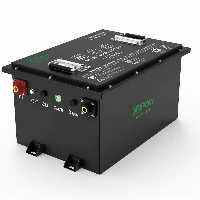
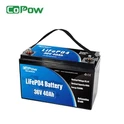
When building a 24V lithium iron phosphate battery pack, the industry-standard approach is to connect eight cells in series, commonly referred to as an 8S configuration. This is mainly because each LiFePO4 cell has a nominal voltage of 3.2V, and eight cells in series produce a total nominal voltage of 25.6V, which falls perfectly within the optimal operating range of a 24V system.
In real-world use, the battery pack voltage fluctuates depending on the state of charge. When the battery is fully charged and each cell reaches 3.65V, the total pack voltage rises to about 29.2V. When the battery is nearly depleted and the cell voltage drops to around 2.5V, the total voltage falls to roughly 20V. This voltage profile matches extremely well with inverters and chargers originally designed for 24V lead-acid battery systems.
Although some may consider using a 7-cell configuration (22.4V nominal), its overall voltage range is too low to allow connected equipment to perform at its full potential. For this reason, an 8-cell series configuration is widely recognized worldwide as the most reliable and practical solution for 24V LiFePO4 battery systems.
24V LiFePO4 Battery Pack (8S Configuration) Specifications
| Status | Voltage per Cell | Total Pack Voltage (8S) | Description |
| Nominal | 3.2V | 25.6V | The industry standard for "24V" systems. |
| Fully Charged | 3.65V | 29.2V | The upper limit during charging. |
| Discharge Cut-off | 2.5V | 20.0V | The point where the BMS stops power to protect cells. |
| Working Range | 3.0V – 3.4V | 24.0V – 27.2V | Where the battery spends 80% of its cycle. |

7S vs 8S LiFePO4 Configurations: What's the Difference?
When deciding between a 7S (7 cells in series) and an 8S (8 cells in series) configuration for a 24V system, the choice is clear: 8S is the industry standard, while 7S is rarely used.
Here is a detailed breakdown of the differences:
1. Voltage Range Comparison
| Specification | 7S Configuration | 8S Configuration (Recommended) |
|---|---|---|
| Nominal Voltage | 22.4V (3.2V × 7) | 25.6V (3.2V × 8) |
| Fully Charged Voltage | 25.55V (3.65V × 7) | 29.2V (3.65V × 8) |
| Discharge Cut-off Voltage | 17.5V (2.5V × 7) | 20.0V (2.5V × 8) |
2. Key Differences and Impact
Equipment Compatibility:
- 8S: Its voltage range (20.0V – 29.2V) closely aligns with traditional 24V lead-acid batteries. Most inverters, solar charge controllers, and DC motors are designed specifically for this range.
- 7S: The voltage is too low. A fully charged 7S pack (approx. 25.5V) is barely equal to the nominal voltage of an 8S pack. Using 7S often triggers "Low Voltage" alarms on inverters, causing them to shut down prematurely.
Efficiency and Performance:
- 8S: Allows devices to operate at a higher, more stable voltage, which generally results in higher efficiency and less heat generation in the wiring.
- 7S: As the battery drains, the voltage can drop below 20V. To maintain the same power output, the system must draw more current, which increases the risk of overheating wires and components.
Availability of Components:
- 8S: BMS and chargers for 8S LiFePO4 are ubiquitous, affordable, and easy to find.
- 7S: Components specifically for 7S LiFePO4 are rare. There is also a high risk of accidentally purchasing 7S NCM (Triple Lithium) components, which have completely different voltage profiles and could create safety hazards.
Unless you have highly specialized equipment that strictly cannot exceed 26V, always choose the 8S configuration. It is the "gold standard" for 24V LiFePO4 systems.

Full Charge and Cut-Off Voltage of a 24V LiFePO4 Battery
For a 24V LFP battery pack, the full charge voltage is typically 29.2V. This value is based on the standard 8S configuration (eight cells connected in series), since the optimal charge cut-off voltage for a single LiFePO4 cell is 3.65V. Therefore, the total full charge voltage is calculated as 3.65V × 8 = 29.2V. When the battery reaches this voltage, the charger usually stops charging or switches to a float or standby mode.
The discharge cut-off voltage is generally set at around 20V. The lower discharge limit for a single LiFePO4 cell is typically 2.5V, which results in a total pack voltage of 2.5V × 8 = 20V for an 8S configuration.
In real-world applications, however, many battery management systems or inverters set a slightly higher cut-off voltage-such as 21V or 21.6V-to help extend battery lifespan. This practice reduces the risk of irreversible capacity degradation caused by deep discharge.

Does the Number of Cells Affect Inverters and Equipment Compatibility?
In short: Yes, the number of cells connected in series directly affects the compatibility between the inverter and the equipment.
The number of cells determines the Nominal Voltage of the battery pack. If the voltage does not match, it can lead to anything from the device failing to start to permanent circuit damage or even fire hazards.
1. Core Impact: Input Voltage Range
Inverters and electrical equipment have a specific rated operating voltage range.
- Under-voltage: If there are too few cells, the voltage will drop below the inverter's startup threshold. The inverter will then trigger a low-voltage error and cut output to protect the battery from over-discharging.
- Over-voltage: If there are too many cells, the voltage may exceed the tolerance of the inverter's internal capacitors and power components (such as MOSFETs), leading to permanent hardware failure.
2. Cell Count Differences Across Battery Chemistries
Even if the nominal voltage is the same (e.g., 48V), different battery chemistries require different cell counts, which dictates their compatibility:
| Battery Type | Nominal Cell Voltage | Typical Cells for 48V System | Full Charge Voltage (Typical) |
| Lead-Acid | 2.0V | 24 Cells | Approx. 54V - 56V |
| LiFePO4 (LFP) | 3.2V | 15 or 16 Cells | 54V - 58.4V |
| NMC (Li-ion) | 3.7V | 13 or 14 Cells | 54.6V - 58.8V |
Note: Many inverters designed for 48V LiFePO4 systems must support a voltage ceiling of at least 58.4V if using a 16-cell (16S) configuration. If a legacy inverter designed for 13S NMC is used, it may frequently trigger over-voltage alarms.
3. Efficiency and Power Handling
Current Stress: For a given power output, according to the formula P = V * I, the higher the voltage (determined by the cell count), the lower the required current.
Compatibility Tip: If you are using high-power equipment, increasing the number of cells (shifting to a higher voltage platform like 48V instead of 12V) significantly reduces heat and cable loss. However, this requires an inverter specifically rated for that higher voltage.
4. Charge Controller Compatibility
If your system includes a Solar Charge Controller (MPPT), it is highly sensitive to the number of cells. The controller needs to know the exact cell count to set:
- Bulk Voltage
- Float Voltage
- Cut-off Voltage
Summary and Recommendations
When matching cell count with an inverter, always check the following:
- Verify the Inverter's DC Input Range: Ensure the battery pack's voltage-at both "fully charged" and "empty" states-falls within the inverter's allowed window.
- BMS Settings: Ensure the protection thresholds of the BMS are synchronized with the inverter's alarm thresholds to avoid operational conflicts.

Common Applications of 24V LiFePO4 Battery Systems
The reason 24V LiFePO4 battery systems are so popular in the market lies in their ability to strike an ideal balance between low-voltage safety and high efficiency. Compared with 12V systems, a 24V system delivers the same power at half the current, which not only simplifies cable selection but also significantly reduces power losses during energy transmission.
| Application Category | Specific Equipment | Why Choose 24V LiFePO4? |
| RVs & Camping | Rooftop AC, microwaves, ice makers | High power demand. Compared to 12V, 24V cuts current in half, reducing cable heat and improving inverter efficiency. |
| Solar Energy Storage | Off-grid cabins, remote monitoring, street lights | The "sweet spot" between cost and efficiency. Lower loss than 12V, and components are often cheaper than 48V systems. |
| Marine | Trolling motors, windlasses, thrusters | Many high-performance motors are native 24V. The lightweight nature of lithium improves boat draft and speed. |
| Industrial Handling | Electric pallet jacks, scissor lifts | Built for high-frequency use. Long cycle life (3000+ cycles) significantly reduces long-term replacement costs. |
| Medical & Mobility | Electric wheelchairs, mobility scooters | High safety and low weight. LiFePO4 is chemically stable (fire-resistant) and makes devices easier to transport. |
| Backup Power (UPS) | Server racks, telecom base stations | High temperature resistance. It remains stable in outdoor cabinets without air conditioning compared to Lead-Acid or NMC. |

Key Things to Consider When Building or Buying a 24V LiFePO4 Battery
Whether you plan to build the system yourself or purchase a ready-made solution, there are several key factors that deserve close attention when designing a 24V LiFePO4 battery system.
1. Cell Quality and Consistency - Crucial for DIYers
Grade: Always ensure you are using Grade A cells. Grade B cells are often factory rejects with higher internal resistance, inflated capacity ratings, or shorter lifespans.
- Matching: Before assembly, the voltage, internal resistance, and capacity of all cells must be highly consistent.
- Top Balancing: Before connecting them in series, you must perform a "Top Balance" by connecting all cells in parallel and charging them to 3.65V to ensure they all start at the same state of charge.
2. Battery Management System Specifications
The BMS is the "brain" of your battery. Consider the following:
- Continuous Current: Ensure the BMS's rated continuous discharge current (e.g., 100A or 200A) can handle your maximum load (e.g., your inverter's peak power).
- Protection Features: It must include protection against over-charging, over-discharging, over-current, short circuits, and high/low temperature.
- Active vs. Passive Balancing: For 24V systems, a BMS with active balancing is more effective at correcting voltage gaps between cells, thereby extending the overall battery life.
3. Temperature Management (Low-Temp Charging)
LiFePO4 batteries have a critical weakness: they cannot be charged below 0°C (32°F).
- Heating Function: If you operate in cold climates (winter camping or outdoor stations), choose a battery or BMS with an integrated self-heating function.
- Heat Dissipation: Ensure the battery enclosure has adequate ventilation during high-power discharge cycles.
4. Charger Compatibility
- Voltage Profile: A 24V LiFePO4 system has a nominal voltage of 25.6V, with a full charge voltage typically set between 28.4V and 29.2V.
- Algorithm: Standard lead-acid chargers often have "desulfation" or "equalization" modes that use high voltage spikes, which can damage a lithium BMS. Use a dedicated LiFePO4 charger or an MPPT controller with a lithium profile.
5. Connections and Wiring (Busbars & Cables)
- Busbars: Use solid copper busbars (preferably nickel-plated to prevent oxidation).
- Wire Gauge: Since a 24V system can still pull significant current (a 2000W load draws about 80A), select the correct AWG cable size to prevent excessive voltage drop and fire hazards.
Comparison: Buying vs. Building
| Dimension | Buying Pre-built (e.g., CoPow) | Building (DIY) |
| Difficulty | Plug-and-play, zero threshold | Requires tools (multimeter, torque wrench) and expertise |
| Safety | Factory sealed; vibration and pressure tested | User assumes all risk; potential for loose connections |
| Monitoring | Usually includes integrated Bluetooth App | Requires purchasing separate Bluetooth modules or displays |
| Cost | Includes warranty and service; higher upfront price | Lower hardware cost, but no official after-sales support |
CoPow 24V LiFePO4 Batteries for Stable and Efficient Power
CoPow's 24V LiFePO4 battery systems have built a solid reputation in the off-grid storage and motive power markets. Users generally choose them for their advanced intelligence and high safety standards. To ensure power delivery remains both stable and efficient, these battery systems incorporate several practical design optimizations.
Core Advantages of CoPow 24V LiFePO4 Batteries
| Feature | Technical Details | Value to the User |
| Integrated Smart BMS | Advanced Battery Management System monitors voltage, current, and temperature. | Stability: Automatically prevents overcharge, over-discharge, and short circuits without manual intervention. |
| Bluetooth Monitoring | Real-time tracking of cell voltage and State of Charge (SOC) via a mobile App. | Transparency: Know exactly how much power is left, avoiding unexpected shutdowns during outdoor activities. |
| Grade A Cells | Uses brand-new, high-quality lithium iron phosphate cells. | Efficiency: Charge/discharge efficiency exceeds 95%, with a lifespan typically reaching over 10 years (4000+ cycles). |
| Lightweight Design | Weighs approximately 1/3 of an equivalent lead-acid battery. | Portability: Ideal for RVs and boats, reducing vehicle weight and improving fuel economy. |
Why the 24V System Is "More Efficient"
CoPow promotes 24V battery configurations over 12V systems based on several fundamental engineering principles.
- Reduced Line Loss: According to the formula P = I² × R, when the system voltage is increased from 12V to 24V, the current required to deliver the same amount of power is reduced by half. This reduction in current leads to approximately a 75% decrease in heat loss through the cables.
- Higher Inverter Efficiency: 24V inverters generally convert DC power to AC (110V/220V) more efficiently than 12V inverters, ensuring that more of the stored energy is actually delivered to your appliances.
- Better Support for High-Power Loads: A 24V system can easily handle high-wattage devices in the 2000W–3000W range-such as RV air conditioners-without the need for impractically thick wiring.
Recommended Application Scenarios
- High-End RV Upgrades: If your camper has high-draw appliances, a CoPow 24V 100Ah or 200Ah bank is an ideal drop-in solution.
- Trolling Motors: For professional anglers, these batteries provide a steady current that makes motors run quieter and last longer on the water.
- Small Residential Solar: When paired with solar panels, CoPow batteries build a reliable micro-grid for essential lighting and communication.
Ready to optimize your power system for maximum efficiency?
Contact our technical team today for a free custom energy evaluation, or let me know your device wattage below to find the perfect CoPow battery for your needs!
faq
How Many Cells Are in an 8kWh LiFePO4 Battery Pack?
The number of cells required for an 8 kWh lithium iron phosphate battery pack depends on the capacity of the individual cells and the series-parallel configuration.
However, we can use a common configuration to estimate this. If standard 3.2 V LiFePO₄ cells are used to build a typical 51.2 V system (16 cells in series), the total energy is 8 kWh ÷ 51.2 V ≈ 156 Ah. We would typically select a capacity close to this value (such as 150Ah or 160Ah), so a configuration of 16 cells in series (16S1P) would generally suffice. If smaller-capacity cells are used (e.g., 50Ah or 100Ah), parallel connections must be added to the 16-cell series configuration (e.g., 16S2P or 16S3P), bringing the total number of cells to 32, 48, or even more.