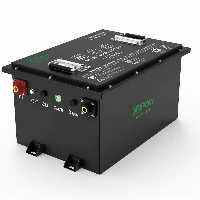
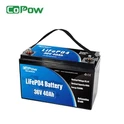
In the realm of 24V trolling motors, 50Ah, 100Ah, and 200Ah batteries are the most common choices.
Based on their capacity, we can get a general idea of the runtime of these battery types.
However, to provide a more comprehensive understanding, we will conduct a side-by-side comparison to outline the recommended uses, as well as the pros and cons of each 24V trolling motor battery.
Finally, we will offer practical selection tips. Please continue reading.

Key Differences Between 24V 50Ah, 100Ah, and 200Ah Batteries
Let's start by taking a look at how each 24V battery actually performs.
| Battery Specification | Total Energy (Wh) | Energy Capacity (kWh) | LiFePO4 Weight | Usage Duration |
|---|---|---|---|---|
| 24V 50Ah | 1280Wh | 1.28kWh | 10–15kg | Less than half a day |
| 24V 100Ah | 2560Wh | 2.56kWh | 20–28kg | Full-day use |
| 24V 200Ah | 5120Wh | 5.12kWh | 40–55kg | Extended runtime |
Here's a simple calculation: Wh = V × Ah. For example, 24V × 50Ah = approximately 1200Wh. You might wonder why this differs from the 1280Wh listed in the table.
This is because the actual nominal voltage of a lithium iron phosphate battery is 25.6V, and its actual energy capacity is 1280Wh, not 1200Wh. Within the industry, 25.6V is commonly referred to as 24V-this is a unique characteristic of lithium iron phosphate batteries.
What are the different types of 24V trolling motor batteries? Let's take a look at the table below:
| Battery Type | 24V 50Ah Runtime | 24V 100Ah Runtime | 24V 200Ah Runtime | 24V 50Ah Weight | 24V 100Ah Weight | 24V 200Ah Weight | Usable Capacity | Cycle Life | Charging Speed |
|---|---|---|---|---|---|---|---|---|---|
| Lead-Acid Flooded | 2–4 hours | 4–8 hours | 8–16 hours | 28–35kg | 55–70kg | 110–140kg | About 50% | 200–500 cycles | Slow |
| AGM | 2–5 hours | 5–9 hours | 9–18 hours | 22–30kg | 45–60kg | 90–120kg | About 50–60% | 300–700 cycles | Medium |
| Gel Battery | 3–5 hours | 5–10 hours | 10–20 hours | 24–32kg | 48–65kg | 95–130kg | About 50–60% | 500–1000 cycles | Slow |
| LiFePO4 (Lithium Iron Phosphate) | 4–6 hours | 8–12 hours | 16–24+ hours | 10–15kg | 20–28kg | 40–55kg | 80–100% | 3000–6000 cycles | Fast |
| Ternary Lithium (NMC) | 4–6 hours | 8–12 hours | 16–24+ hours | 8–13kg | 18–25kg | 35–50kg | 80–100% | 1000–3000 cycles | Fast |
Who is the 24V 50Ah trolling battery suitable for?
The 24V 50Ah is a compact, entry-level trolling motor battery that is well-suited for recreational anglers and those who fish exclusively in coastal waters or lakes.
In terms of boat types, it is suitable for small fishing boats, kayaks, Jon boats, and small aluminum boats, such as the Lund Boats Rebel XL 1650, Tracker Boats GRIZZLY 1436 Jon, and Hobie Mirage Pro Angler 12.
In terms of usage time, this battery is suitable for users who boat for 2–4 hours per day, assuming normal speeds and minimal use of electrical equipment.
Pros and Cons of a 24V 50Ah Trolling Battery:
| Advantages of 24V 50Ah Battery | Disadvantages of 24V 50Ah Battery |
|---|---|
| Lightweight design (typically 10–15kg) | Limited runtime at high motor speeds |
| Easy for one person to carry and install | Not ideal for all-day fishing trips |
| Lower purchase cost | Runtime drops quickly above 70% throttle |
| Takes up less space on small boats | May struggle in strong wind or current |
| Improves boat balance and maneuverability | Less suitable for heavy boats |
| Shallower draft after lithium upgrade | Frequent recharging may be required |
| Great for kayaks and small Jon Boats | Not ideal for high-power trolling motors |
| Much lighter than lead-acid batteries | Real-world runtime affected heavily by load and weather |
| Simple lithium upgrade solution | Limited reserve power for long-distance trolling |

Why is 24V 100Ah the most popular choice?
There are many online discussions about trolling batteries, and most of them focus on the 24V 100Ah model. This refers to standard 24V 100Ah LiFePO4 batteries.
Why is this battery so popular?
It's not just because it's the most common choice, but also because it offers excellent value for the price. It strikes a good balance in terms of weight, runtime, cost, and installation, making it suitable for a wide range of boat models, such as the well-known Ranger Boats Z175, Nitro Boats Z18, and Skeeter Boats FXR series.
Whether you're a recreational angler or a professional, this battery is a great choice.
Who is it really for? What are the typical use cases?
The answer is people who love to spend almost the entire day on the water as soon as they head out.
Some medium to large bass boats, such as the Skeeter Boats FXR Series we mentioned earlier-which can accommodate two or more people and are equipped with power-consuming devices like radar detectors and LiveScope-are all well-suited for this 24V 100Ah trolling motor battery.
Just how much has its battery life improved?
| Trolling Motor Current Draw | Power Consumption | 24V 100Ah Theoretical Runtime | Typical Real-World Runtime |
|---|---|---|---|
| 10A | 240W | 10 hours | 8–9 hours |
| 20A | 480W | 5 hours | 4–4.5 hours |
| 30A | 720W | 3.3 hours | 2.8–3 hours |
| 40A | 960W | 2.5 hours | 2–2.2 hours |
| 50A | 1200W | 2 hours | 1.5–1.8 hours |
| 60A | 1440W | 1.6 hours | 1.2–1.5 hours |
| 70A | 1680W | 1.4 hours | Around 1 hour |
As I've said before, no one can keep going at full speed all the time. We're not out for a joyride; we're here to fish and enjoy life. That's why our trips often last eight hours or more.
Recommended Reading: How Long Will a 24V 100Ah Battery Last with a Trolling Motor?

Just how impressive is a 24V 200Ah battery?
At the 200Ah level, we're already talking about exceptionally long runtime. 200Ah translates to a total energy capacity of 24V × 200Ah = 4,800 Wh, which is equivalent to a 5 kWh lithium iron phosphate battery-almost on par with a small solar energy storage system.
The 24V 200Ah trolling motor battery is undoubtedly better suited for professional anglers; the renowned angler ACOB Wheeler has even used this battery to compete in the Bassmaster Classic.
So, what types of boats is it suitable for?
It is commonly used on medium to large boats such as the Ranger Boats Z521R, Nitro Boats ZV21, and Skeeter Boats FXR21. These boats typically feature high-power motors like the Minn Kota Ultrex QUEST or Garmin Force, with hull lengths of approximately 20–21 feet, not to mention various professional fish finders.


Why do so many people regret buying a model with too small a capacity?
Unlike low-power devices such as trolling motors, LED boat lights, and GPS systems, it is a high-power device that consumes electricity continuously-that is, a power-driven device.
Its power consumption dynamics are quite complex. For example, while the boat's LED lights are not affected by resistance factors such as wind speed or water current, they are closely related to the trolling motor.
When it comes to a 50Ah battery, many people assume they rarely use it-only going out to sea occasionally-but they fail to consider the environmental factors that may arise during navigation. As a result, sometimes as soon as Spot Lock is turned on, the battery drains rapidly, completely ruining the experience, and ultimately forcing them to spend more money on a 100Ah battery.
Whether it's a trolling motor or other powered equipment, we should often follow the principle of "buying bigger rather than smaller" to avoid losing the bigger picture by focusing on minor details.
Is bigger always better?
"Go big, not small" does not mean you should buy a battery with an extremely large capacity.
"Go big, not small" means purchasing a 24V trolling motor battery with a theoretical capacity slightly greater than your actual needs.
A larger battery means a higher price, greater weight, and a larger footprint. When making your actual choice, you need to consider a variety of factors.
Here is a reference table:
| Battery Capacity | Price Level | Weight | Space Requirement | Recommended Boat Types | Best For | Typical Usage Style |
|---|---|---|---|---|---|---|
| 24V 50Ah | Entry-level | 10–15kg | Small | Kayaks, Jon Boats, small aluminum boats | Budget-conscious users | Half-day fishing, light trolling |
| 24V 100Ah | Mainstream | 20–28kg | Medium | Bass boats, aluminum fishing boats, multi-species boats | Most anglers | Full-day fishing, balanced performance |
| 24V 200Ah | High-end | 40–55kg | Large | Large Bass boats, Deep V boats, professional fishing boats | Heavy-duty users | Long-duration trolling, tournament-level use |
Final Thoughts
For most casual anglers, a 24V 100Ah trolling motor battery offers the best value for money.
But it can be even better!
CoPow can provide you with high-end, custom-made 24V 100Ah lithium-ion trolling motor batteries. From rust protection, smart battery management systems, and self-heating modules to rugged casings and precision screws, every detail can be tailored to your needs, making it the ultimate trolling motor battery to help you shine at major tournaments like the Bassmaster Classic!
Feel free to contact us anytime-we'll respond to your message within 24 hours.