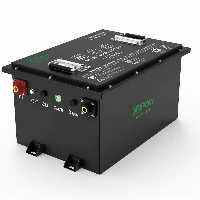
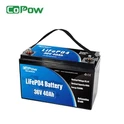
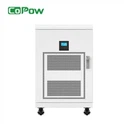
24V batteries are widely used in solar systems, marine equipment, RV power supplies, and even golf carts.
Many users face a common question in practical applications: How long does the battery actually last? Some focus solely on the battery's Ah capacity, while others concentrate only on the device's power rating. However, calculations often deviate significantly from reality if inverter efficiency, depth of discharge, and actual load conditions are ignored.
Therefore, this article will start with the most fundamental formula, progressively explaining how to calculate the runtime of a 24V battery. Practical examples will help readers grasp the real-world implications behind these numbers.

How to Calculate the Runtime of a 24V Battery?
To calculate how long a 24V battery will last, we first need to understand its formula:
Runtime (hours) = Battery capacity (Ah) × Battery voltage (V) × Inverter efficiency × Depth of discharge (DoD) ÷ Device power (W)
This might seem a bit complex, so let's simplify it: Total battery energy ÷ Device power consumption = Runtime.
Example: Suppose you have a 24V 100Ah battery powering a 1000W device with a 94% inverter efficiency. Using a standard 24V battery, its maximum discharge depth is 80% of capacity.
- First, calculate total battery energy: 24V × 100Ah = 2400Wh.
- Then factor in efficiency and depth of discharge: 2400 × 0.94 × 0.8 = 1804.8Wh.
- Finally, divide by the device power: 1804.8 ÷ 1000W ≈ 1.8 hours.
Thus, this 24V 100Ah battery can run for approximately 1.8 hours.
- Note: This case uses a 24V lithium iron phosphate battery. For other types of 24V batteries, the situation will differ. If using a 24V lead-acid battery, its discharge depth is only 50%, resulting in significantly different final calculations.
- Let's compare them visually: For a 24V 100Ah battery, the lithium battery can operate for 1.8–2 hours, while the lead-acid battery can only run for 1.1–1.3 hours.
How Battery Type Affects 24V Battery Runtime?
Among all influencing factors, battery type undoubtedly plays a decisive role in determining service life. 24V batteries primarily include lead-acid batteries, AGM batteries, nickel-cadmium batteries, and lithium iron phosphate batteries. We will now introduce each type in turn.
Let us continue using the example and assumptions from the previous section:
- The battery capacity is 100Ah (24V × 100Ah = 2400Wh).
- Load: 1000W device
- Inverter efficiency: 94%
- Depth of Discharge (DoD): Safe discharge depth is 70% for lead-acid batteries and 80% for LiFePO4 batteries.
Lead-acid battery: DoD approximately equals 50% to 70%
100 × 24 × 0.7 × 0.94 / 1000 ≈ 1.58 hours
For a more conservative discharge (DoD 50%):
100×24×0.5×0.94/1000 ≈ 1.13 hours
100×24×0.5×0.94/1000 ≈ 1.13 hours
AGM Battery: DoD approximately 70%
100×24×0.7×0.94/1000 ≈ 1.58 hours
Performance is slightly better than standard lead-acid batteries, but runtime difference is negligible.
Nickel-Cadmium (NiCad) Battery: DoD approximately 60% to 70%
100×24×0.65×0.94/1000 ≈ 1.46 hours
Lithium Iron Phosphate Battery (LiFePO4): DoD ≈ 80%
100×24×0.8×0.94/1000 ≈ 1.8 hours
100×24×0.8×0.94/1000 ≈ 1.8 hours
In terms of runtime, lithium iron phosphate batteries are the optimal choice. For example, Copow's 24V solar panels can deliver up to 1.8 hours of runtime or even longer.

What Factors Affect How Long a 24V Battery Lasts?
Theory is theory, reality is reality. Ultimately, we live in the real world. Therefore, the factors affecting the lifespan of a 24V battery cannot be generalized.
- Battery Capacity: The larger the battery capacity, the more electricity it can store, and consequently, the longer the device can operate.
- Device Power Consumption: The more power a device consumes, the faster the battery drains. For example, a 1000W device will deplete the battery much faster than a 200W device.
- Inverter Efficiency: Energy loss occurs when using an inverter to convert direct current (DC) to alternating current (AC).
- Depth of Discharge: Excessive power draw can damage battery lifespan.
- Battery Type: Lead-acid batteries can only safely utilize about 50% of their capacity, while lithium iron phosphate batteries can handle 80% or even 90%.
- Ambient Temperature: In cold environments, the battery's actual capacity decreases.
- Battery Degradation: Over time, a battery's capacity gradually diminishes.
How Long Will a 24V 100Ah Battery Last?
In the Rocky Mountains of Colorado, USA, there is a photographer named Jack who owns an off-grid cabin powered by a standard 24V grid system. Although his battery bank is also rated at 24V 100Ah, he does not operate it as recommended in the manual.
His power consumption pattern is far from the simplicity of theoretical calculations: he doesn't rely solely on a single device drawing a constant 1000W load. Instead, he simultaneously operates multiple devices with varying power requirements.

1. Calculation of Actual Usable Energy
Jack is quite careful with his battery, so he sets the depth of discharge (DoD) to 80%.
Theoretical total energy:
24V × 100Ah = 2400Wh (approximately 2.4 kWh).
However, to extend battery life, he only uses 80% of the capacity, so:
Actual usable energy = 2400Wh × 0.8 = 1920Wh
In other words, this battery provides approximately 1920Wh of usable energy in practical use.
2. Real-world load list (mixed usage)
Jack works 4 hours at night. During this period, the power consumption of devices in the cabin is as follows:
- Starlink satellite terminal: approx. 60W (runs continuously to upload photos and video footage)
- High-performance laptop: approx. 90W (used for video editing)
- Cabin LED lighting: 20W
- Small car refrigerator: 50W when compressor runs, but not continuously; load factor approx. 30%, average power consumption approx. 15W
Therefore, the real-time total power consumption is: P = 60W + 90W + 20W + 15W = 185W
3. Accounting for "Hidden Costs" (System Losses)
In practice, inverter efficiency is not constant. When a 1000W inverter powers only 185W of load, efficiency typically drops to about 85%. Additionally, the inverter itself has static power consumption-even when no devices are connected, it draws approximately 15W while powered on.
Therefore, the system's actual power consumption is:
Total power consumption = (185W ÷ 0.85) + 15W ≈ 233W
4. Final Result: How long will this battery last?
Based on the actual usage scenario above:
The battery's usable energy is 1920Wh, and the system's actual power consumption is approximately 233W.
Therefore, the runtime is:
Runtime = 1920Wh ÷ 233W ≈ 8.2 hours
This demonstrates that with the same 24V lithium battery, if you use a 1000W microwave oven as specified in the manual, it will run out of power in under two hours.
However, if you follow Jack's approach and only meet basic living and office needs, it can reliably support over eight hours of use-just enough for him to work through the night and recharge via solar panel the next morning.
How Long Will a 24V 200Ah Battery Last?
A 24V 200Ah battery can power a 1000W device for approximately 3.8 hours. This range may seem somewhat broad, but that's okay-let's consider another simple example.
Suppose you have a 24V 200Ah lithium battery installed on a small fishing boat to power a 400W onboard refrigerator and some lighting fixtures.
The battery's total capacity is 24V × 200Ah = 4800Wh. Assuming you stop using it when the charge level reaches 80%, the available capacity at that point is approximately 3840Wh.
Now, the total power consumption of the onboard equipment is 400W. Calculating the usable capacity of the battery: 3840Wh ÷ 400W. This indicates it can run for approximately 9.6 hours.
In other words, this 24V 200Ah battery can sustain power for about 10 hours, which is sufficient to cover the needs from setting out for fishing in the morning until returning in the afternoon.
How to Make a 24V Battery Last Longer?
Regardless of whether you are using a 24V, 36V, 48V, or 12V battery, the following points must be observed:
1. Avoid draining the battery to 0%.
Charge the battery when it reaches 20%–30% remaining capacity. Consistently discharging the battery completely will shorten its lifespan.
2. Use the correct charger:
Different battery types require specific chargers. Never use chargers interchangeably, as this will directly damage the battery.
3. Avoid direct sunlight:
Keep batteries out of direct sunlight whenever possible. If on a boat, ensure the cabin isn't overly airtight.
4. Maintain optimal charge levels:
When storing batteries long-term, keep them charged between 50% and 70%.
4. Avoid sudden power surges:
Prevent abrupt activation of high-power devices or motors, as sudden high-current spikes can degrade battery performance.
6. Conduct regular inspections and maintenance:
Keep battery terminals clean and connections secure to prevent corrosion or poor contact.
Final Thoughts
Overall, the runtime of a 24V battery is influenced by multiple factors. It depends not only on the battery's capacity but also on device power consumption, inverter efficiency, depth of discharge, and battery type-all of which directly impact how long the battery can sustain power delivery.
Mastering the correct calculation methods and planning usage based on actual power consumption allows you to maximize the battery's performance, ensuring an efficient and reliable power system. Whether on a boat, in an RV, or within a solar system, this battery can reliably support daily operations when used appropriately.
FAQ
how long will a 24v 200ah battery last?
A 24V 200Ah battery provides a nominal energy capacity of approximately 4.8 kWh (24V × 200Ah). Its actual runtime depends on the connected load. For example, it can power a 100W device for about 48 hours, a 500W device for roughly 9 to 10 hours, and a 1000W device for approximately 4 to 5 hours.
In real-world applications, however, runtime may vary due to factors such as inverter efficiency, depth of discharge (DoD), and ambient temperature.