


Lithium Ion Forklift Battery
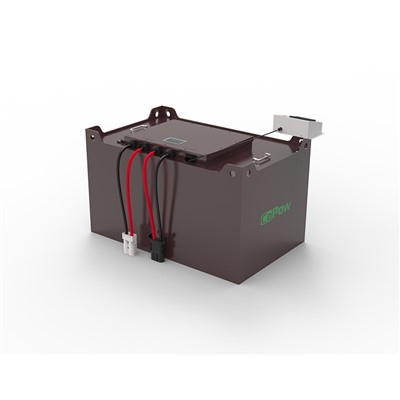
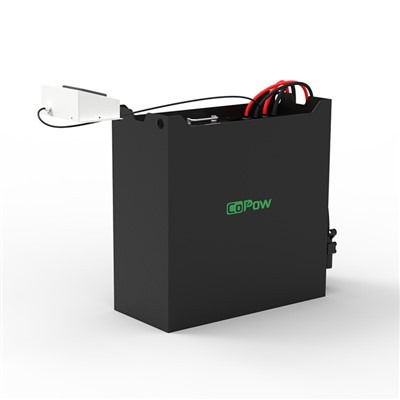
COPOW Lithium Forklift Batteries
Powering Forklift Efficiency with High-Current Output and Smart Monitoring.
As a long-standing player in the forklift industry, COPOW has always been committed to delivering reliable power solutions for high-frequency and high-intensity operating scenarios. We understand the real performance challenges forklifts face under heavy workloads, which is why we have invested heavily in targeted research and development of lithium battery technology.
Core Technology & Discharge Performance:
We adopt a self-developed lithium iron phosphate electrochemical system, utilizing a high-temperature solid-state process to produce nano-structured cathode materials.
This enables our batteries to achieve an extended service life while maintaining stable performance even in low-temperature environments.
To meet heavy-duty requirements, our battery packs support 2C continuous discharge and up to 10C peak discharge for instantaneous high-current output. This ensures consistent and powerful energy delivery, even during prolonged, high-load forklift operations.
Flexible Modular Design:
To accommodate different forklift models and operating conditions, COPOW batteries feature a modular architecture that supports flexible series and parallel configurations.
- Structural Stability: Each module is pre-designed with temperature control systems, heating elements, and dedicated wiring interfaces. The overall structure is robust, ensuring internal components remain secure even in the event of minor impacts.
- Easy Installation: The battery housing is made of high-strength square aluminum casing combined with bolt-type terminal connections. This design enhances mechanical durability while significantly improving on-site installation and maintenance efficiency.
Manufacturing Capacity & Service Support:
COPOW operates with a complete R&D team and fully automated production lines, with an annual production capacity of 2 GWh.
We are able to respond quickly to customized requirements and provide professional after-sales technical support, including remote monitoring services.
Intelligent Monitoring & Management: Safety and usability are key priorities. Each battery is equipped with an intelligent BMS.
By simply scanning a QR code, users can access a mobile app to monitor real-time battery status and perform remote management, making maintenance more intuitive and efficient.
Get a Custom Lithium Battery Solution





Why Choose cOPOW LiFePO4 Forklift Battery?


Custom & OEM Lithium Forklift Battery Manufacturer
As a technology-driven manufacturer of lithium forklift batteries, Copow's core strength lies in our R&D team’s professional background with industry leaders like CATL and BYD. We do more than just assemble batteries; we integrate top-tier industry standards into the design of every battery pack we produce.
Product Technology & Performance
We provide long-cycle-life Lithium Batteries for electric Forklifts, deeply integrated with our self-developed intelligent BMS and cloud-based IoT platform. This solution allows for precise monitoring of all battery parameters and supports remote diagnostics, ensuring your equipment always operates at peak performance.
Deep Customization for Diverse Needs
For buyers, COPOW’s strength lies in its exceptional adaptability. We perfectly match the specifications of major global forklift brands and possess extensive hands-on experience in lead-acid to lithium conversions. If you value technical transparency, safety standards, and digital management, COPOW is a practical and reliable choice.
Three Reasons to Choose COPOW:
- Tier-1 Technical Background: Our core team’s professional experience ensures high reliability in cell selection and overall system architecture.
- Universal Brand Compatibility: Whether for new OEM integration or retrofitting older units, we provide precisely matched power solutions for any model.
- Efficient Digital Management: Through our cloud platform, you can monitor battery health and operational efficiency in real time, making maintenance more predictable.
Every battery deployed should be stable, visible, and controllable—this is the tangible value COPOW delivers to our customers.


Compatible with Multiple Forklift Models

Lithium Forklift Batteries for Industrial Applications


Custom Solutions for CoPow Forklift Batteries


CoPow Lithium forklift battery with app monitoring

Production Process of Copow LiFePO4 Battery

The Authoritative Certifications of CoPow forklift Batteries

- For the special working conditions of industrial vehicles, CoPow has developed and produced high-multiplication lithium iron phosphate batteries, which have the characteristics of high multiplication, long cycle life, high safety performance, strong consistency, and wide adaptability to the environment.
- Intelligent battery management system is adopted to manage the battery scientifically, achieve automatic equalization and prolong the service life of the battery; after strict reliability test and market verification, it ensures the safety and stability of the whole machine performance.
- CAN bus data transmission, seamless connection with vehicle control system and charging system.
- Remote cloud platform data to obtain real-time operation data of the power supply, the use of the location, to achieve fault point judgement, remote program upgrade and other functions; mobile phone APP query real-time operation data of the power supply, so that the operator can easily
- understand the operation status of the locomotive at any time.
Lithium-Ion vs. Lead-Acid Forklift Batteries
Lithium-ion and lead-acid batteries are two battery types commonly used in industrial forklifts, each with unique characteristics and application scenarios. Below is a detailed comparison of them in several aspects:
Lithium-ion batteries use a lithium compound as the positive electrode material, the negative electrode is usually graphite, and the electrolyte is a lithium salt solution. It is more environmentally friendly and safer, with no heavy metal pollution. Lead-acid batteries are composed of lead and lead oxide (positive electrode), spongy lead (negative electrode), and the electrolyte is dilute sulfuric acid.
Lithium-ion batteries have higher energy density, usually in the range of 100-265 Wh/kg, providing longer running time and suitable for high energy consumption applications; lead-acid batteries have lower energy density, usually in the range of 30-50 Wh/kg, requiring more frequent charging and suitable for short and medium energy consumption applications.
Lithium-ion batteries have a longer cycle life, usually more than 2000-5000 cycles. Longer life, typically 5-10 years. Lead-acid batteries have a shorter cycle life, typically 500-1000 cycles. The service life is shorter, usually 2-5 years.
Lithium-ion batteries charge quickly, usually 1-4 hours to be fully charged. It supports opportunity charging (e.g. charging during breaks) and has no memory effect. Lead-acid batteries take longer to charge, usually 6-12 hours. Need to be fully discharged and then recharged, memory effect exists.
Lithium-ion batteries have low maintenance requirements and do not require the addition of electrolyte. Battery management systems (BMS) are usually built-in to manage charging, discharging and temperature; lead-acid batteries have higher maintenance needs, especially wet-charge lead-acid batteries, which require regular inspections and electrolyte additions. Electrode wiring may need to be cleaned to prevent corrosion.
Lithium-ion batteries have a higher initial cost, but their long life and low maintenance costs result in a lower total cost of ownership. Lead-acid batteries have a lower initial cost, but higher maintenance and replacement costs.
Lithium-ion batteries are suitable for applications requiring high performance, long life and low maintenance.
FAQ
We're professional forklift lithium battery manufacturers and suppliers in China, specialized in providing high quality customized service. We warmly welcome you to wholesale forklift lithium battery at competitive price from our factory.
12v 30ah Lithium Ion Battery, 36V 40Ah Lithium Ion Battery, solar rechargeable lithium batteries