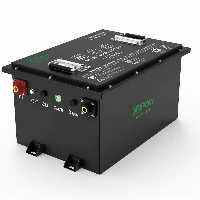
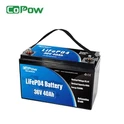
The 48V golf cart lithium-ion battery conversion kit is rapidly becoming the mainstream solution in the golf cart upgrade market.
By 2026, as LiFePO4 technology continues to mature, an increasing number of models from brands such as Club Car, EZGO, Yamaha, and Evolution will begin adopting or upgrading to 48V lithium-ion battery systems.
This article provides a comprehensive analysis of 48V lithium-ion battery conversion kits for golf carts, covering: the components included in the kit, available capacities, compatible models, the key differences between 48V lithium-ion batteries and traditional lead-acid batteries, and how to select the most suitable 48V lithium-ion conversion solution.
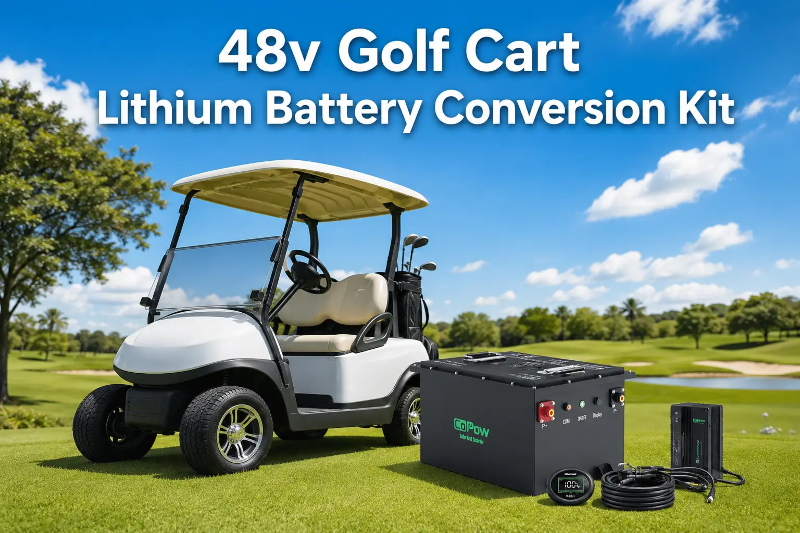
What Is Included In A 48V Golf Cart Lithium Battery Conversion Kit?
Upgrading a 48V golf cart lithium battery isn't as simple as just buying a battery. It's like a desktop computer: if you only have the main unit and a monitor, but no mouse or keyboard, it still won't work.
The mouse and keyboard correspond to components such as the LCD display, buck converter, and battery management system.
Although their value pales in comparison to that of the battery, without these accessories, the golf cart simply won't start.
So, what exactly does a golf cart lithium-ion battery upgrade kit include? Let's take a closer look:
| Component / Accessory | Required or Optional | Main Function | Why It Matters | Specifications / Notes |
|---|---|---|---|---|
| 48V LiFePO4 Golf Cart Battery | Required | Core power source of the conversion kit | Replaces traditional lead-acid batteries | Capacities: 65Ah, 100Ah, 105Ah, 150Ah |
| Smart BMS (Built-In) | Required | Protects the battery system | Prevents overcharge, over-discharge, overheating, and short circuits | CAN, RS485, Bluetooth supported |
| Lithium Battery Charger | Required | Charges the lithium battery correctly | Lead-acid chargers are often incompatible | Output: 58.4V |
| LCD Display / SOC Meter | Usually Required | Displays battery percentage and voltage | Helps users monitor battery status in real time | Some support touchscreen |
| DC-DC Converter (48V to 12V) | Usually Required | Powers 12V accessories | Supports lights, USB ports, speakers, horns, etc. | Outputs: 12V 10A–30A |
| Main Power Cables & Wiring Harness | Required | Connects the battery to the golf cart | Ensures safe and stable current delivery | Heavy-duty copper cables |
| Mounting Brackets / Tray Kit | Usually Required | Secures the lithium battery | Prevents vibration and movement | Especially important for Club Car / EZGO / Yamaha |
| Fuse or Circuit Breaker | Required | Electrical protection | Prevents overload and short circuits | Ratings: 100A–400A |
| Anderson Connector / Quick Plug | Usually Required | Quick battery connection | Simplifies installation and maintenance | High-current industrial connectors |
| Charging Port | Required | Dedicated charging interface | Ensures charging compatibility | Often upgraded during conversion |
| Waterproof Battery Case | Required | Protects internal components | Improves durability and outdoor safety | Common IP ratings: IP65 / IP67 |
| Bluetooth Module | Optional | Wireless battery monitoring | Allows smartphone monitoring | Integrated into smart BMS |
| Mobile Monitoring App | Optional | Displays battery data in real time | Monitors SOC, voltage, temperature, cycles | iOS and Android support |
| CAN / RS485 Communication Cable | Optional | Communication between battery and controller/display | Supports advanced diagnostics | Popular in smart golf carts |
| On/Off Power Switch | Optional but Recommended | Controls battery output manually | Convenient for storage and maintenance | Waterproof versions preferred |
| Solenoid Upgrade | Optional but Recommended | Handles high-current switching | Old solenoids may fail with lithium systems | Heavy-duty lithium-compatible solenoids |
| Motor Controller Compatibility Kit | Optional | Improves controller compatibility | Needed for some older golf carts | Especially for upgraded motors |
| Battery Heating Function | Optional | Warms the battery in cold weather | Protects charging performance below 0°C | Popular in North America and Europe |
| Temperature Sensors | Optional | Monitors battery temperature | Improves safety and charging protection | Built into premium systems |
| Waterproof Connectors | Optional but Recommended | Improves moisture resistance | Prevents corrosion and connection failure | Useful in humid or marine environments |
| Emergency Disconnect Switch | Optional | Quickly disconnects battery power | Improves emergency safety | Common in commercial fleets |
| Fireproof Insulation Materials | Optional | Enhances internal safety | Reduces thermal risks | Used in premium lithium batteries |
| GPS / Cloud Monitoring Module | Optional | Remote fleet monitoring | Useful for rental or commercial fleets | Premium feature |
| Installation Hardware Kit | Required | Includes bolts, screws, clamps, spacers | Necessary for installation | Included in complete kits |
| User Manual & Wiring Diagram | Required | Installation guidance | Reduces installation errors | Includes safety instructions |
| Warranty Card | Required | After-sales support | Protects customer investment | Warranty: 5–10 years |
| Certification Documents | Required | Compliance and transportation approval | Important for imports and commercial sales | CE, UN38.3, MSDS, UL, IEC62619 |

What Battery Capacities Are Available For 48V Lithium Conversion Kits?
The 50Ah and 65Ah models are the entry-level options for 48V lithium-ion golf cart conversion kits. Moving up from there are the most popular 48V 100Ah and 48V 105Ah lithium-ion conversion kits on the market.
Of course, there are even higher capacities available, such as 150Ah, 160Ah, 200Ah, and beyond, but these typically require custom manufacturing by the golf cart battery manufacturer.
So, exactly how many capacity options are available for 48V lithium-ion golf cart batteries? Please refer to the table below:
| Battery Capacity | Driving Range* | Usage Scenario | Weight vs Lead-Acid | Charging Time | Popularity Level |
|---|---|---|---|---|---|
| 48V 50Ah | 15–25 km (9–15 miles) | Light-duty short-distance use | ~25–30 kg (55–66 lbs), about 55–70% lighter than lead-acid | 2–4 hours | Entry-Level |
| 48V 65Ah | 25–40 km (15–25 miles) | Daily personal use | ~30–35 kg (66–77 lbs), about 50–65% lighter | 3–5 hours | Entry-Level |
| 48V 80Ah | 35–55 km (22–34 miles) | Medium-duty usage | ~38–45 kg (84–99 lbs), about 45–60% lighter | 4–5 hours | Moderate |
| 48V 100Ah | 50–80 km (31–50 miles) | Standard golf cart applications | ~45–55 kg (99–121 lbs), about 50–65% lighter | 4–6 hours | Very Popular |
| 48V 105Ah | 55–85 km (34–53 miles) | Enhanced range & hill climbing | ~50–58 kg (110–128 lbs), about 50–65% lighter | 4–6 hours | Extremely Popular |
| 48V 120Ah | 65–95 km (40–59 miles) | Heavy daily use | ~58–68 kg (128–150 lbs), about 45–60% lighter | 5–7 hours | Popular |
| 48V 150Ah | 80–120 km (50–75 miles) | Commercial & utility carts | ~70–85 kg (154–187 lbs), about 40–55% lighter | 6–8 hours | High-End |
| 48V 160Ah | 90–130 km (56–81 miles) | Multi-passenger & commercial carts | ~75–90 kg (165–198 lbs), about 40–55% lighter | 6–8 hours | High-End |
| 48V 180Ah | 100–145 km (62–90 miles) | Heavy-duty utility applications | ~85–100 kg (187–220 lbs), about 35–50% lighter | 7–9 hours | Premium / Custom |
| 48V 200Ah | 110–160 km (68–99 miles) | Long-range commercial fleets | ~95–115 kg (209–254 lbs), about 35–50% lighter | 7–10 hours | Premium Custom |
| 48V 210Ah | 120–170 km (75–106 miles) | High-performance modified carts | ~100–120 kg (220–265 lbs), about 35–50% lighter | 8–10 hours | Premium Custom |
| 48V 280Ah | 160–220 km (99–137 miles) | Industrial or specialty vehicles | ~130–160 kg (287–353 lbs), about 30–45% lighter | 10–12 hours | Rare / Fully Customized |

Which Golf Cart Models Are Compatible With 48V Lithium Conversion Kits?
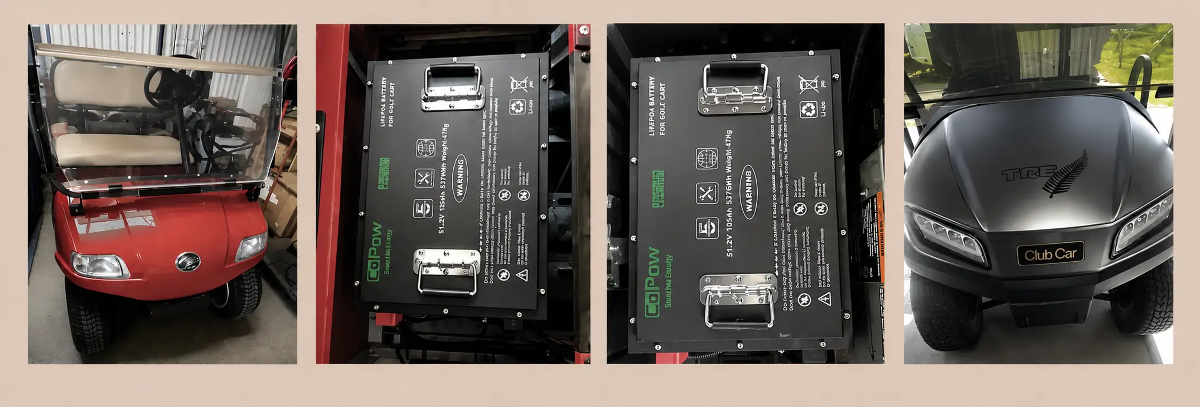
From a technical standpoint, upgrading to a lithium-ion battery system involves replacing the existing lead-acid battery system rather than completely altering the vehicle's structure.
As long as the vehicle is built on a 48V platform, most golf carts can be converted to lithium-ion batteries.
However, there may be differences among various models in terms of battery compartment size, controller compatibility, wiring harness configuration, and onboard electronic systems.
Therefore, we recommend consulting a professional before proceeding with a lithium-ion battery upgrade to avoid unnecessary waste.
Below is a reference table for different models across various golf cart brands:
| Golf Cart Brand | Popular Compatible Models | Compatible with 48V Lithium Conversion | Original Battery Configuration | Compatibility Difficulty | Upgrade Notes |
|---|---|---|---|---|---|
| Club Car | DS 48V | Yes | 6×8V lead-acid batteries | Easy | One of the most common lithium conversion platforms |
| Club Car | Precedent | Yes | 6×8V or 4×12V lead-acid | Easy | Excellent compatibility with most lithium kits |
| Club Car | Tempo | Yes | 48V lead-acid system | Easy | Modern wiring systems simplify installation |
| Club Car | Onward | Yes | 48V factory platform | Easy | Often upgraded with Bluetooth lithium batteries |
| Club Car | Carryall Series | Yes | 48V utility platform | Moderate | Commercial carts may require higher Ah batteries |
| EZGO | TXT 48V | Yes | 6×8V lead-acid batteries | Easy | Extremely popular for lithium upgrades |
| EZGO | RXV | Yes | 48V AC drive system | Moderate | Some models may require controller communication support |
| EZGO | Freedom RXV | Yes | 48V lead-acid system | Moderate | Often upgraded to 100Ah or 105Ah lithium kits |
| EZGO | Valor | Yes | 48V system | Easy | Compact battery trays may require bracket kits |
| EZGO | Express Series | Yes | 48V utility platform | Moderate | Larger passenger carts benefit from higher capacities |
| Yamaha | Drive / Drive2 | Yes | 48V lead-acid configuration | Easy | One of the easiest Yamaha lithium conversions |
| Yamaha | G19 | Yes | 48V lead-acid system | Moderate | Older carts may require wiring upgrades |
| Yamaha | G22 | Yes | 48V battery setup | Moderate | Battery tray modification may be needed |
| Yamaha | Adventurer Series | Yes | Utility 48V platform | Moderate | Often paired with higher-capacity lithium packs |
| Evolution | Classic Series | Yes | Factory 48V platform | Easy | Many already support lithium-ready electronics |
| Evolution | Forester Series | Yes | 48V lithium-ready chassis | Easy | Frequently upgraded with premium lithium systems |
| Evolution | D5 Series | Yes | Modern 48V architecture | Easy | Advanced displays often support CAN communication |
| ICON | i20 / i40 / i60 | Yes | 48V platform | Easy | Commonly converted to smart lithium batteries |
| ICON | Commercial Series | Yes | 48V utility system | Moderate | High-capacity batteries recommended |
| Star EV | Sirius / Classic | Yes | 48V battery system | Moderate | Some models require DC-DC converter upgrades |
| Tomberlin | E-Merge Series | Yes | 48V electric platform | Moderate | Onboard electronics may require compatibility checks |
| Cushman | Shuttle Series | Yes | 48V utility configuration | Moderate | Utility carts often need larger Ah capacity |
| Columbia | ParCar Series | Yes | 48V lead-acid platform | Moderate | Older models may require custom wiring |
| Garia | Luxury Golf Carts | Yes | Premium 48V systems | Moderate | High-end electronics may need CAN integration |
| Advanced EV | Advent / EV1 Series | Yes | 48V electric platform | Easy | Modern lithium-ready configurations |
| Bintelli | Beyond / Nexus Series | Yes | 48V system | Easy | Usually compatible with standard lithium kits |
| Denago | EV Series | Yes | 48V lithium-ready architecture | Easy | Frequently supports plug-and-play upgrades |
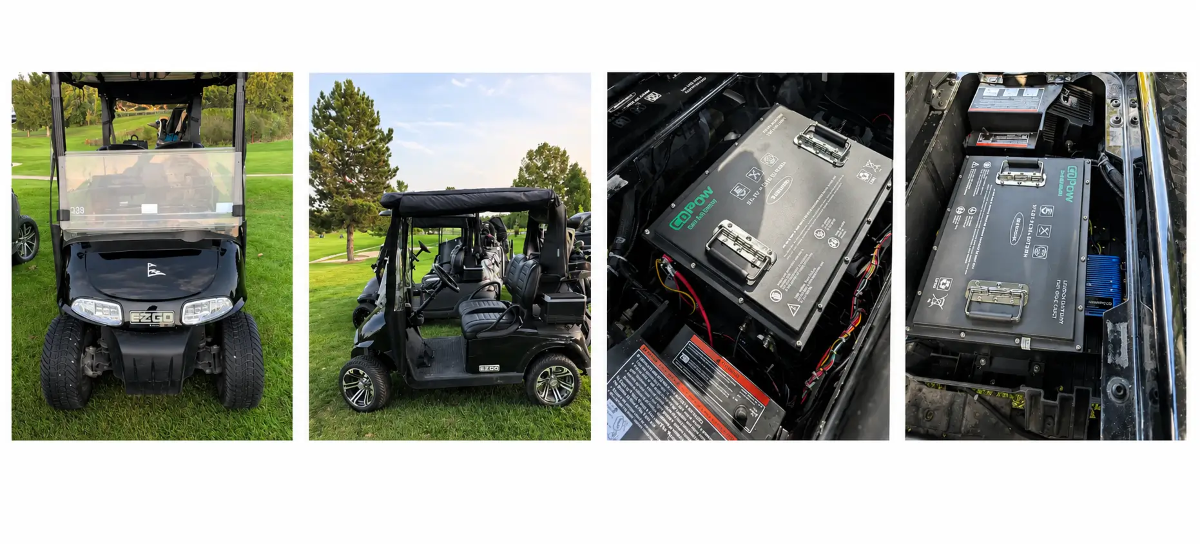
What is the difference between 48V lead-acid and 48V lithium-ion batteries for golf carts?
From a 48V perspective, there is a significant difference between 48V lithium-ion golf cart batteries and 48V lead-acid golf cart batteries.
Setting performance aside for the moment, their configurations are also completely different.
A 48V lead-acid battery consists of six 8V or eight 6V individual cells; the assembled battery is very heavy, weighing approximately 300 kg.
In contrast, a 48V lithium-ion battery consists of a single integrated battery pack, weighing 30% to 50% less than a 48V lead-acid battery.
The specific differences between them are shown in the table below:
| Comparison Item | 48V Lead-Acid Golf Cart Battery | 48V Lithium-Ion Golf Cart Battery |
|---|---|---|
| Battery Structure | Multiple individual batteries connected in series | Single integrated lithium battery pack |
| Typical Configuration | 6×8V or 8×6V batteries | 1×48V lithium battery pack |
| Battery Chemistry | Flooded Lead-Acid / AGM / Gel | LiFePO4 (Lithium Iron Phosphate) |
| Typical Weight | ~250–320 kg (551–705 lbs) | ~45–120 kg (99–265 lbs) |
| Weight Reduction | - | About 30%–70% lighter than lead-acid |
| Energy Density | Low | High |
| Installation Complexity | Complicated wiring between multiple batteries | Simplified installation |
| Battery Maintenance | Requires regular watering and terminal cleaning | Virtually maintenance-free |
| Charging Time | 8–12 hours | 2–6 hours |
| Charging Efficiency | ~70%–80% | ~95%–98% |
| Cycle Life | 300–1,000 cycles | 3,000–6,000+ cycles |
| Expected Service Life | 2–4 years | 8–12 years |
| Voltage Stability | Voltage drops significantly under load | Stable voltage output |
| Acceleration Performance | Weaker acceleration under heavy load | Faster acceleration and stronger torque |
| Hill Climbing Ability | Performance drops as voltage decreases | Better climbing performance |
| Driving Range | Shorter | Longer |
| Usable Capacity | Usually only 50% usable to avoid damage | 80%–100% usable capacity |
| Self-Discharge Rate | Higher | Very low |
| Charging Memory Effect | Can suffer sulfation if not fully charged | No memory effect |
| Performance in Cold Weather | Significant performance loss | Better low-temperature performance |
| Fast Charging Support | Limited | Excellent |
| Opportunity Charging | Not recommended | Supported |
| Heat Generation | Higher during charging/discharging | Lower |
| Environmental Impact | Contains lead and acid | More environmentally friendly |
| Corrosion Risk | Acid leakage may corrode battery tray | No acid leakage |
| Safety Protection | Limited built-in protection | Smart BMS protection system |
| Bluetooth / Smart Monitoring | Usually unavailable | Commonly supported |
| LCD Battery Display | Rare | Common |
| CAN / RS485 Communication | Rare | Common in smart systems |
| Mobile App Monitoring | Not available | Widely supported |
| Waterproof Capability | Limited | Commonly IP65 / IP67 |
| Maintenance Cost | High over long-term use | Lower long-term ownership cost |
| Long-Term Cost Efficiency | Lower upfront cost but higher replacement frequency | Higher upfront cost but lower lifetime cost |
| Power Output Consistency | Performance weakens as battery drains | Consistent power output |
| Storage Performance | Easily damaged if stored discharged | Better long-term storage capability |
| Charging Equipment | Standard lead-acid charger | Dedicated lithium charger required |
| Battery Tray Space Usage | Requires large tray space | More compact and flexible |
| Upgrade Potential | Limited | Excellent for high-performance upgrades |
| Suitable User Type | Budget-focused occasional users | Users seeking performance, range, and low maintenance |
| Typical Market Trend (2026) | Gradually declining | Rapidly becoming mainstream |
How To Choose The Best 48V Golf Cart Lithium Battery Conversion Kit?
Sometimes, when it comes to golf cart batteries, more expensive doesn't necessarily mean better.
Battery capacity, cell quality, the sophistication of the battery management system, and after-sales service all impact the long-term user experience.
It's like building a computer: if you use the latest graphics card but a processor from several years ago, the whole system won't run smoothly.
It's like being "missing a limb."
With a computer, it's no big deal-you can just replace the parts. But with a golf cart's lithium-ion battery, it's a different story.
The battery cells and the battery management system inside the battery cannot be replaced. You'll have to spend a fortune on a brand-new one and deal with the after-sales service department because of this "limping" battery.
We should determine the following in advance:
Identify your specific needs.
Many car owners, when purchasing batteries, do not consider their own driving environment and habits; instead, they blindly pursue high capacity. If the vehicle is used primarily for daily golfing, a 48V 100Ah or 105Ah LiFePO4 conversion kit is sufficient.
For four-seater models, however, a capacity of 150Ah or even higher may be required.
Pay Attention to Cell Brand and Quality
Many low-cost conversion kits on the market use Grade B or even cells of unknown origin to cut costs. While issues may not be apparent in the short term, long-term use can lead to rapid capacity degradation, inconsistent voltage, or even swelling.
High-quality conversion kits, on the other hand, use Grade A battery cells from manufacturers such as CATL, BYD, and EVE Energy. These cells offer greater assurance in terms of cycle life, consistency, and stability.
Battery Management System
An excellent Battery Management System (BMS) should include overcharge protection, over-discharge protection, overcurrent protection, short-circuit protection, high/low temperature protection, and cell balancing functions.
If the vehicle has high power demands, attention must also be paid to continuous discharge current and peak discharge capacity. Some low-end systems, despite being rated at 100Ah, have insufficient BMS discharge capacity, leading to power loss, current limiting, or even protective shutdown during hill climbs or acceleration.
Compatibility
Not all 48V conversion kits are truly plug-and-play, as golf carts of different brands and model years vary in battery compartment size, controller specifications, wiring harness configuration, and charging port types.
Charger Compatibility
48V lithium-ion systems come equipped with 58.4V smart lithium iron phosphate battery chargers, with common specifications including 15A, 18A, and 20A.
Smart Features
Although features such as Bluetooth monitoring, mobile apps, battery level displays, and remote monitoring are not mandatory, they significantly enhance the user experience.
Safety
In addition to the safety of the battery cells themselves, flame-retardant construction, fuse systems, short-circuit protection, and high protection ratings are also critical.
After-sales Service and Technical Support
Many users may encounter issues later on, such as controller compatibility, charger configuration, SOC calibration, or wiring harness compatibility. If the battery manufacturer lacks technical support capabilities, this can cause significant problems.
Truly established manufacturers can provide installation guides, wiring diagrams, Battery Management System parameter support, remote technical assistance, and even video tutorials.
Future Plans
If you plan to make modifications in the future-such as upgrading to a high-power controller, installing larger tires, adding a lift kit, installing an in-vehicle refrigerator, upgrading lighting and audio systems, or adding an inverter system-it's best to choose a conversion kit with expansion capabilities in advance.
Need A Custom Solution? Discover CoPow's 48V Golf Cart Lithium Battery Conversion Kits
If you're looking for more than just a standard 48V golf cart lithium battery-but rather a complete, customized solution tailored to your vehicle, operating environment, and operational needs-then CoPow's 48V Golf Cart Lithium Battery Conversion Kits may be a better fit for you than traditional, off-the-shelf products.
Many owners face a practical problem when upgrading their golf cart lithium batteries: although generic conversion kits on the market have similar specifications, they often fail to fit properly after installation due to various mismatches-such as incompatible battery compartment sizes, incorrect wiring harness lengths, controller compatibility issues, or incompatible chargers. In some cases, upgraded vehicles may even experience power limitations, coding errors, or inaccurate SOC displays.
This is particularly true for modified golf carts-such as those fitted with larger tires, upgraded high-power controllers, or lift kits-or vehicles that operate under heavy loads for extended periods. Standardized lithium-ion battery systems often struggle to fully meet the demands of these vehicles.
CoPow's greatest strength lies not merely in manufacturing lithium-ion batteries, but in its capabilities for deep customization and system integration.
As a company specializing in lithium iron phosphate battery system integration, CoPow can tailor the entire 48V lithium battery conversion kit to specific golf cart platforms and customers' actual usage scenarios.
Benefits of choosing CoPow:
- Grade A lithium iron phosphate battery cells from brands such as CATL, BYD, and EVE Energy
- Multiple capacity options
- Standard configuration with in-house BMS
- IP65–68 protection rating
- Custom solutions for specialized vehicle models
- OEM/ODM customization services
Feel free to contact us.
Related articles:
How Much Does A Golf Cart Battery Weigh?
How Much Do 48v Golf Cart Batteries Cost?
How Long Does A 48V Lithium Golf Cart Battery Last?