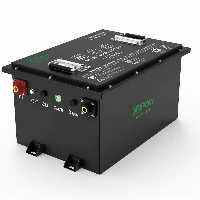
For many beginners, 200Ah battery sounds like a massive energy reservoir capable of powering all appliances. However, the reality is often surprising: if you choose the wrong battery type or overlook the impact of ambient temperature, the power you expected to last two days could be depleted in just a few hours.
This guide will cut through complex electrical parameters, ranging from basic calculation logic to the efficiency losses often ignored by most users, to comprehensively dissect every variable affecting battery performance. Through real-world load tests and comparisons, we will reveal the significant gap between lead-acid and lithium batteries.

Understanding 200Ah Batteries
Ah (Amp-hour) is the unit used to measure a battery's storage capacity. A 200Ah battery means it can theoretically deliver a total of 200 Amps of current over one hour.
To make it more intuitive, you can think of it like a "fuel tank":
Capacity: 200Ah is the size of the tank.
Current (A): The rate at which the fuel flows out.
Time (h): How long it takes for the fuel to run dry.
The Core Calculation
In an ideal world, the calculation is very straightforward:

- If you power a device drawing 1A, it will last 200 hours.
- If you power a device drawing 20A, it will last 10 hours.
Common 200Ah Battery Types
There are two main types of 200Ah batteries on the market, and they perform quite differently:
Lead-Acid Batteries (AGM/Gel):
- Pros/Cons: Cheaper upfront but very heavy.
- The Catch: They should not be deeply discharged. Typically, you can only use about 50% of the rated capacity without significantly shortening the battery's lifespan.
Lithium Iron Phosphate (LiFePO4):
- Pros/Cons: Lightweight, more expensive, but lasts much longer (up to 10+ years).
- The Edge: They have a high Depth of Discharge (DoD), meaning you can safely use 80% - 90% of the capacity while maintaining stable voltage.

Calculating How Long a 200Ah Battery Will Last
To accurately calculate how long a 200Ah battery will last, you cannot rely on theoretical numbers alone. We need a three-step approach: moving from ideal calculations to considering Depth of Discharge (DoD), and finally accounting for inverter efficiency loss.
Step 1: Basic Theoretical Formula (Ideal State)
If you know the power consumption of your device (Watts, W) and the battery voltage (Volts, V), you can use the following formula:

Example:
Suppose you have a 12V 200Ah battery powering a 100W laptop:

Step 2: Considering Depth of Discharge (DoD) - The Critical Factor
In reality, you should never fully drain a battery (especially lead-acid types).
- Lead-Acid Batteries (AGM/Gel): Recommended DoD is 50%.
- Lithium Batteries (LiFePO4): Recommended DoD is 80% - 90%.
The Adjusted Formula:

Comparison for a 12V 200Ah battery powering a 100W device:

Step 3: Accounting for Inverter Efficiency
If you are using an inverter to convert Direct Current (DC) to Alternating Current (AC) for household appliances, the inverter itself consumes energy. Efficiency typically ranges from 85% to 95%.
Final Real-World Formula:

Quick Reference Table (Based on a 12V 200Ah Lithium Battery)
Assuming usable energy is 2,160Wh (90% DoD):
| Device Type | Power (W) | Estimated Runtime |
| LED Bulb | 10W | 216 Hours |
| Smartphone Charging | 15W | 144 Hours |
| Portable Fridge | 50W | 43 Hours |
| LCD TV | 150W | 14.4 Hours |
| Microwave | 1000W | ~2 Hours |

Factors Affecting Battery Duration
Although 200Ah is a fixed theoretical value, the actual duration a battery can last in practice is influenced by a combination of physical and chemical factors.
First and foremost is the Depth of Discharge (DoD), which is the most critical variable. Lead-acid batteries can typically only safely utilize about 50% of their capacity, whereas Lithium Iron Phosphate batteries can be discharged to 80–95% without compromising their lifespan. This means that for the same nominal 200Ah rating, the usable energy from a lithium battery is nearly double that of a lead-acid one.
Secondly, the Peukert Effect plays a significant role, particularly in lead-acid batteries. This phenomenon dictates that the higher the discharge current, the lower the total capacity the battery can deliver. If you drain the battery quickly using high-power appliances, the total energy obtained will be far less than 200Ah.
Ambient temperature also plays a decisive role. In cold environments, the internal chemical activity decreases while internal resistance increases. At temperatures below 0°C, the actual capacity can shrink by more than 20%.
Furthermore, if you use an inverter to convert DC to AC, its conversion efficiency (typically between 85% and 95%) consumes a portion of the energy. Additionally, the inverter's own standby power consumption represents a hidden loss.
Finally, the battery's State of Health (SoH) cannot be overlooked. As the number of charge-discharge cycles increases, internal materials gradually degrade. A battery that has been in use for three years may have seen its true capacity shrink from 200Ah to 160Ah or even lower.
Tips to Extend 200Ah Battery Life
To maximize the lifespan of your 200Ah battery, the core principles are mastering the Depth of Discharge (DoD) and optimizing your charging rhythm.
For lead-acid batteries, it is crucial to adhere to the rule of recharging once the remaining capacity drops to 50%. Deep discharging can cause irreversible damage and significantly shorten their service life. Although lithium batteries are more durable, it is still best to operate them within a 20% to 90% state of charge. Avoiding frequent full depletion or charging to 100% can extend their cycle life from a few thousand cycles to nearly 10,000.
Temperature management is another decisive factor. Batteries are most vulnerable to extreme cold and heat; the ideal operating environment is around 25°C. In winter, keep batteries warm or move them indoors to prevent chemical reactions from being hindered. In summer, ensure adequate ventilation and cooling, as sustained high temperatures accelerate internal material degradation.
Regarding electrical connections, keep terminals clean and tight. Oxidation layers or loose interfaces create additional resistance, leading to overheating and energy loss. If you are using a battery bank composed of multiple cells, perform regular equalization charging to ensure consistent voltage across all units, preventing individual cells from failing prematurely due to imbalance.
Furthermore, selecting a matched smart charger serves as the final line of defense. It automatically adjusts charging modes based on the battery's condition, preventing risks like swelling or fire caused by overcharging. Finally, even if the battery is not in use, it should be recharged every one to three months to prevent it from entering a deep sleep state due to self-discharge, which could render it completely useless.
Conclusion
After delving into the various parameters, it becomes clear that to arrive at a definitive answer to "How long will a 200Ah battery last?", one must move beyond theory and return to reality. A 200Ah rating is not an infinite energy reservoir to be squandered at will; rather, it is an "energy account" that requires precise management.
The more thoroughly you understand the principles of energy loss, depth of discharge, and temperature dynamics, the more reliable your power security will be.