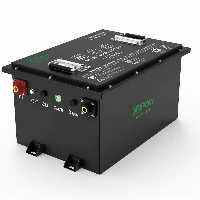
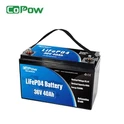
Taking a 36V 100Ah lithium-ion battery as an example, a rough estimate suggests that a 36V lithium-ion battery can last 3–10 hours, which translates to a range of approximately 30–60 kilometers for an electric vehicle.
These vehicles and electrical devices include golf carts, small fishing boats, RVs, small forklifts, and small energy storage systems.
In practical applications, you also need to consider factors such as load size, vehicle speed, road conditions, payload, and ambient temperature.
We have covered each of these in this article to help you quickly understand them.

What is the physical lifespan of a 36V lithium-ion battery?
If a 36V lithium battery is built with LiFePO4 cells, it can typically deliver around 3,000 to 5,000 full cycles.
A full cycle means discharging the battery from 100% down to 0%. In real-world use, this usually translates to a lifespan of about 7 to 10 years, although actual results depend on factors like temperature, usage habits, and charging conditions.
In fact, 3,000 to 5,000 cycles is considered a conservative estimate. High-quality LiFePO4 cells can often exceed 6,000 cycles under optimal conditions.
However, poor usage habits can significantly shorten battery life. Frequently discharging below 20% or constantly charging to 100% may accelerate aging.
By comparison, standard lead-acid batteries typically last only 300 to 500 cycles, which usually means around 2 to 3 years of use under similar conditions.
More advanced lead-acid types, such as AGM or GEL batteries, can reach 500 to 800 cycles, but their overall lifespan still falls short of lithium batteries.
| Battery Type | Typical Cycle Life | Average Lifespan |
|---|---|---|
| Lithium Iron Phosphate (LiFePO4) | 3,000–5,000+ Cycles | 7–10 Years |
| AGM Battery | 500–800 Cycles | 3–5 Years |
| GEL Battery | 500–800 Cycles | 3–5 Years |
| Lead-acid Battery (Lead-Acid) | 300–500 Cycles | 2–3 Years |

How long does a 36V 100Ah lithium-ion battery last on a single charge?
The runtime of a 36V lithium battery mainly depends on its capacity and the type of equipment it powers.
For example, a 36V 100Ah lithium battery used in a fishing boat with a 55–80 lb thrust trolling motor can typically run for about 6–8 hours at a normal cruising speed.
In a golf cart, a fully charged 36V lithium battery can usually deliver a range of 20–30 miles per charge, although actual distance will vary depending on terrain, speed, vehicle weight, and driving habits.
For off-grid systems, runtime depends largely on the total power consumption of your devices. With a 36V 100Ah battery, you might get around 8 hours of use, but this can vary significantly depending on the load and usage patterns.
* To give you a clearer idea of real-world performance, we've put together a comparison table below.
| Application Scenario | Power / Load Characteristics | Runtime / Range | Notes |
|---|---|---|---|
| Fishing boat electric propulsion | Thrust 55-80 lbs | Continuous 6-8 hours | Normal cruising speed |
| Golf cart | Electric drive system | 20-30 miles per full charge | Actual range affected by terrain, speed, weight |
| Off-grid home / small appliances | Lighting, fridge, fan, TV, etc. | About 8 hours | Runtime varies with load power |
| Electric bicycle / e-motorbike | Motor 500-1000W | 30-50 miles | Speed, terrain, and load affect range |
| Electric patrol car / small EV | Motor 1000-1500W | 15-25 miles per charge | Used in parks, factories, campuses |
| Portable power / mobile storage | Low-power devices (lights, fan, laptop) | Several hours up to 10+ hours | Outdoor or emergency use |
| Small electric boat / kayak | Motor 200-400W | 5-10 hours | For recreational water activities |
| Electric tools / small construction equipment | Drill, saw, grinder, etc. | 2-4 hours | Depends on tool type and power |
| Electric curtains / smart home systems | Low-power motors | Continuous 1-2 days | Residential automation use |
| Small industrial transport / AGV | Motor 500-1500W | 4-6 hours | Short-distance factory / warehouse use |
| Electric wheelchair / mobility scooter | Motor 200-400W | 8-12 miles | Depends on weight and terrain |
| Small sightseeing car / tourist EV | Motor 1000-1500W | 15-25 miles | Parks or community transport |
| Gardening / lawn equipment | Electric lawn mower, sprayer | 2-5 hours | Motor 300-800W |
| Electric water pump / small pump | 100-500W | Continuous 4-6 hours | For irrigation, garden use |
| Electric rowing paddle / auxiliary oar | 50-300W | 6-10 hours | Light recreational boats |
| Solar energy storage system | Load 100-500W | 6-10 hours or more | Paired with solar panels extends runtime |
| Emergency backup power | Lights, communication, computers | Several hours | For power outage scenarios |
| Electric scooter / hoverboard | 250-500W | 15-30 miles | Speed and load affect range |
| Small unmanned boat / underwater robot | Motor 50-300W | 2-5 hours | Recreational or research use |
| Electric fan / mini cooler | 10-100W | 8-24 hours | Depends on device power |
| Electric mini fridge / cooler | 30-100W | 8-12 hours | Car, portable, or outdoor use |
| Boat navigation & electronics | 10-50W | 10-20 hours | Includes radar, GPS, lights |
| Small electric hoist / lifting machine | 500-1500W | 2-6 hours | Short-term industrial / warehouse use |
| Electric home healthcare devices | Low-power medical equipment | Several hours | For home rehab or care |
| Lightweight electric toys / kids' vehicles | 50-200W | 1-2 hours | Depends on motor power and load |

How long can a 36V lithium-ion battery of different capacities run on a single charge?
Before discussing the range of a 36V lithium-ion battery at different capacities, we first need to understand the capacity range of this type of battery. The capacity of a 36V battery ranges from a minimum of 20Ah to a maximum of 600Ah.
| Battery Capacity | Total Energy (Approx.) | Golf Cart Runtime | Trolling Motor Runtime | RV / Off-Grid Runtime | AGV / Industrial Equipment Runtime |
|---|---|---|---|---|---|
| 36V 20Ah | 0.72 kWh | 1–2 hours | 1–3 hours | 1–3 hours | <1 hour |
| 36V 30Ah | 1.08 kWh | 1.5–3 hours | 2–4 hours | 2–4 hours | 1–2 hours |
| 36V 50Ah | 1.8 kWh | 2–4 hours | 4–6 hours | 4–8 hours | 2–4 hours |
| 36V 80Ah | 2.88 kWh | 3–6 hours | 5–8 hours | 6–12 hours | 4–6 hours |
| 36V 100Ah | 3.6 kWh | 4–8 hours | 6–10 hours | 8–16 hours | 5–8 hours |
| 36V 150Ah | 5.4 kWh | 6–12 hours | 10–15 hours | 12–24 hours | 8–12 hours |
| 36V 200Ah | 7.2 kWh | 8–16 hours | 15–24 hours | 24–48 hours | 10–16 hours |
| 36V 300Ah | 10.8 kWh | 12–24 hours | 24–36 hours | 2–4 days | 16–24 hours |
| 36V 400Ah+ | 14.4 kWh+ | 1–2+ days | 2–4+ days | 4–7+ days | 1–2+ days |
What Are the Best Ways to Extend the Life of Your 36V Lithium Battery?
To maximize the lifespan of your 36V lithium battery, the key is to reduce stress and avoid excessive heat during daily use. With proper habits, you can significantly extend its overall lifespan.
1. Practice "Partial Discharge"
Try not to drain the battery to 0% or keep it at 100% for long periods. The ideal operating range is between 20% and 80%. Staying at extreme charge levels can accelerate cell aging.
2. Control the Temperature
Lithium batteries are sensitive to heat. Avoid charging or storing them in temperatures above 45°C (113°F). After heavy use, such as climbing hills, let the battery cool down for about 30 minutes before charging.
3. Proper Long-term Storage
If you won't be using the battery for more than a month, keep it at around 40%–60% charge (approximately 36V–37V). Store it in a cool, dry place and recharge it every 2–3 months to prevent over-discharge.
4. Use the Correct Charger
A 36V battery pack typically charges up to 42V. Using an incompatible or low-quality charger can damage the battery or its management system. Whenever possible, use standard charging instead of fast charging to reduce long-term wear.
5. Avoid High Current Bursts
Try to accelerate smoothly, especially when starting or climbing. Sudden high current draws generate excess heat and can shorten battery life over time.
Why a 36V Lithium Battery is Better Than Lead-Acid?
In terms of performance and long-term value, 36V lithium batteries clearly outperform traditional lead-acid batteries. The difference is noticeable not only in daily use but also in total cost over time.
First, energy density.
For the same capacity, lithium batteries are about one-third the weight of lead-acid batteries and much more compact, making them easier to handle and install.
Second, more consistent power output.
Lead-acid batteries tend to lose voltage as they discharge, which can cause noticeable drops in performance. In contrast, lithium batteries maintain stable voltage throughout most of their discharge cycle. They also support deeper discharge (up to 80%–100%), while lead-acid batteries can be damaged if discharged beyond 50%.
Finally, lower long-term cost and maintenance.
Although lithium batteries have a higher upfront cost, they typically last 5–10 years and offer a cycle life up to five times longer than lead-acid batteries. They also require little to no maintenance-no water refilling or regular servicing-making them a more practical and cost-effective choice in the long run.
Signs Your 36V Lithium Battery is Aging
As a 36V lithium battery reaches the end of its lifespan, it will begin to show several clear warning signs. Recognizing these early can help prevent unexpected downtime and potential safety risks.
1. Significant Range Reduction
This is usually the most noticeable sign. If your battery used to cover 40 km on a full charge but now only reaches 20 km or less, its actual capacity has significantly declined due to aging.
2. Voltage Sag Under Load (Loss of Power)
As batteries age, internal resistance increases. When you accelerate or climb hills, the battery may struggle to deliver sufficient current, causing a sudden voltage drop. In some cases, the device may shut off even when the indicator still shows remaining charge.
3. Abnormally Fast Charging
If a battery that previously took 5 hours to charge now reaches full in just 1–2 hours, it's a warning sign. This usually means the battery can no longer store as much energy as before.
4. Excessive Overheating
Under normal conditions, the battery should remain relatively cool. If it becomes hot during charging or use, this may indicate internal damage or increased resistance, leading to excess heat buildup.
5. Swelling or Physical Deformation
Any swelling, bulging, or cracking of the battery casing is a serious safety concern. This is often caused by internal gas buildup. Stop using the battery immediately if you notice any deformation, as it may pose a fire risk.
6. Rapid Self-Discharge
A healthy battery should retain its charge for weeks when not in use. If it loses significant power within just a few days, it may indicate internal damage or degradation.
Solve Your Runtime Challenges: Premium 36V Lithium Battery Power Solutions
Where can you find a high-quality 36V lithium-ion battery? Where can you have a 36V lithium-ion battery custom-made to suit your needs? We recommend CoPow-a professional manufacturer of lithium iron phosphate batteries.
CoPow's 36V batteries are widely used in forklifts, golf carts, boats, energy storage systems, floor sweepers, and many other applications.
These batteries utilize Grade A LiFePO4 cells from CATL, delivering powerful performance with a cycle life of 4,000–6,000 cycles and a service life exceeding 8 years-no battery replacement is needed during this period.
By choosing CoPow, you'll enjoy the following benefits:
- High-quality lithium iron phosphate cells for greater power and longer service life
- Intelligent Battery Management System (BMS)
- One-on-one dedicated service
- High-end customization services
- One-stop solutions
- Reasonable minimum order quantity (MOQ)
- Comprehensive certifications
- Comprehensive and high-quality after-sales service system, offering 5–10-year warranty coverage
- Stable supply chain
- Mature production processes
- Over 30 successful lithium battery upgrade cases.
Final Thoughts
From the text, it is clear that 36V lithium-ion batteries are not truly universal; they simply have a wide range of applications and are relatively versatile.
In terms of runtime and lifespan, their performance varies significantly across different sectors, but overall, their runtime remains superior to that of other batteries.
When making a selection, we should consider the different capacities, lifespans, and runtime performance in various scenarios mentioned in the text to determine which model is best suited for our needs and whether we need to upgrade to a battery with a higher voltage.
Frequently Asked Questions About 36V Lithium Batteries
How Long Will a 36V 10Ah Battery Last?
A set of 36V, 10Ah batteries has a total capacity of approximately 0.36 kWh, though the exact figure depends on the specific type of battery.
| Battery Type | Speed | Runtime | Range | Common Applications |
|---|---|---|---|---|
| Lead-Acid Battery | 20–25 km/h | 40–70 Minutes | 15–25 km | Older e-bikes, low-speed scooters |
| Ternary Lithium Battery | 25–40 km/h | 1–2 Hours | 25–45 km | E-bikes, electric scooters |
| LiFePO4 Battery | 25–35 km/h | 1–2.5 Hours | 25–50 km | E-bikes, small EVs, energy storage |
| LTO Battery | 25–35 km/h | 1–2 Hours | 20–40 km | High-frequency charging equipment |
| NiMH Battery | 20–30 km/h | 50–90 Minutes | 18–30 km | Early electric vehicles, hybrid systems |
Performance Comparison in Different Applications:
| Application Scenario | Motor Power | Typical Speed | Estimated Range |
|---|---|---|---|
| E-bike (Eco Mode) | 250W | 20 km/h | 35–50 km |
| Electric Scooter | 350W | 25 km/h | 25–40 km |
| Standard Electric Vehicle | 500W | 30–35 km/h | 18–30 km |
| Hill Climbing / Full-Speed Riding | 500W+ | 35–45 km/h | 15–25 km |
How long does a 36V golf cart last?
A fully charged 36V golf cart typically has a range of 20 to 40 kilometers or can operate continuously for 2 to 6 hours. The actual range depends on various factors, including battery capacity and type, as well as the vehicle's load, speed, terrain, and driving habits.