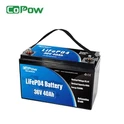
When selecting forklift batteries, many people tend to focus solely on price and capacity, while overlooking key factors such as voltage compatibility, operating environment, charging methods, battery weight, dimensional compatibility, and long-term operating costs.
This can result not only in insufficient range and poor charging efficiency, but may also compromise the forklift's stability and even shorten the service life of the entire system.
This article provides a comprehensive analysis of the most common mistakes made when selecting forklift batteries, covering core issues such as capacity selection, voltage matching, battery type, battery weight, charging systems, and environmental adaptability, to help you choose the most suitable forklift battery solution based on your actual operating conditions.
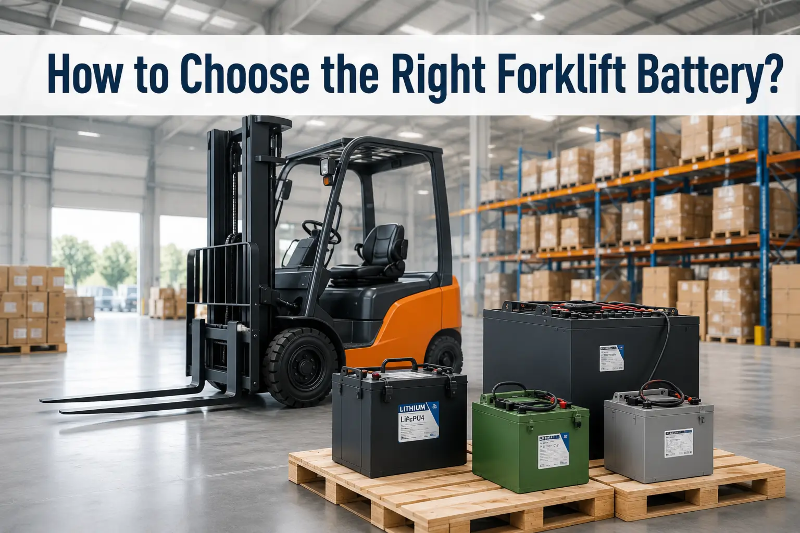
What Type Of Battery Does Your Forklift Use?
Currently, electric forklifts primarily use two types of batteries: lead-acid batteries and lithium-ion batteries. Among these, LiFePO4 batteries are the most common.
Different types of batteries directly impact a forklift's runtime, charging efficiency, maintenance costs, service life, and overall operational efficiency.
Lead-Acid vs Lithium Forklift Batteries: Which Is Better?
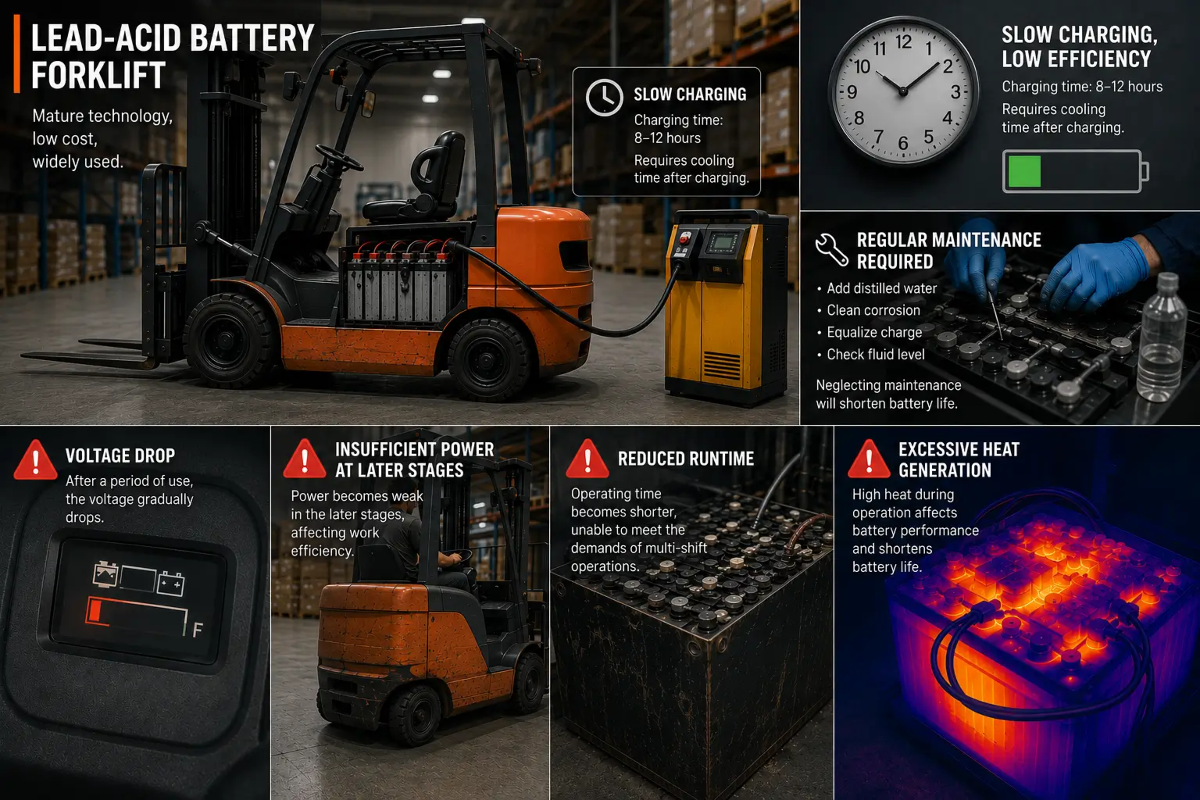
For a long time, lead-acid batteries have been the mainstream choice in the forklift industry because the technology is mature, the price is relatively low, and the market ecosystem is well-established. As a result, many warehouses, factories, and businesses with limited budgets still rely heavily on lead-acid forklifts today.
However, lead-acid batteries also have some obvious drawbacks: they charge slowly, typically taking 8 to 12 hours to fully charge, and require additional time to cool down after charging; Additionally, lead-acid batteries require regular maintenance, including adding distilled water, cleaning corrosion, equalizing charges, and checking fluid levels; failure to do so will shorten the battery's lifespan.
After several years of use, many users find that lead-acid batteries are prone to issues such as voltage drop, insufficient power in the latter stages of operation, reduced runtime, and excessive heat generation. These problems become even more pronounced in multi-shift and high-intensity work environments.
In recent years, an increasing number of companies have begun switching to lithium-ion forklifts, particularly those equipped with lithium iron phosphate batteries.
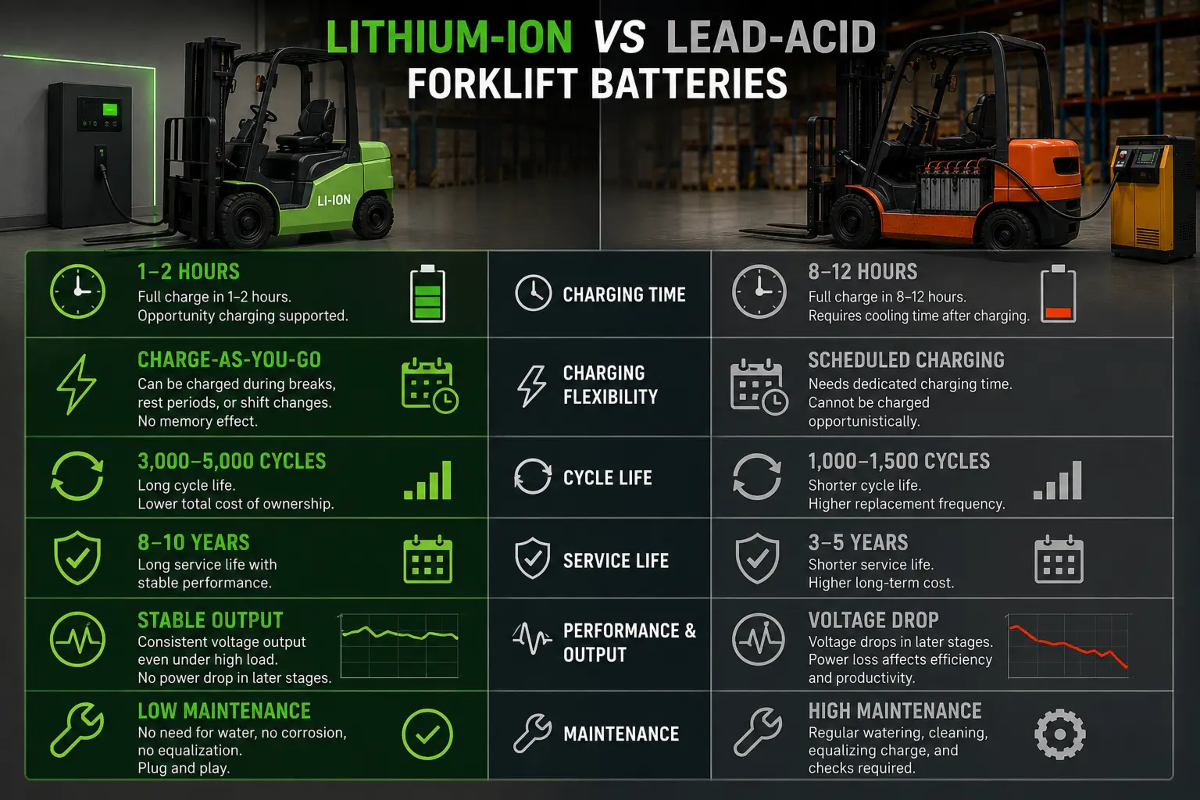
Compared to lead-acid batteries, one of the greatest advantages of lithium-ion batteries is their higher charging efficiency. Most lithium-ion forklifts can be fully charged in just 1–2 hours, supporting "charge-as-you-go" operation. Operators can quickly top up the battery during meal breaks, rest periods, or shift changes, eliminating the need for lengthy charging and cooling times associated with lead-acid batteries.
Furthermore, lithium-ion batteries have a longer service life, with a cycle life of 3,000 to 5,000 cycles, whereas lead-acid batteries typically last only 1,000 to 1,500 cycles.
This means that lithium-ion batteries can often be used reliably for 8 to 10 years, while lead-acid batteries may need to be replaced after just 3 to 5 years.
Furthermore, lithium-ion batteries provide a more stable output voltage. Even when power consumption is high, the forklift maintains consistent power output, effectively preventing power loss during the latter stages of operation and thereby improving overall operational efficiency.
In addition to lead-acid and lithium-ion batteries, there is another type of battery on the market: nickel-cadmium forklift batteries.
However, due to their higher cost, complex maintenance, and certain environmental concerns, these batteries are now relatively rare and are used only in specific industrial applications.
Recommended Reading: Forklift Battery Types: Which One Is the Best Value?
How To Calculate The Right Forklift Battery Capacity?
Using this formula, we can roughly estimate the battery capacity required for a forklift.
Required Capacity (Ah) = Average Operating Current (A) × Continuous Operating Time (h)
For example, a 48V forklift has an average operating current of approximately 100A. If it needs to operate continuously for 5 hours per day, its theoretical required capacity is:
100A × 5h = 500Ah.
This means that this forklift requires a battery capacity of at least 500 Ah.
However, during the actual selection process, we do not recommend choosing a battery with exactly 500 Ah. This is because during starting, climbing slopes, lifting heavy loads, and frequent acceleration, the instantaneous current typically exceeds the average value.
If the battery capacity is too close to the theoretical value, it can easily lead to issues such as insufficient range, rapid voltage drop, and power degradation later on.
Therefore, we recommend allowing a capacity margin of 15% to 30% to ensure more stable equipment operation. If operating conditions are particularly demanding or the workload is high, we recommend selecting a 600Ah battery.
This not only ensures stable equipment operation but also effectively extends the battery's service life.
Recommended Reading: How Long Do Forklift Batteries Last?
Forklift Batteries Runtime Estimation Table
| Forklift Voltage | Battery Capacity | Light Duty Runtime | Medium Duty Runtime | Heavy Duty Runtime | Typical Applications |
|---|---|---|---|---|---|
| 24V | 210Ah | 5–7 Hours | 3–5 Hours | 2–3 Hours | Small pallet trucks, walkie stackers |
| 24V | 280Ah | 7–9 Hours | 5–6 Hours | 3–4 Hours | Electric pallet jacks, compact warehouse forklifts |
| 24V | 350Ah | 8–10 Hours | 6–7 Hours | 4–5 Hours | Light warehouse handling |
| 36V | 360Ah | 7–9 Hours | 5–6 Hours | 3–4 Hours | Narrow aisle forklifts |
| 36V | 450Ah | 8–10 Hours | 6–8 Hours | 4–5 Hours | Medium-duty indoor operations |
| 36V | 525Ah | 9–11 Hours | 7–8 Hours | 5–6 Hours | Multi-shift warehouse use |
| 48V | 420Ah | 6–8 Hours | 4–5 Hours | 3–4 Hours | Standard counterbalance forklifts |
| 48V | 500Ah | 8–10 Hours | 5–7 Hours | 4–5 Hours | Most common warehouse forklifts |
| 48V | 600Ah | 9–12 Hours | 7–8 Hours | 5–6 Hours | Heavy warehouse handling |
| 48V | 700Ah | 10–13 Hours | 8–9 Hours | 6–7 Hours | High-intensity logistics centers |
| 72V | 560Ah | 7–9 Hours | 5–6 Hours | 4–5 Hours | Heavy-duty forklifts |
| 72V | 700Ah | 9–11 Hours | 7–8 Hours | 5–6 Hours | Container yards, ports |
| 80V | 620Ah | 8–10 Hours | 6–7 Hours | 4–5 Hours | Large industrial forklifts |
| 80V | 775Ah | 10–12 Hours | 8–9 Hours | 6–7 Hours | Multi-shift heavy-duty operations |
| 80V | 930Ah | 12–14 Hours | 9–10 Hours | 7–8 Hours | Ports, steel plants, large logistics hubs |
How Many Shifts Does Your Forklift Operate Per Day?
In addition to the type and capacity of forklift batteries, it is essential to consider the number of daily shifts the forklift operates.
In many cases, the key factor in determining whether a company needs to upgrade to lithium-ion batteries is not simply the purchase price, but rather the actual workload and overall operational efficiency requirements.
One Shift
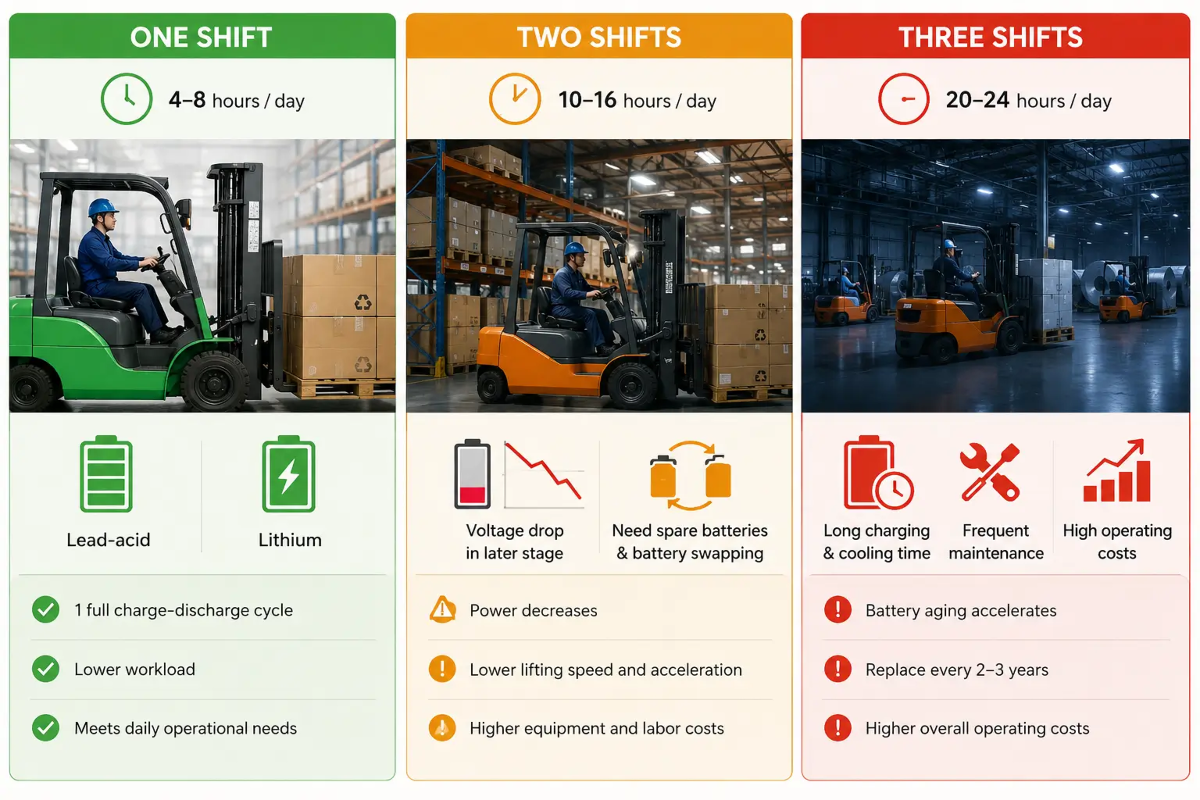
If a forklift operates only 4–8 hours per day, both lead-acid and lithium iron phosphate batteries can meet daily operational needs.
This is because, under these conditions, the battery typically needs to complete only one full charge-discharge cycle per day. The overall workload is relatively low, and the demands on battery life and sustained output capacity are correspondingly lower.
Two Shifts
A two-shift system means forklifts need to operate continuously for 10 to 16 hours per day. In this scenario, battery capacity and sustained output capability become particularly critical.
Under high-intensity continuous use, lead-acid batteries often experience a voltage drop during the latter half of the shift, leading to insufficient power, slower lifting speeds, and reduced acceleration performance.
To ensure continuous operation, many companies are forced to equip their fleets with additional spare batteries and establish dedicated battery-swapping areas. This not only increases equipment costs but also raises labor and management expenses.
Three-shift operation
If forklifts operate on a three-shift schedule, the equipment is effectively in a state of nearly 24-hour continuous operation. This scenario typically occurs in high-intensity industrial settings such as large logistics centers, ports, cold storage facilities, steel mills, and workshops with 24-hour continuous production.
Under these conditions, the disadvantages of lead-acid batteries are further magnified. Due to their long charging times, cooling requirements, and frequent maintenance needs, companies must not only stock spare batteries but also invest in dedicated battery-swapping equipment and maintenance personnel, resulting in increasingly high overall operating costs.
Furthermore, prolonged, high-frequency deep cycling accelerates the aging of lead-acid batteries. In high-intensity operating environments, batteries may need to be replaced every two to three years.
Choosing The Correct Forklift Battery Voltage
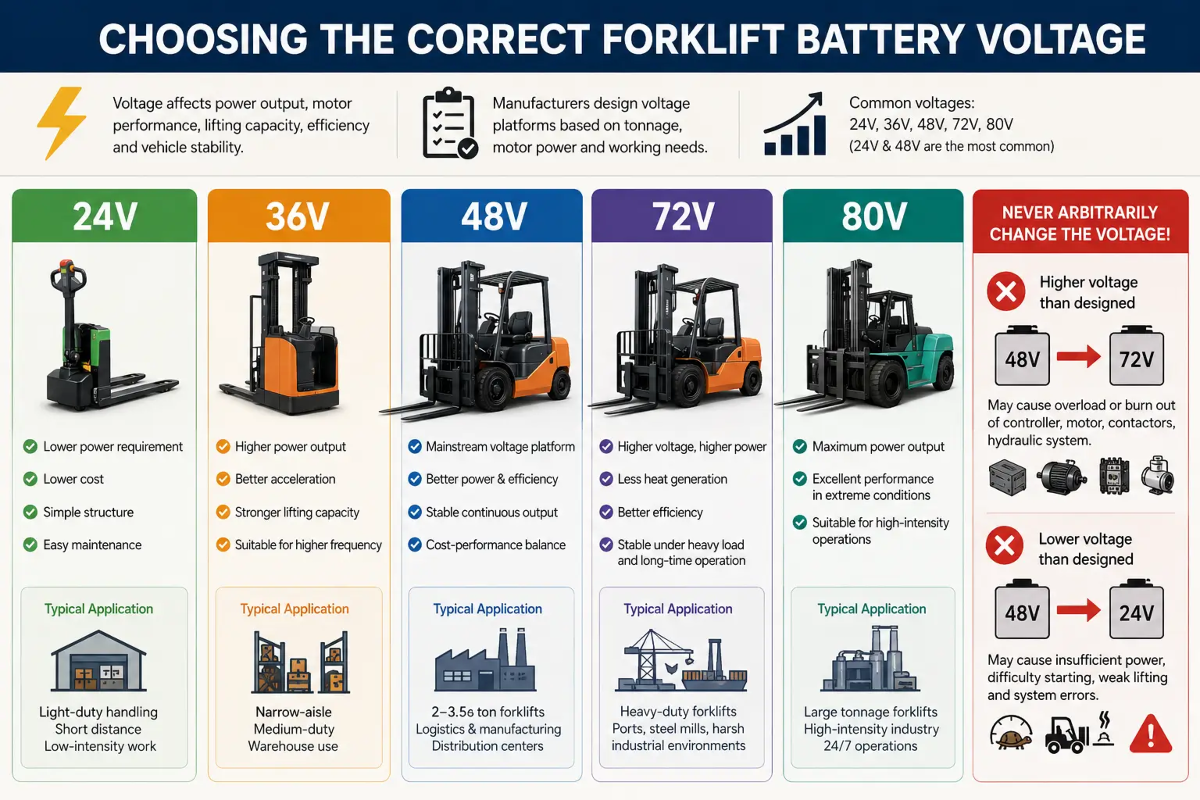
Voltage not only affects a forklift's power output but also directly impacts motor performance, lifting capacity, operational efficiency, and overall vehicle stability.
Forklift voltage is not chosen arbitrarily; in most cases, forklift manufacturers design corresponding voltage platforms in advance based on the vehicle's tonnage, motor power, hydraulic system, and actual operational requirements.
Currently, common forklift voltages include 24V, 36V, 48V, 72V, and 80V, with 24V and 48V being the two most common voltage systems.
24V Forklift Batteries
Small electric pallet trucks, walkie stackers, and light-duty warehouse equipment mostly use 24V systems.
This is because these types of equipment handle lighter loads and have relatively low power requirements; a 24V voltage is sufficient to meet daily material handling needs. Additionally, 24V systems have lower overall costs, simpler structures, and are easier to maintain.
36V Forklift Batteries
36V batteries are typically used in small-to-medium-sized warehouse forklifts or narrow-aisle forklifts.
Compared to 24V systems, 36V systems provide higher power output, making them better suited for warehouse environments with higher work intensity and greater operational frequency. They also offer superior performance in terms of acceleration and lifting capacity.
48V Forklift Batteries
48V is currently one of the most mainstream voltage platforms for counterbalanced electric forklifts.
Many electric forklifts with load capacities between 2 and 3.5 tons use 48V systems because they strike a good balance between power performance, operational efficiency, and overall cost.
Compared to low-voltage systems, 48V forklifts offer better acceleration, higher lifting efficiency, and more stable continuous power output, making them widely used in logistics warehouses, manufacturing plants, and distribution centers.
72V and 80V Forklift Batteries
72V and 80V systems are more commonly used in large heavy-duty forklifts, high-tonnage industrial vehicles, and high-intensity industrial settings such as ports and steel mills.
Due to their higher voltage, these systems can deliver greater power output at the same current, effectively reducing heat generation and improving overall operational efficiency. They maintain more stable power performance during heavy-load operations, hill climbing, and prolonged continuous operation.
When replacing forklift batteries, never arbitrarily change the vehicle's original voltage.
For example, a forklift designed for 48V cannot be directly converted to operate at 72V; doing so can easily cause the controller, motor, contactors, and hydraulic system to overload, and in severe cases, may even burn out critical components.
Similarly, if the voltage is lower than the vehicle's original design value, the forklift may experience issues such as insufficient power, difficulty starting, weak lifting capacity, and system error messages.
Forklift Battery Selection Chart By Application
| Application Scenario | Typical Forklift Type | Recommended Voltage | Recommended Capacity | Recommended Battery Type | Typical Daily Runtime | Recommended Shift Type | Main Battery Requirements |
|---|---|---|---|---|---|---|---|
| Small Warehouse | Electric Pallet Jack | 24V | 210–280Ah | Lead-Acid / LiFePO4 | 4–6 Hours | Single Shift | Low cost, simple operation |
| Retail Warehouse | Walkie Stacker | 24V | 280–350Ah | LiFePO4 Preferred | 4–8 Hours | Single Shift | Compact size, fast charging |
| Narrow Aisle Warehouse | Reach Truck | 36V | 360–525Ah | LiFePO4 | 6–10 Hours | Single / Double Shift | Stable lifting performance |
| General Logistics Center | Counterbalance Forklift | 48V | 420–600Ah | LiFePO4 | 6–10 Hours | Double Shift | High efficiency, opportunity charging |
| Manufacturing Factory | Electric Forklift | 48V | 500–700Ah | LiFePO4 | 8–12 Hours | Double Shift | Continuous operation stability |
| Beverage & Food Warehouse | Reach Truck / Pallet Truck | 48V | 500–700Ah | LiFePO4 | 8–12 Hours | Double Shift | Fast charging, low maintenance |
| Cold Storage Warehouse | Cold Storage Forklift | 48V / 80V | 600–775Ah | Low-Temp LiFePO4 | 6–10 Hours | Double / Triple Shift | Low-temperature discharge capability |
| Heavy Manufacturing | Heavy-Duty Forklift | 72V | 560–700Ah | LiFePO4 | 8–12 Hours | Double / Triple Shift | High-current output |
| Port & Container Yard | Heavy Forklift | 80V | 775–930Ah | LiFePO4 | 10–16 Hours | Triple Shift | Continuous heavy-load operation |
| Steel Plant | Industrial Forklift | 80V | 930Ah+ | Industrial LiFePO4 | 12–24 Hours | Triple Shift | Heat resistance, high durability |
| Paper Mill | Clamp Forklift | 48V / 72V | 600–800Ah | LiFePO4 | 8–14 Hours | Double / Triple Shift | Long runtime, high lifting frequency |
| Construction Material Yard | Outdoor Forklift | 72V / 80V | 700–930Ah | LiFePO4 | 8–14 Hours | Double Shift | Outdoor durability, slope climbing |
| Airport Cargo Handling | Electric Tow Tractor | 48V / 72V | 500–700Ah | LiFePO4 | 6–12 Hours | Double Shift | Stable towing performance |
| Automotive Factory | AGV / Forklift | 48V | 420–600Ah | Smart LiFePO4 | 8–16 Hours | Double / Triple Shift | CAN communication, automation support |
| Pharmaceutical Warehouse | Reach Truck | 36V / 48V | 360–600Ah | LiFePO4 | 6–10 Hours | Single / Double Shift | Clean operation, maintenance-free |
| E-Commerce Fulfillment Center | High-Speed Forklift | 48V / 72V | 600–800Ah | LiFePO4 | 10–16 Hours | Triple Shift | Fast charging, continuous uptime |
How Forklift Battery Size And Weight Affect Compatibility?
Forklift batteries are not merely power sources; they are also a critical component of the vehicle's counterweight system.
During the forklift design phase, manufacturers calculate the vehicle's center of gravity, balance structure, and load capacity based on the battery's weight.
For many electric forklifts, the rear counterweight does not rely solely on traditional metal counterweight blocks; the battery itself plays a significant role in maintaining balance.
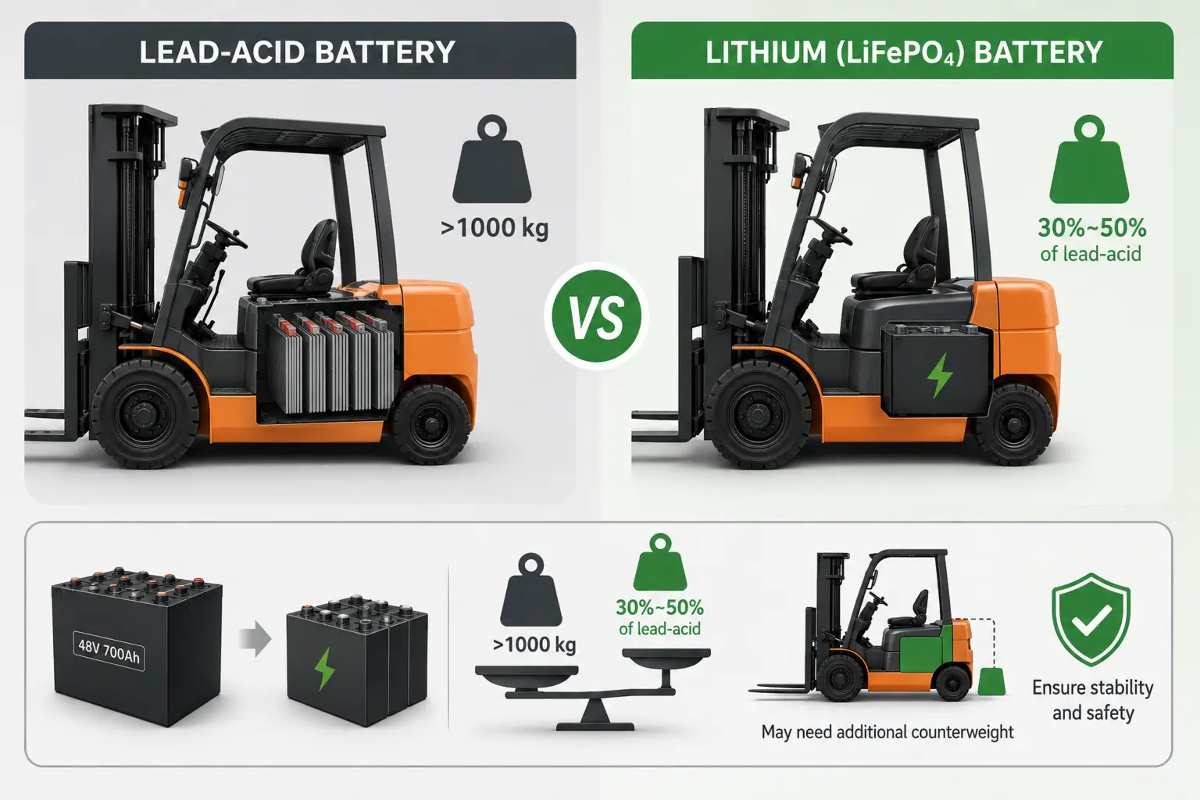
This is because lead-acid batteries contain a large amount of lead plates and electrolyte, making them very heavy.
For example, a set of 48V 700Ah lead-acid forklift batteries often weighs over 1,000 kilograms; whereas a LiFePO4 lithium iron phosphate battery of the same specifications weighs only 30% to 50% of the lead-acid battery.
Therefore, when upgrading from lead-acid batteries to lithium-ion batteries, in addition to considering battery capacity and voltage, it is essential to assess whether the vehicle's weight distribution will change.
For some forklifts, after replacing the batteries with lightweight lithium-ion units, it may even be necessary to add additional counterweights to ensure the vehicle maintains stability and safety under heavy-load conditions.
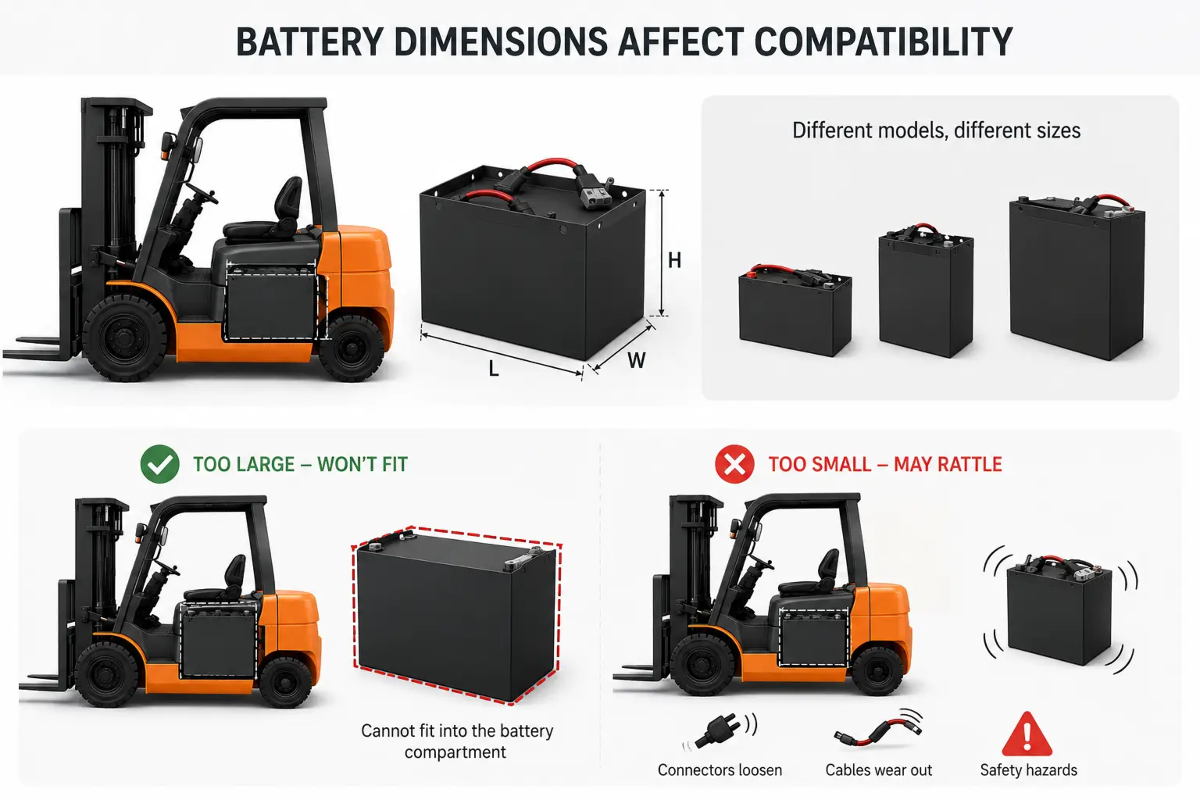
In addition to weight, battery dimensions also directly affect compatibility.
Battery compartment dimensions vary across different forklift brands and models; even with identical voltage and capacity, there may be significant differences in the battery's length, width, and height.
If the battery is too large, it will not fit into the original battery compartment; if it is too small, it may rattle during vehicle operation. Prolonged vibration can cause connectors to loosen, cables to wear out, and even create safety hazards.
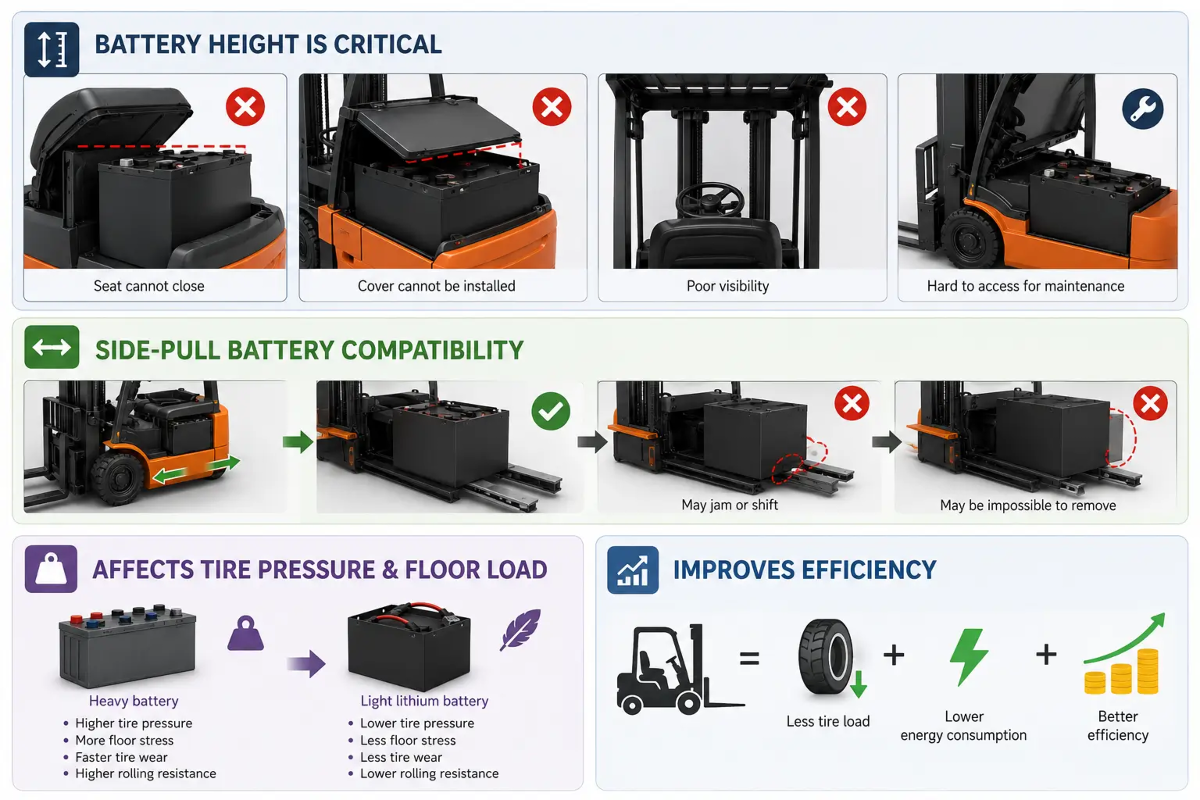
Battery height is particularly critical.
If the battery height exceeds the vehicle's designed clearance, it may prevent the seat from closing properly, make it impossible to install the battery cover, and even impair the driver's visibility and access for future maintenance.
For forklifts with a side-pull battery replacement mechanism, the battery casing dimensions must perfectly match the existing slide rail system. Otherwise, during battery replacement, the battery may jam, shift out of position, or even become impossible to remove.
Furthermore, the weight of forklift batteries can also affect tire pressure and floor load-bearing capacity.
In older warehouses or settings with limited floor load-bearing capacity, excessively heavy batteries increase structural stress on the floor, thereby increasing tire wear and ground friction resistance; in contrast, lighter lithium-ion batteries can effectively reduce the vehicle's overall weight, thereby reducing the load on the tires and improving energy efficiency to some extent.
Batteries of different sizes and weights also affect the design of the vehicle's cooling system.
High-capacity batteries generate more heat; if the battery compartment is too cramped or lacks adequate cooling capacity, heat can easily accumulate inside, causing the battery temperature to rise continuously and thereby affecting the battery's cycle life, charge/discharge performance, and overall safety.
Consequently, many high-power lithium-ion battery systems incorporate additional cooling ducts, ventilation structures, or even active cooling systems to ensure stable operation even under high-load conditions.
Recommended Reading: How Much Does A Forklift Battery Weigh?
How Cold Or Hot Temperatures Affect Forklift Batteries?
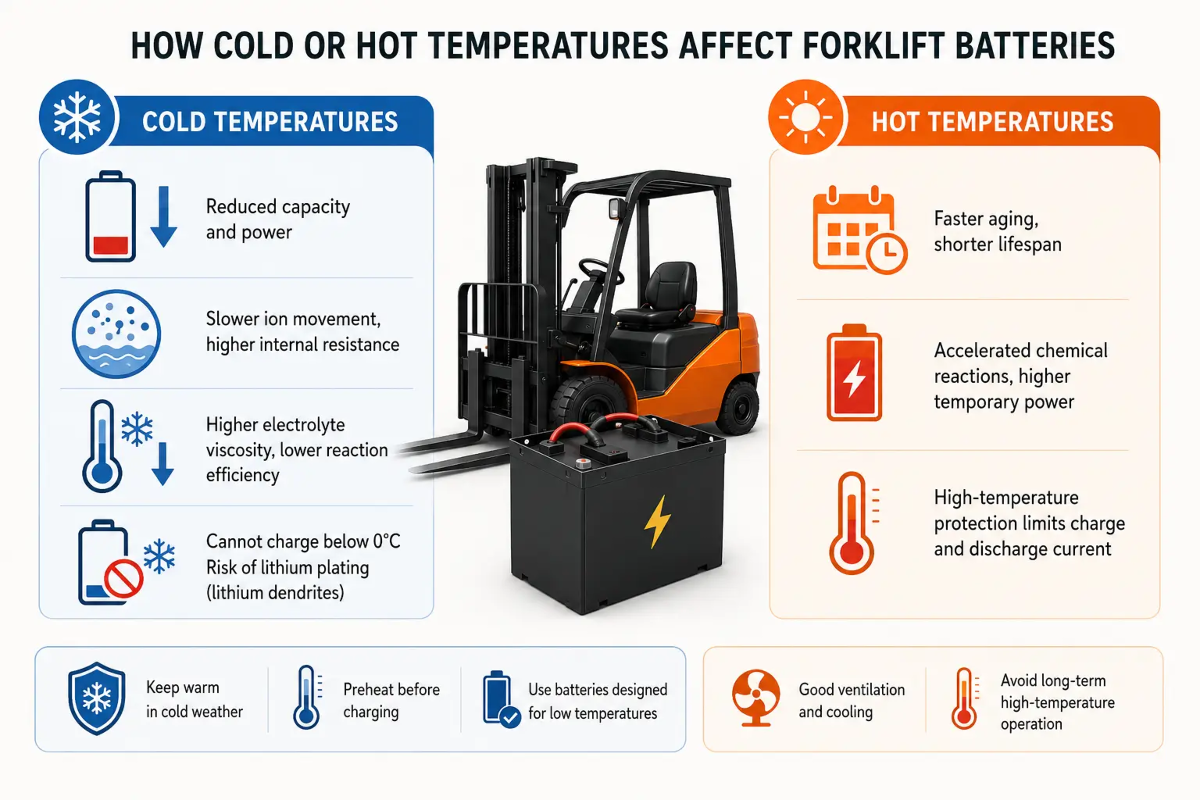
In cold environments, the most noticeable issues with forklift batteries are reduced capacity and diminished power.
This is because, as temperatures drop, the movement of ions inside the battery slows down, leading to increased electrolyte viscosity, higher internal resistance, and reduced chemical reaction efficiency.
In addition, low temperatures can affect charging; most standard lithium-ion batteries cannot be charged directly below 0°C, as charging at low temperatures can easily lead to lithium precipitation-the so-called "lithium dendrite" problem-which permanently damages the cell structure.
The impact of high temperatures on forklift batteries is more evident in terms of reduced lifespan.
Although high temperatures accelerate internal chemical reactions, temporarily boosting power output, they actually hasten the battery's aging process. When temperatures become excessively high, the battery management system activates its high-temperature protection function, limiting the charge and discharge currents.
Common Mistakes When Choosing A Forklift Battery
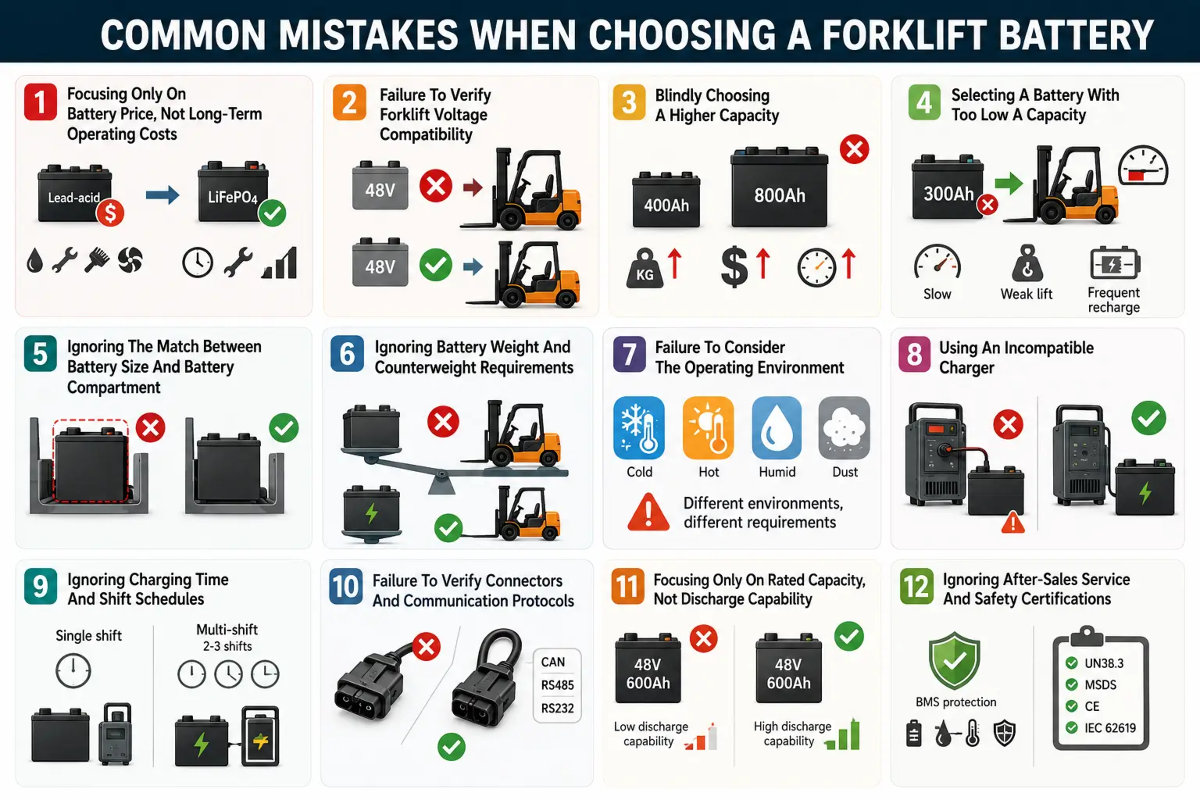
A common mistake many people make is focusing solely on price or capacity while overlooking the forklift's voltage, dimensions, weight, operating conditions, charging method, and long-term operating costs.
1. Focusing Only on Battery Price, Not Long-Term Operating Costs
When selecting batteries, many users prioritize price above all else. Although lead-acid batteries have lower upfront purchase costs, they require regular water top-ups, equalization charging, and terminal cleaning, as well as a dedicated charging area with proper ventilation.
For warehouses operating on multiple shifts with high usage frequency, lead-acid batteries may also require spare batteries and battery-swapping equipment. In contrast, while LiFePO4 batteries have a higher initial price, they charge faster, require less maintenance, and have a longer lifespan, potentially resulting in lower total long-term costs.
2. Failure to verify forklift voltage compatibility
This is a very serious mistake, as the forklift battery voltage must match the original vehicle system-such as 24V, 36V, 48V, 72V, or 80V-and cannot be changed arbitrarily.
3. Blindly choosing a higher capacity
Many people believe that the higher the Ah rating, the better, but this is not entirely accurate.
While a higher capacity theoretically extends runtime, it also increases the battery's size, weight, cost, and charging requirements. If the forklift is used only for single-shift operations, light loads, and short-distance transport, an excessively large battery capacity may result in unnecessary cost waste.
4. Selecting a Battery with Too Low a Capacity
Selecting a battery with too low a capacity is also very common. Many users choose low-Ah batteries to save money, but this often results in the forklift losing speed during working hours, requiring frequent mid-shift recharging, experiencing lifting weakness under heavy loads, and even frequently triggering low-voltage protection.
5. Ignoring the Match Between Battery Size and Battery Compartment
Forklift batteries cannot be installed simply because their voltage and capacity are suitable; battery compartment dimensions may vary across different brands and models.
6. Ignoring Battery Weight and Counterweight Requirements
Forklift batteries are also part of the counterweight system, particularly for counterbalanced forklifts. Manufacturers factor battery weight into the vehicle's center of gravity and balance calculations during the design phase.
7. Failure to consider the operating environment
Different environments impose entirely different requirements on batteries.
8. Using an incompatible charger
This is an easily overlooked issue; different battery types require different charging curves.
9. Ignoring charging time and shift schedules.
If a forklift operates only a few hours a day, a standard charging solution may suffice; however, in two- or three-shift operations, charging speed becomes critical.
10. Failure to verify connectors and communication protocols
Many forklift lithium-ion batteries require communication with the vehicle's control system, instrument panel, or charger. Common communication protocols include CAN, RS485, and RS232.
11. Focusing only on rated capacity, not discharge capability
Even for a 48V 600Ah battery, there may be significant differences in continuous discharge current and peak discharge capability among different batteries.
12. Ignoring After-Sales Service and Safety Certifications
Forklift batteries are industrial power batteries; one should not rely solely on price quotes.
It is essential to verify whether the battery features a reliable Battery Management System with protection against overcharging, over-discharging, short circuits, and temperature fluctuations, as well as balancing capabilities. Additionally, check for necessary certifications and test reports, such as UN38.3, MSDS, CE, and IEC 62619.
Final Thoughts
As LiFePO4 lithium iron phosphate technology continues to mature, an increasing number of companies are switching from lead-acid batteries to lithium-ion battery solutions.
Compared to lead-acid batteries, lithium-ion batteries offer significant advantages in charging efficiency, cycle life, maintenance requirements, and sustained output capacity, making them particularly well-suited for high-frequency, high-efficiency modern logistics operations.
However, lead-acid batteries still hold certain advantages in scenarios with limited budgets, single-shift operations, and low-intensity working conditions.
When making the final selection, it is recommended to focus on the following key factors:
- Whether the forklift's original voltage is compatible;
- Whether the battery capacity meets actual operating time requirements;
- Whether the battery size and weight are compatible with the vehicle's structure;
- Whether it supports current shift schedules and charging methods;
- Whether the working environment involves low-temperature, high-temperature, or high-dust conditions;
- Whether the BMS, safety protections, and certifications are comprehensive;
- Whether reliable after-sales service and technical support are available.
For more information on CoPow forklift batteries, please click here.