To breathe new life into your golf cart, understanding the configuration logic of a 48-volt battery system is essential for every owner. Whether you are debating between the low-maintenance setup of four 12-volt batteries, the high-capacity arrangement of eight 6-volt units, or considering a direct upgrade to a single lightweight 48-volt lithium battery, this guide covers it all.
From technical principles and installation details to real-world user experiences, we will break down the secrets of 48-volt system configurations to help you find the perfect balance between budget and performance, delivering a worry-free driving experience that truly lets you install and forget.
Understanding 48v Golf Cart Battery System Setup
Understanding the 48-volt battery system of a golf cart is about more than just getting the vehicle moving; it is essential for extending battery life and ensuring safety. These systems typically connect multiple batteries in series to achieve the required voltage. The following is a detailed breakdown of the 48-volt system setup.
1. Common Battery Configurations
A 48V system is typically composed of multiple lower-voltage batteries connected together. Common configurations include:
- Six 8V Batteries: The most common traditional setup.
- Four 12V Batteries: Easier to maintain (fewer batteries), but typically offers slightly lower total capacity (range).
- Eight 6V Batteries: Provides the longest runtime/range, but is heavier and takes up more space.
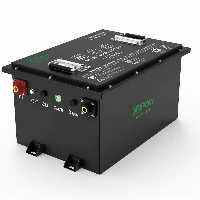
- Single 48V Lithium Battery: A modern upgrade solution that is extremely lightweight and maintenance-free.
2. Connection Method: Series
To achieve 48V, the batteries must be connected in Series.
- Principle: Connecting in series increases the voltage while keeping the capacity (Ah, Ampere-hours) the same.
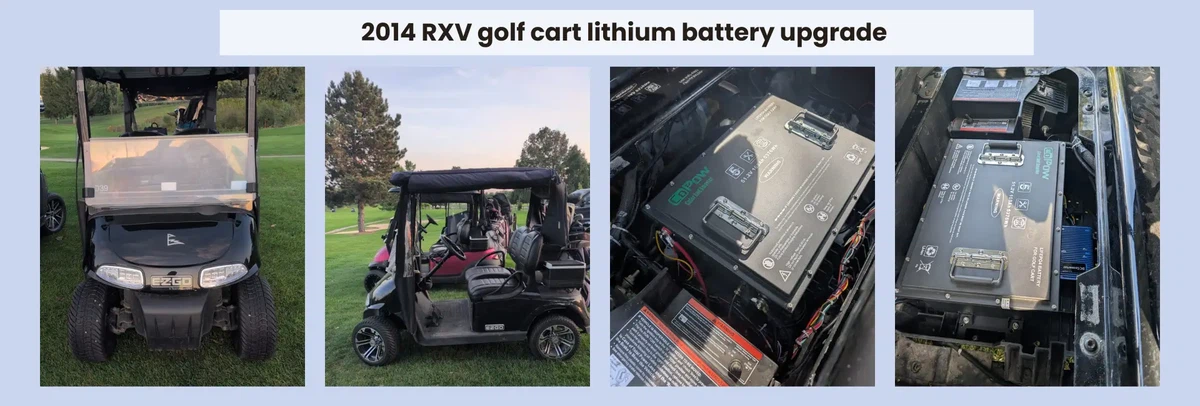
Feasibility Study of Connecting Four 12-Volt Batteries in Series
Connecting four 12V batteries in series is a technically mature and common solution, typically used to build 48V power systems for applications like golf carts, solar energy storage, or heavy-duty UPS backup systems.
1. Technical Principles and Output
In a series connection, the voltages add up, but the capacity (Ah) remains the same.
- Voltage Calculation: 12 V + 12 V + 12 V + 12 V = 48 V
- Capacity Example: If each battery is 100 Ah, the total bank remains 100 Ah.
- Total Energy: 48 V × 100 Ah = 4.8 kWh
2. Core Requirements for Feasibility
To ensure safety and longevity, you cannot simply connect any four batteries together. They must meet the "Four Consistencies":
- Same Brand & Model: Different brands have different internal resistances; mixing them leads to uneven charging/discharging.
- Identical Capacity (Ah): If one battery is 50Ah and the others are 100Ah, the smaller one will over-discharge first and fail prematurely.
- Same Age/Usage: Old batteries have higher internal resistance and will act as "parasites" on new ones, dragging down the entire bank's performance.
- Same State of Charge (SoC): Before connecting them, ensure all four batteries are fully charged to the same voltage level.
3. Pros and Cons Analysis
| Advantages | Risks & Disadvantages |
| Higher Efficiency: Higher voltage means lower current, reducing heat loss in cables. | Single Point of Failure: If one battery fails, the entire circuit is broken (0V output). |
| Inverter Cost: 48V inverters are generally more efficient than 12V or 24V models. | Balancing Challenges: Over time, individual battery voltages will drift apart. |
How to Wire 4 12V Batteries in Series for a 48V Golf Cart?
Configuring a 48-volt battery pack for your golf cart is an excellent upgrade that significantly improves motor efficiency. Connecting four 12-volt batteries in series is as straightforward as linking them in a chain, but paying attention to safety details during wiring is crucial. Here are the specific wiring steps and precautions.
1. Wiring Steps (Series Connection)
Imagine the batteries are lined up (1-2-3-4):
- Jumper 1: Connect Battery 1 Negative (-) → Battery 2 Positive (+).
- Jumper 2: Connect Battery 2 Negative (-) → Battery 3 Positive (+).
- Jumper 3: Connect Battery 3 Negative (-) → Battery 4 Positive (+).
Final Output:
- The remaining Positive (+) on Battery 1 = 48V Main Positive.
- The remaining Negative (-) on Battery 4 = 48V Main Negative.
2. Pro-Tips to Avoid Failure
- Never Mix & Match: Batteries must be the same brand, model, and age.
- Cable Gauge: Golf carts pull high current; use 4 AWG or thicker dedicated battery cables.
- Pre-Charge: Ensure all 4 batteries are fully charged individually before connecting them to ensure balanced voltage.
- Essential Add-on: Strongly recommend a 48V Battery Balancer. Without it, one battery will likely fail within months due to uneven charging.
3. Final Check
Once connected, use a multimeter to measure the voltage across the main positive and negative terminals. A reading between 48V and 52V indicates a successful setup.
Will Using Four 12V Lithium Batteries Affect Golf Cart Performance?
Using four 12V lithium batteries in series to power a 48V golf cart offers significant performance gains but comes with specific technical risks.
Performance Gains: Lithium batteries are approximately 70% lighter than lead-acid batteries; this massive weight reduction results in faster acceleration, more responsive braking, and less wear on the turf. More importantly, lithium has a flat discharge curve, meaning the cart maintains full power even at low battery levels, unlike lead-acid batteries which "bog down" as they drain. Additionally, lithium supports fast charging and has no memory effect, leading to near-zero maintenance.
Potential Challenges: Since each 12V lithium battery has its own independent BMS (Battery Management System), a series setup can be tricky. If one battery triggers a protection shutdown due to a momentary current spike (like sudden acceleration), the entire cart will instantly lose power. Furthermore, the continuous discharge rating of the lithium batteries must match the cart's controller requirements (usually 100A or higher) to avoid frequent tripping.
Recommendation: Ensure you choose high-discharge rate lithium batteries and install a lithium-specific balancer to prevent voltage drift between the four units.
Is It Safe to Use 4 12-Volt Batteries in a 48V Golf Cart?
If using lead-acid batteries, the risk is very low as long as the connecting cables are thick enough and the polarity is correct. However, when connecting 12-volt lithium batteries in series, the main safety challenge lies in the compatibility of the Battery Management Systems. Since each lithium battery has its own independent protection board, if one triggers a shutdown due to abnormal voltage, the entire circuit may generate an instantaneous high-voltage surge that could damage the battery management system or the golf cart controller.
Furthermore, voltage imbalance is the biggest hidden danger; over time, slight differences in charge levels among the four batteries can cause one to overcharge and potentially catch fire during charging while others remain undercharged. Therefore, although the physical connection is simple, it is essential to install a 48-volt battery balancer to keep all four batteries synchronized and to use high-quality cables sized 4 AWG or larger to prevent overheating and melting under high current loads.

Common Misconceptions About Using 4×12V Batteries
There are several common misconceptions regarding wiring four 12V batteries in series for a 48V system. These misunderstandings are often the primary cause of premature battery failure or system malfunctions:
1. Capacity Misconception (Ah)
Myth: Capacity quadruples (e.g., four 100Ah batteries become 400Ah).
Truth: In series, voltage quadruples (48V), but capacity remains the same (100Ah). Total energy increases, but the current-handling limit does not.
2. Mixing Misconception
Myth: New and old batteries, or different brands, can be used together.
Truth: Never mix them. Older batteries have higher resistance and act like "parasites," quickly dragging down and destroying the new batteries.
3. Charging Misconception
Myth: A 48V charger automatically balances each individual battery.
Truth: The charger only monitors the total voltage. Without a Battery Balancer, one battery can easily overcharge (fire risk) while another undercharges (premature failure).
4. Lithium Misconception
Myth: Any 12V lithium battery can be wired in series.
Truth: You must confirm the BMS supports series connection. Otherwise, the voltage spikes caused by a sudden trip can fry the battery's protection board.
5. Cable Misconception
Myth: The length of the connecting jumper cables doesn't matter.
Truth: Cables must be identical in length and gauge. Uneven lengths cause different resistances, leading to internal "imbalance" and overheating.
The Better Choice: Why a Drop-In 48V LiFePO4 Battery Pack Makes More Sense?
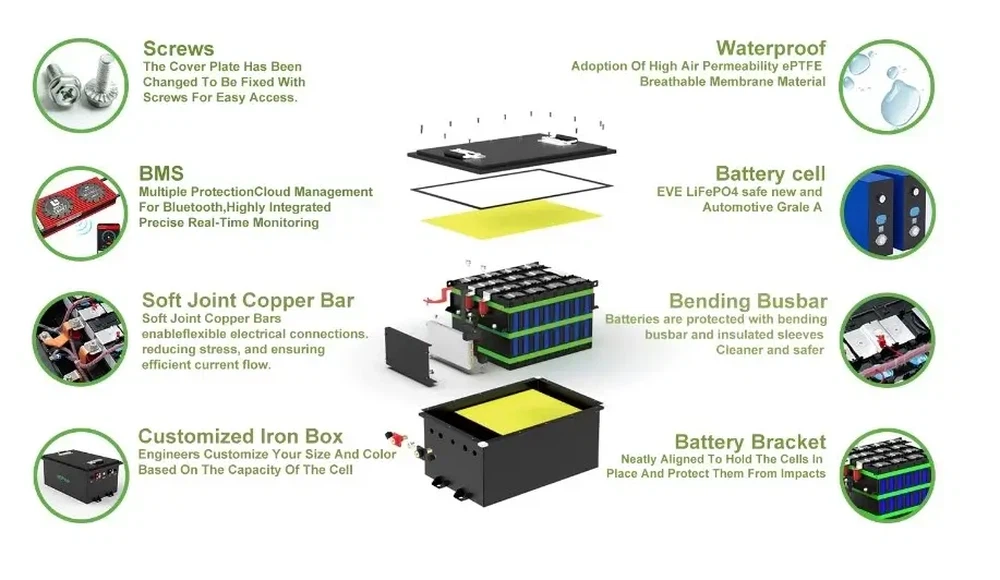
Opting for an integrated 48-volt lithium iron phosphate battery pack is the smarter choice. It uses a single battery management system to precisely monitor all cells, completely eliminating the voltage imbalance and frequent tripping issues common in multi-battery series setups, so no extra balancer is needed.
This approach greatly simplifies wiring, reduces overheating risks caused by contact resistance, and makes installation and maintenance much easier. Designed specifically for high-current 48-volt scenarios, it delivers more stable performance during hill climbing and acceleration.
Although the initial cost is slightly higher, its extremely long lifespan and very low failure rate offer far better long-term value and safety than traditional series combinations, making it the ultimate upgrade for a true "install and forget" experience.

Key Differences Between a 4×12V Battery Setup and a Single 48V Battery Configuration
Choosing between connecting four 12-volt batteries in series or using a single 48-volt battery is the most critical decision in golf cart modification. Here are the key differences in actual usage.
1. Management System
- 4x12V Series: Uses four independent BMS units that don't communicate. If one battery hits a limit (like a voltage spike during acceleration) and shuts down, the entire cart stops. Troubleshooting which of the four failed can be difficult.
- Single 48V: Uses one unified BMS to monitor all internal cells. This provides a synchronized system and prevents the "sudden shutdown" issues common with series setups.
2. Balance and Lifespan
- 4x12V Series: Prone to "Voltage Drift." Over time, individual batteries charge and discharge at slightly different rates. Without an external balancer, one battery may overcharge while another stays empty, significantly shortening the pack's life.
- Single 48V: Cells are physically balanced during manufacturing and managed by one BMS. This typically results in a 20% to 50% longer lifespan compared to unmanaged series configurations.
3. Installation and Safety
- 4x12V Series: Requires three extra jumper cables. More connection points mean higher resistance, more heat spots, and a higher risk of terminals loosening due to vibrations.
- Single 48V: A true "Drop-in" solution with only two main cables. It simplifies installation, increases safety, and keeps the battery bay clean.
4. Cost Comparison
- 4x12V Series: Lower upfront cost. It's attractive for tight budgets and allows for individual battery replacement (though mixing new and old is not recommended).
- Single 48V: Higher initial investment but is a "set and forget" solution. When factoring in the longer lifespan (up to 10 years) and lack of maintenance, the Total Cost of Ownership (TCO) is usually lower over the long term.
4x12V vs 6x8V vs 8x6V - What's the Difference?
In a 48-volt golf cart system, choosing between four 12-volt, six 8-volt, or eight 6-volt batteries essentially involves balancing range, battery life, and installation simplicity.
| Feature | 4 × 12V Setup | 6 × 8V Setup | 8 × 6V Setup |
|---|---|---|---|
| Total Voltage | 4 × 12 V = 48 V | 6 × 8 V = 48 V | 8 × 6 V = 48 V |
| Typical Capacity (Ah) | Low (~100–150 Ah) | Medium (~150–175 Ah) | Highest (~210–260 Ah) |
| Driving Range | Shortest (light use) | Balanced (industry standard) | Longest (heavy-duty use) |
| Lifespan | Shorter (fewer cycles) | Longer | Longest (best deep-cycle durability) |
| Complexity | Simplest (fewest cables) | Moderate | Most complex (many cables/connection points) |
| Maintenance | Lowest (4 units to check) | Moderate | Highest (8 units to check) |
| Weight | Lightest | Moderate | Heaviest (highest deck load) |
| Best For | Budget-conscious, flat terrain | Most standard golf carts | Frequent hills, long commutes |
Four 12V Batteries or One 48V Golf Cart Battery Pack? Real-World User Experiences Compared
When choosing batteries for a golf cart, many enthusiasts struggle with the decision: should they connect four 12-volt batteries in series, or simply install a single integrated 48-volt battery pack?
Based on real-world user testing and feedback, the difference in experience between these two options is significant, much like the contrast between an old-school large-displacement manual car and a modern smart electric vehicle.
The Reality of Four 12V Batteries (Lead-Acid or Budget Lithium)
Many users initially opt for four 12V batteries for the "staged investment" and "fault tolerance." As one veteran cart owner put it: "My budget was tight at first, and a set of four 12V lead-acid batteries only cost a few thousand. Plus, I figured if one failed, I could just replace that specific unit without scrapping the whole system."
In practice, however, this "saving" often turns into a headache. Users frequently report that the sheer number of jumper cables makes maintenance a chore. Because they are wired in series, the "bucket effect" kicks in-if even one battery's performance dips, it drags down the entire pack's range. The biggest frustration for users is voltage imbalance: during charging, one unit might overcharge while another remains underfilled, shortening the overall lifespan to just 2–3 years. For lead-acid users, there's the added burden of topping off water and scrubbing white corrosion off terminals. Toss in the noticeable power lag on hills during winter, and the "range anxiety" becomes impossible to ignore.
The "Game-Changer" Moment: Single 48V Battery Pack (LiFePO4)
Switching to a single 48V lithium battery (like a 100Ah or 160Ah unit) feels, quite literally, like "shedding a heavy load." Users report that once the several hundred pounds of old batteries are gone, the cart feels reborn-punchier acceleration, nimbler steering, and even less wear and tear on the turf.
In terms of management, the single 48V pack features an integrated BMS that acts like a smart butler, keeping every internal cell perfectly balanced. One user who upgraded from a 4x12V setup noted: "I used to constantly worry about which battery was dying. Now, I just check the app on my phone to see voltage, current, and exact percentage." Most importantly, the voltage curve is incredibly flat: even at 10% capacity, the cart still tackles hills with plenty of torque, unlike lead-acid batteries that "wimp out" halfway through their charge. While the upfront cost can be steep, when you factor in a 10-year lifespan and zero maintenance, the consensus among hardcore enthusiasts is: "I should have switched sooner."
When Should You Choose 4 12V Batteries?
Opting for four 12-volt batteries to create a 48-volt system is usually a compromise driven by specific needs. While serious golf cart enthusiasts often prefer 6-volt or 8-volt batteries to maximize range, choosing the 12-volt configuration is the smarter move in the following situations.
- Limited Space: When the battery compartment is small and cannot accommodate 6 or 8 batteries.
- Lightweight Requirements: To reduce the overall vehicle weight, improving climbing performance or reducing chassis strain.
- Short-Distance Commuting: For short daily trips (e.g., within a neighborhood) where maximum range isn't necessary and 12V capacity is sufficient.
- Budget & Simple Maintenance: Lower initial purchase cost and easier wiring/replacement with only 3 connection cables required.
- Key Reminder: 12V batteries typically have a shorter cycle life than 6V or 8V batteries, making them best suited for "low-intensity, short-distance" environments.
Conclusion
Whether you ultimately choose the setup of four 12-volt batteries in series or decide to embrace the integrated single 48-volt lithium golf cart battery, the core goals remain unchanged: efficiency, safety, and range.
If you are on a tight budget and only need the cart for short trips, the high cost-performance ratio of four 12-volt batteries is undoubtedly a solid starting point. However, if you desire stronger climbing power, a lighter vehicle, and up to ten years of worry-free use, a single 48-volt lithium battery pack is definitely the ultimate upgrade for the future.
Ready to stop worrying about voltage drift and heavy maintenance? Upgrade your ride with Copow. Visit Copow today to find your perfect 48-volt power match.
FAQ
Is There a Risk of Electric Shock from 48V Golf Cart Batteries?
Under normal conditions, the risk of electric shock from a 48V golf cart battery is relatively low, as 48V is considered a low-voltage DC system and is unlikely to cause severe injury like high-voltage electricity. However, some risk still exists-especially in damp environments, when the skin is broken, or if both the positive and negative terminals are touched at the same time-which may result in a noticeable tingling sensation or a mild electric shock.
In addition, 48V systems can deliver high current, and a short circuit may cause sparks, burns, or equipment damage. Therefore, proper insulation and waterproofing are essential during operation and maintenance, and direct contact with battery terminals should be avoided.