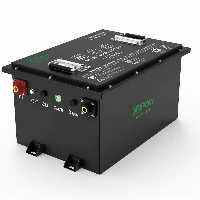
The fundamental difference between 12V and 24V battery systems is that, at the same output power, a 24V system requires only half the current of a 12V system.
This gives 24V systems significant advantages in reducing line losses, minimizing heat generation, lowering cable specifications, and powering high-power equipment.
On the other hand, the advantage of 12V battery systems lies in their greater compatibility; they are suitable for a wide range of applications, from automobiles, RVs, and boats to refrigerators, water pumps, inverters, and audio systems. Furthermore, installation is much simpler than with 24V systems, as it does not require connecting batteries in series, redesigning wiring, or adding additional voltage conversion equipment.
In recent years, with advances in lithium-ion battery technology, 24V lithium-ion batteries often do not require series connection; purchasing a single 24V battery pack is sufficient. However, compatibility issues still need to be considered, as many devices are primarily designed for 12V loads.
Furthermore, if a 24V battery is to be used to power 12V devices, a DC-DC converter is required.

For example:
When powering a 2400W inverter, the theoretical current in a 12V system is approximately 200A, while in a 24V system it is approximately 100A.
The higher the current, the thicker the cables must be, and the higher the ratings of fuses, terminals, switches, and connectors must be.
Otherwise, issues such as excessive heat generation, excessive voltage drops, low system efficiency, burnt-out connections, and frequent triggering of the battery management system's overcurrent protection mechanism may occur, resulting in an inability to supply power normally.
Therefore, when the system power is low and the wiring is short, using a 12V battery is more convenient. However, if you need to use high-power inverters, air conditioners, trolling motors, or large solar panels, and require longer wiring, a 24V battery is more suitable.
12V vs 24V Battery System at a Glance
| Comparison Item | 12V Battery System | 24V Battery System |
|---|---|---|
| Nominal Voltage | 12V | 24V |
| Battery Configuration | Typically uses one 12V battery | Uses two 12V batteries in series or one dedicated 24V lithium battery |
| Current (Same Power Output) | Higher current | About half the current of a 12V system |
| Power Transmission Efficiency | Lower over long cable runs | Higher with lower energy loss |
| Heat Generation | Generates more heat under high loads | Generates less heat due to lower current |
| Cable Size Required | Requires thicker cables | Can use thinner cables |
| Suitable Power Range | Low to medium-power applications | Medium to high-power applications |
| Installation Complexity | Simple; usually requires only one battery | More complex when using two 12V batteries in series; simpler with a dedicated 24V battery |
| Device Compatibility | Compatible with most 12V devices | Designed for 24V devices; 12V devices typically require a DC-DC converter |
| Initial Cost | Lower upfront cost | Higher upfront cost |
| Charging Requirements | Requires a 12V charger | Requires a 24V charger |
| System Scalability | Better for small systems | Better for larger and higher-power systems |
| Typical Applications | Cars, RVs, boats, refrigerators, water pumps, inverters, lighting systems | Forklifts, off-grid solar systems, larger RVs, electric boats, high-power inverters, industrial equipment |
| Main Advantages | Wide compatibility, simple installation, lower cost | Higher efficiency, lower current, reduced voltage drop, ideal for high-power applications |
| Main Disadvantages | Higher current results in greater voltage drop and power loss | Lower compatibility with 12V devices and may require a DC-DC converter |
What Is a 12V Battery?
A 12V battery is a direct current (DC) energy storage battery with a nominal voltage of 12 volts. It consists of multiple individual cells connected in series and stores and releases electrical energy through chemical reactions, providing a stable DC power supply for various devices.
Depending on the battery's chemical system, a 12V battery can consist of 6 2V lead-acid cells, 4 3.2V lithium iron phosphate (LiFePO4) cells, or 3 3.7V lithium-ion cells connected in series.
Due to their moderate voltage and good compatibility, 12V batteries are widely used in automobiles, RVs, boats, solar energy storage, backup power systems, trolling motors, lighting systems, and various off-grid devices.
Depending on their intended use, 12V batteries can be classified into three types: starting batteries (used to deliver a high current instantaneously to start the engine of a car or boat), deep-cycle batteries (used for continuous power supply), and dual-purpose batteries that serve both functions.
Among these, lead-acid batteries are less expensive but are heavy, have a shorter lifespan, and require cumbersome maintenance. 12V lithium iron phosphate batteries weigh 50% to 70% less than lead-acid batteries and have a cycle life of 3,000 to 5,000 cycles or more.
High-quality batteries offer even longer cycle lives. For example, CoPow's 12V 100Ah lithium iron phosphate battery can withstand 4,000–6,000 charge-discharge cycles, with a service life of up to 8–10 years.
In addition, these batteries charge very quickly-reaching a full charge in just 1–3 hours-and require virtually no maintenance, with an actual usable capacity of over 90%. As a result, they have become the primary upgrade choice for RVs, boats, and energy storage systems.

What Is a 24V Battery?
A 24V battery is a type of DC energy storage battery with a nominal voltage of 24V. It consists of multiple individual cells connected in series and is equipped with a battery management system that provides protection against overcharging, over-discharging, overcurrent, short circuits, and temperature-related issues.
For example, a 24V lead-acid battery typically consists of 12 individual 2V cells connected in series, with a fully charged voltage of approximately 25.2V; A 24V LiFePO4 battery uses an 8-cell series configuration with a nominal voltage of 25.6V and a fully charged voltage of approximately 29.2V; for a ternary lithium battery, a 7-cell series configuration is used, with a nominal voltage of approximately 25.9V and a fully charged voltage of approximately 29.4V.
There are two types of 24V battery configurations.
There are two ways to set up a 24V battery system: purchase a 24V lithium-ion battery pack directly, or connect two 12V lead-acid or lithium-ion batteries in series to create a 24V system. For users who aren't very familiar with batteries, we recommend using a 24V lithium-ion battery pack that's already fully prepared.
Take CoPow's 24V lithium battery pack as an example. It features a modular design with the cells already connected in series, an integrated BMS, and even built-in circuit protection. It's ready to use right out of the box, which is quite convenient, but this "set it and forget it" approach does increase your initial purchase cost.
However, if you take a long-term view, you'll find that there's a good reason for the higher price-especially for users with limited battery compartment space. It saves a significant amount of space and leaves more room for future capacity upgrades.

12V vs 24V: What Are the Advantages of Each?
We have already mentioned the advantages and disadvantages of 12V and 24V batteries in the opening paragraph; to reinforce this point for our readers, we will now provide a more detailed explanation.
Advantages of a 12V Battery System
1. Greater Compatibility
12V is currently the most widely used DC voltage standard. Many cars, RVs, and boats, as well as onboard refrigerators, lighting equipment, water pumps, fans, audio systems, winches, and communication devices, are powered by 12V. Therefore, 12V battery systems can be used directly without the need to install a DC-DC converter.
2. Simpler Installation
If power requirements are modest, a single 12V battery is sufficient-no need for series connections or rewiring.
3. Lower Cost
The design of a 12V battery system is relatively simple, requiring fewer battery cells in series and only a single set of positive and negative power lines for wiring-eliminating the need for complex battery series configurations and voltage conversion designs. Additionally, supporting products such as chargers, inverters, and controllers are widely available on the market and easy to procure, resulting in lower costs for 12V batteries compared to other battery specifications.
4. Better Suited for Low- to Medium-Power Devices
For low- to medium-power loads such as refrigerators, lighting, water pumps, fans, small inverters, and various in-vehicle appliances, a 12V system is sufficient to meet daily power needs, eliminating the need to upgrade to a 24V system specifically for these devices.
5. Wider Range of Compatible Products
Since the 12V standard has been in development for many years, chargers, inverters, solar controllers, power modules, and various accessories on the market are highly mature. Users have more product options and find it easier to upgrade and maintain their systems.
6. Better Suited for Small Solar Systems
The 12V system offers high compatibility with portable solar panels, small off-grid energy storage systems, and RV solar systems. For common applications such as camping, outdoor travel, and backup power, a simple and practical power supply system can be quickly set up using just one 12V battery, one solar panel, one solar controller, and one inverter.

Advantages of a 24V Battery System
1. Lower current, lower line losses
At the same output power, based on P = UI, when the system voltage is increased from 12V to 24V, the required current decreases by approximately 50%.
Since energy loss in the circuit primarily results from heat generated by wire resistance-and this loss is proportional to the square of the current (P = I²R)-halving the current theoretically reduces line loss to about one-fourth of the original value. At the same time, the voltage drop and heat generation in the wires are also reduced accordingly.
Consequently, a 24V battery system can deliver more electrical energy to where it is needed, rather than wasting it in the wiring. This not only improves overall power supply efficiency but also reduces performance degradation in equipment caused by voltage drops.
2. Thinner cables can be used, reducing wiring costs
Since the current is halved, a 24V battery system can use smaller-gauge cables to meet the same power requirements. This not only reduces copper costs but also lowers the weight of the wiring harness and saves installation space.
3. Better suited for powering high-power equipment
For high-power equipment such as inverters rated at 2,000W or higher, parking air conditioners, water pumps, and solar energy storage systems, 24V batteries can deliver the same power at a lower current. This reduces the load on connectors, fuses, and switches, resulting in more stable system operation.
4. Higher system efficiency
Inverters, motors, and certain DC-DC conversion devices operate more efficiently at a 24V input, thereby extending battery runtime.
5. Better Suited for Large-Scale Solar Energy Storage Systems
A 24V system allows a single solar charge controller to connect to more solar panels; with the same controller specifications, it can handle twice the solar power of a 12V system.
6. Easier to Scale to High-Capacity Systems
As system capacity and load increase, a 24V system effectively reduces wiring, heat dissipation, and voltage drop issues caused by high currents. It is easier to scale to energy storage systems with capacities of several kilowatts or even higher, and the cost of future upgrades is lower.
7. Better Suited for Long-Distance Wiring
Due to lower line voltage drops, the output voltage remains stable even when the distance between the battery and the load is significant.

12V vs 24V Battery System: Disadvantages of Each
So what are their drawbacks? Let me take a closer look.
Disadvantages of a 12V Battery System
1. Higher current results in greater line losses.
At the same output power, a 12V system requires twice the current of a 24V system, which leads to issues such as voltage drop, heat generation, and line losses-all of which are more significant than in a 24V system.
2. Thicker cables are required, resulting in higher wiring costs.
Because they carry a higher current, 12V systems must use cables with a larger cross-sectional area to ensure safety and minimize voltage drop.
For example:
Suppose a 2000W inverter is installed at the rear of an RV, with the battery located at the front, requiring approximately 3 meters of cable in between. When using a 12V system, the theoretical current at full load for the inverter is approximately 170A.
If the cable's cross-sectional area is insufficient, a significant voltage drop will occur in the circuit. The battery's original output voltage is approximately 12.8V, but after passing through the cable, the inverter may only receive about 11V, preventing it from delivering its rated power (2000W) and potentially causing it to shut down automatically upon detecting an excessively low input voltage. To avoid this situation, a 12V battery system requires thick cable with a cross-sectional area of 50 mm² or 70 mm².
3. The wire must not be too long
Since 12V systems operate at a relatively low voltage, even a 1V loss in the circuit can have a noticeable impact. For example, if a 12V battery outputs 12.8V, a long cable can reduce the voltage reaching the load to 11.5V. The longer the circuit, the greater the reduction in current delivery, which may even prevent the engine from starting.
To address this issue, in addition to shortening the cables, you can try using thicker cables; however, this only provides a partial solution.

Disadvantages of a 24V Battery System
1. Poor compatibility with 12V devices
Although 24V systems are more efficient, most cars, RVs, boats, and portable devices currently on the market are primarily powered by 12V. If you use a 24V battery directly to power 12V devices, not only will they fail to function properly, but they may also be damaged. Therefore, you need an additional voltage conversion solution.
2. Requires an additional DC-DC converter, increasing costs and energy loss
When a 24V system needs to power 12V devices such as refrigerators, lighting, water pumps, and audio systems, a 24V-to-12V DC-DC converter must be installed. This not only increases procurement and installation costs, but the converter itself also results in some energy loss. Conversion efficiency typically ranges from 95% to 98%, meaning that 2% to 5% of the electrical energy is lost as heat.
3. More Complex Charging System
If the vehicle originally uses a 12V electrical system, a 24V battery cannot be charged directly using a 12V alternator or a 12V charger. Therefore, you will need to install an additional 24V charger or a 12V-to-24V DC-DC charger.
4. Relatively Limited Selection of Accessories
Compared to 12V systems, 24V systems offer advantages in terms of efficiency and high-power output, but their ecosystem of compatible accessories is less mature than that of 12V systems.
Many cars, RVs, boats, and outdoor equipment are designed based on the 12V standard, such as lights, refrigerators, water pumps, fans, audio systems, USB charging modules, in-vehicle appliances, and various control switches.
Therefore, when users upgrade from 12V to 24V, they not only need to replace the battery with a 24V one but also verify whether their existing equipment supports 24V input. If a device only supports 12V, a DC-DC step-down converter must be installed; if no suitable conversion solution is available, the device may need to be replaced with one compatible with 24V.

Charging Considerations for 12V and 24V Battery Systems
There are three viable ways to charge 12V and 24V batteries: using shore power or an inverter charger, using an alternator, and using solar power.
1. Shore Power/Inverter Charging
Shore power charging involves connecting an RV, boat, or off-grid energy storage system to the utility grid or a generator, and then using an inverter/charger to convert alternating current (AC) into the direct current (DC) required by the battery, thereby charging the battery.
This charging method offers a steady charging rate and high efficiency; it is the most common charging method for RVs, boats, and off-grid cabins. Additionally, 12V and 24V inverters/chargers are widely available and easy to purchase.

2. Alternator Charging
Alternator charging involves using the vehicle's engine to drive the alternator, which continuously recharges the battery while the vehicle is in motion. This method is widely used in cars, RVs, trucks, and boats. For 12V batteries, you can charge them directly using the vehicle's original 12V alternator.
However, if you are using a 24V battery, you will need to use a 24V alternator for charging, or purchase a 12V-to-24V DC-DC converter to ensure safe charging.
3. Solar Charging
Solar charging uses solar panels to convert light energy into electrical energy, which is then used to charge the battery via an MPPT or PWM solar controller, without the need for an external power source.
This charging method is particularly suitable for 24V batteries because it fully utilizes the power efficiency of MPPT controllers. With the same controller specifications, it supports larger solar arrays, results in fewer line losses, and requires fewer controllers, making it suitable for medium- to large-scale off-grid power systems.
Of course, 12V batteries can also be charged this way, though this method is better suited for small-scale solar power systems.

It can be quite daunting to see multiple MPPT controllers installed in a 12V system, whereas a 24V battery system doesn't require nearly as many.

How to Choose Between a 12V and 24V Battery System?
Depending on the specific application scenario, our recommendations are as follows:
RV: Most RVs and campers-such as Winnebago, Jayco, Coachmen RV, Forest River trailers, Class C RVs, Airstream travel trailers, and Thor Motor Coach-are better suited for a 12V battery system, as their LED lights, refrigerators, water pumps, exhaust fans, diesel heaters, TVs, and audio systems all operate on 12V.
Simply purchase a 12V battery and connect it directly to the power source to get started.
However, if the RV's total load exceeds 2,000–3,000 watts, we recommend opting for a 24V system or higher, as high-power appliances-such as inverters rated at 2,000 watts or more, parking air conditioners, induction cooktops, microwaves, coffee makers, and electric kettles-will operate very unreliably when powered by a 12V battery.

Boats: 12V batteries are also very common in the marine sector. For example, small-to-medium-sized fishing boats, recreational boats, and sailboats-such as the Tracker Boats Pro Guide V-175 Combo, Lund Boats Adventure 1775, Boston Whaler 170 Montauk, Beneteau Oceanis 30.1, and Jeanneau Sun Odyssey 349-all use 12V systems. A 12V battery is sufficient to power onboard navigation equipment, lighting, water pumps, and communication devices.
However, for models such as the Grady-White Canyon 336, Boston Whaler 280 Outrage, Scout Boats 305 LXF, Sea Ray SLX 310, and Beneteau Oceanis 46.1, 24V batteries are practically standard.
Just imagine how frustrating it would be to power an electric trolling motor with a single 12V battery: the power would be very weak, and the speed would be extremely slow.

Off-grid solar systems: For small off-grid systems, 12V is sufficient.However, as the system scales up-especially when the inverter power exceeds 2,000 W and the solar array ranges from 1,000 W to 1,500 W-a 24V system is the better choice; if the load exceeds 3,000 W, it's best to opt for a 48V battery.
Overall, determining battery specifications based on the load level is the most accurate approach.

Conclusion
Should you choose a 12V or a 24V battery system? I'm sure you already have the answer.
These two types of batteries are among the most commonly used on the market, especially the 12V 100Ah battery, which can be described as a "jack-of-all-trades" choice. Meanwhile, 24V batteries are better suited for medium-sized electrical equipment.
Of course, there are many different battery specifications available. If you have high power requirements, you can opt for upwardly compatible 48V or even higher voltages, or customize specific capacities.
You don't necessarily have to limit your choice to off-the-shelf products-for example, a 12V 340Ah battery-and some of our customers have done just that.
If you're still unsure whether to choose a 12V or 24V battery, feel free to contact CoPow. Our engineers will provide professional battery selection advice and customized lithium-ion battery solutions based on your equipment, power load, and application scenario.

Frequently Asked Questions
Can You Upgrade from a 12V to a 24V Battery System?
Yes, but only if the entire electrical system can support a 24V voltage-it's not just a matter of replacing the battery. The most common approach is to connect two 12V batteries of the same specifications, capacity, and model in series to form a 24V system, or to purchase a single 24V battery. If you're only powering a single 24V device, you can also use a DC-DC boost converter.
Can I replace a 12V battery with a 24V battery?
If your vehicle originally had a 12V system, you cannot simply replace the 12V battery with a 24V battery. The upgrade can only be safely completed if the entire electrical system is reconfigured for 24V and all equipment is confirmed to be compatible with 24V.
Is 24V safer than 12V?
24V batteries are indeed slightly safer than 12V batteries because, at the same power consumption, the current in a 24V battery is only half that of a 12V battery. Therefore, 24V batteries pose lower risks in terms of both heat generation and energy loss.
However, from the perspective of electric shock risk, both 12V and 24V batteries are part of low-voltage DC systems and are relatively safe.
Does 24V charge faster than 12V?
Not necessarily. A 24V battery does not necessarily charge faster than a 12V battery. Charging speed primarily depends on the charging power (i.e., power equals voltage multiplied by current), rather than the voltage itself. If the charging power is the same for both 12V and 24V systems, their theoretical charging times will be roughly the same. However, in practical applications, 24V systems are typically capable of delivering higher charging power.
Which battery system is better for solar power?
At present, lithium iron phosphate battery systems are the preferred choice for most residential and commercial solar energy storage systems.
Can a 12V charger charge a 24V battery?
It is important to note that a 12V charger cannot directly charge a 24V battery, because the output voltage of a 12V charger is only about 14V, while a 24V battery requires a voltage between 28.8V and 29.2V to be fully charged.