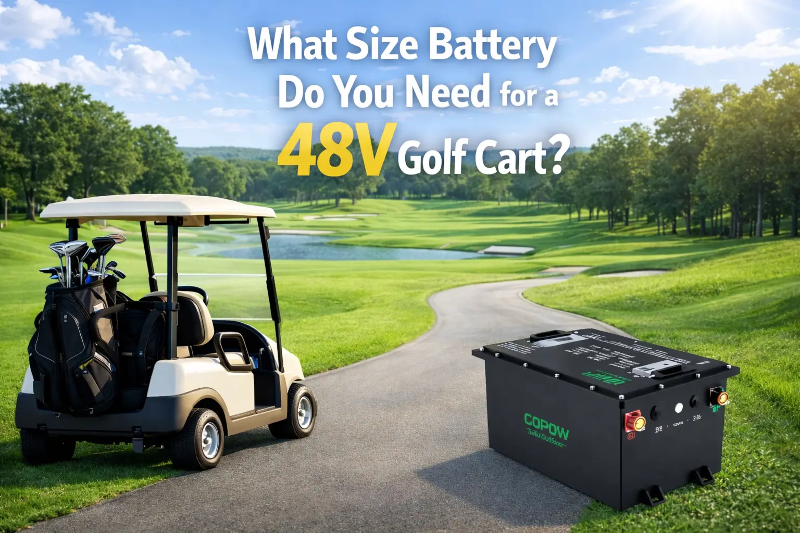
Please note that the term "capacity" used in this article refers to the capacity of a 48V golf cart battery, not its physical dimensions.
This article is intended to help users select the appropriate battery capacity. Using real-world examples and scientific calculation methods, we will help golf cart owners choose the right battery capacity to avoid selecting one that is too large or too small. In addition, we will explain in detail which practical factors influence your choice of golf cart battery capacity.
What Does "48V Golf Cart Battery" Actually Mean?
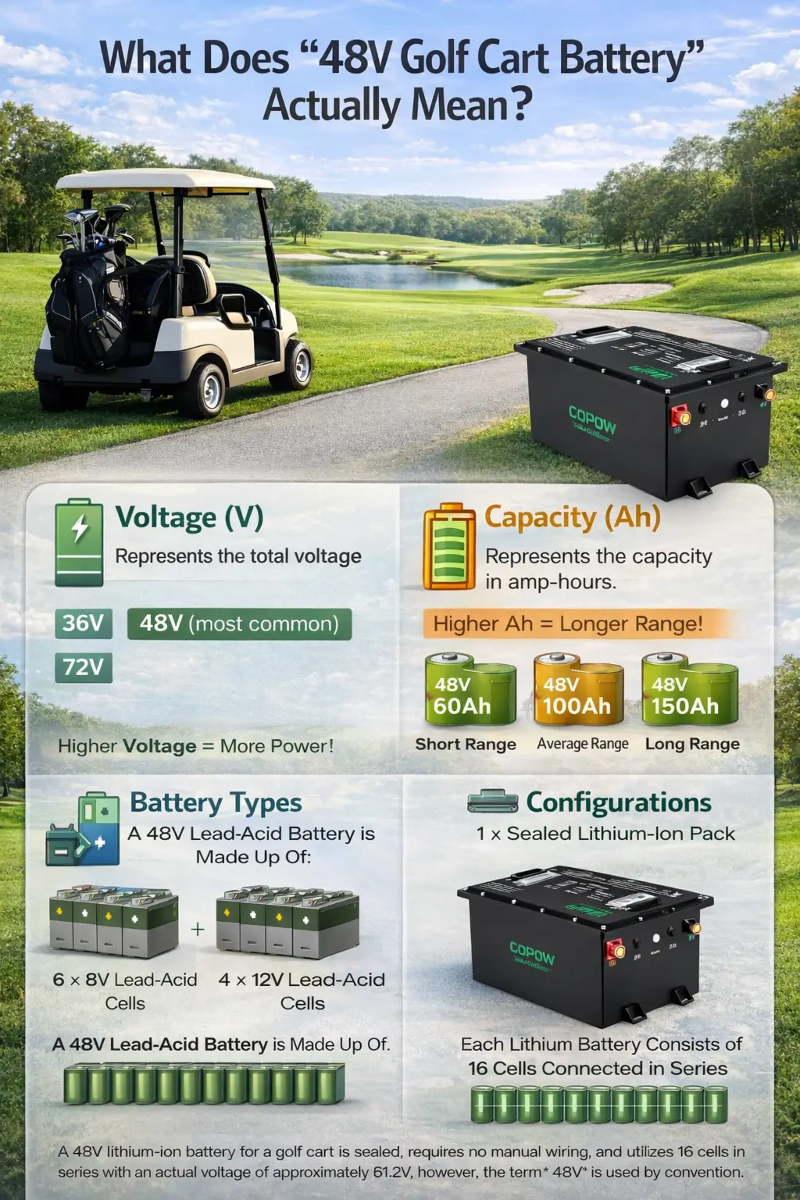
"48V" refers to the battery's total voltage, not its capacity. The higher the voltage, the more powerful the vehicle. Golf carts are available in three voltage configurations: 36V, 48V, and 72V.
"Ah" represents the capacity of a 48V golf cart battery. The battery life and driving range of golf carts-which are of great concern to many people-are closely related to this parameter.
In addition, golf carts use two types of batteries: lead-acid and lithium-ion. These two battery technologies are entirely different, and their assembly processes are therefore quite distinct.
A 48V lead-acid battery can consist of either six 8V cells or four 12V cells.
In contrast, a 48V lithium-ion battery for a golf cart is typically a sealed battery pack that requires no manual wiring. It consists of 16 cells connected in series, with an actual voltage of approximately 51.2V; however, the term "48V" is commonly used by convention.
How to Choose the Right Battery Capacity (Ah) for a 48V Golf Cart?
When it comes to choosing the battery capacity for a 48V golf cart, we believe no one can provide a definitive answer, as everyone's situation is different. Here is a typical example along with a general reference range, which we hope will be helpful to you.
In Florida's golf communities, residents like Mark use their golf carts not only for playing golf, but also for getting around the community and visiting neighbors.
He drives his golf cart for about four hours a day, consuming roughly 25 to 30 amps of electricity each time, and the climate is quite hot. Using him as an example, we can calculate the required battery capacity for the golf cart.
First, we need to calculate the theoretical capacity requirement, which is: Ah = average current × average daily usage time. Therefore, Ah = I × t = 30 × 4 = 120 Ah.
Second, we need to account for actual energy loss. Online discussions often provide only rough estimates. However, the reality is complex, and we need to consider several key factors that affect real-world performance, such as Florida's hot climate, the rate of battery degradation, and uneven road surfaces-all of which impact driving range.
We don't need to account for every single real-world factor-that would be impractical. Instead, we can introduce an efficiency factor, specifically the energy utilization efficiency, which is approximately 0.85. Of the energy input, about 85% is effectively utilized, while 15% is lost. For example, when you charge a battery with 100 units of energy, it actually stores about 85 units, while the remaining 15 units are converted into heat, line losses, and conversion losses.
Therefore, for a battery with a 100% charge, we estimate that the actual usable capacity is approximately 85%, with the remaining 15% attributed to natural loss and excluded from the actual capacity calculation.
We can calculate it this way: 30 × 4 = 0.8530. This gives us a fairly accurate estimate of the amp-hour capacity: Ah = 0.8530 × 4 ≈ 141 Ah. This is a rough range. You can make your selection based on this range. If you're looking for stability, you might want to choose a 48V 150Ah golf cart battery.
The above is an example of the calculation process we provide. You can substitute the appropriate values based on your specific circumstances to perform the calculation, thereby reducing the risks associated with subjective judgment.
Recommended Reading: How Far Can a 48V Golf Cart Go on One Charge?
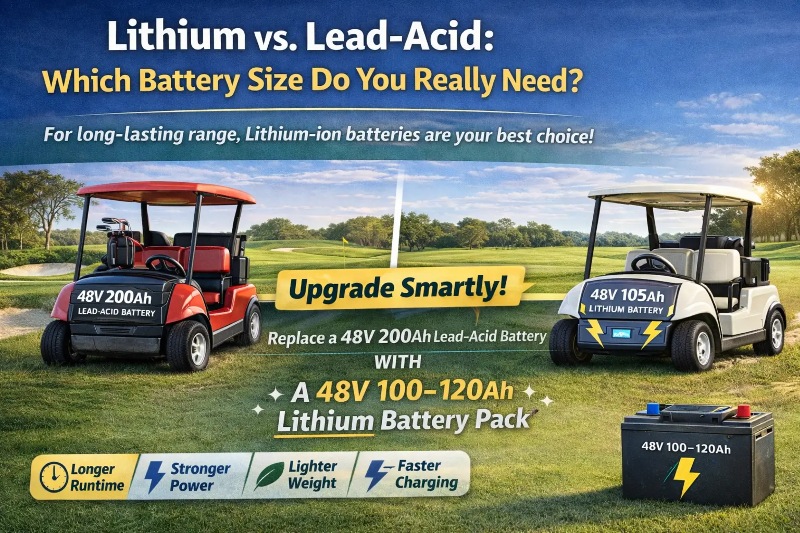
Lithium vs Lead-Acid: Which Battery Size Do You Really Need?
If you're looking for long-lasting range, lithium-ion batteries are your best choice. Lead-acid batteries are gradually being phased out because, for the same rated capacity, their actual usable capacity can be disappointing.
We once had to reassure a customer who faced this very issue. He told us that, while playing golf, even though everyone was using batteries of the same capacity, his partner drove farther and faster than he did. As he drove, he noticed a lack of power, especially when climbing hills. This left him feeling somewhat embarrassed.
Upon further inquiry, he discovered that the batteries they were using were worlds apart. His friend was using a 48V 105Ah lithium-ion battery, while he had just replaced it with a new one and remarked that he should have purchased a lithium-ion battery from the start.
Therefore, choosing a lithium-ion battery is a prerequisite for achieving maximum range. In fact, a 100Ah lithium-ion battery can replace a 150–200Ah lead-acid battery. For example, if you were previously using a 48V 200Ah lead-acid battery, when upgrading to a lithium battery, you only need to purchase a 48V 100–120Ah lithium battery pack. It will provide you with longer runtime, stronger power, lighter weight, and faster charging speeds.
Factors That Affect golf cart Battery Size Selection
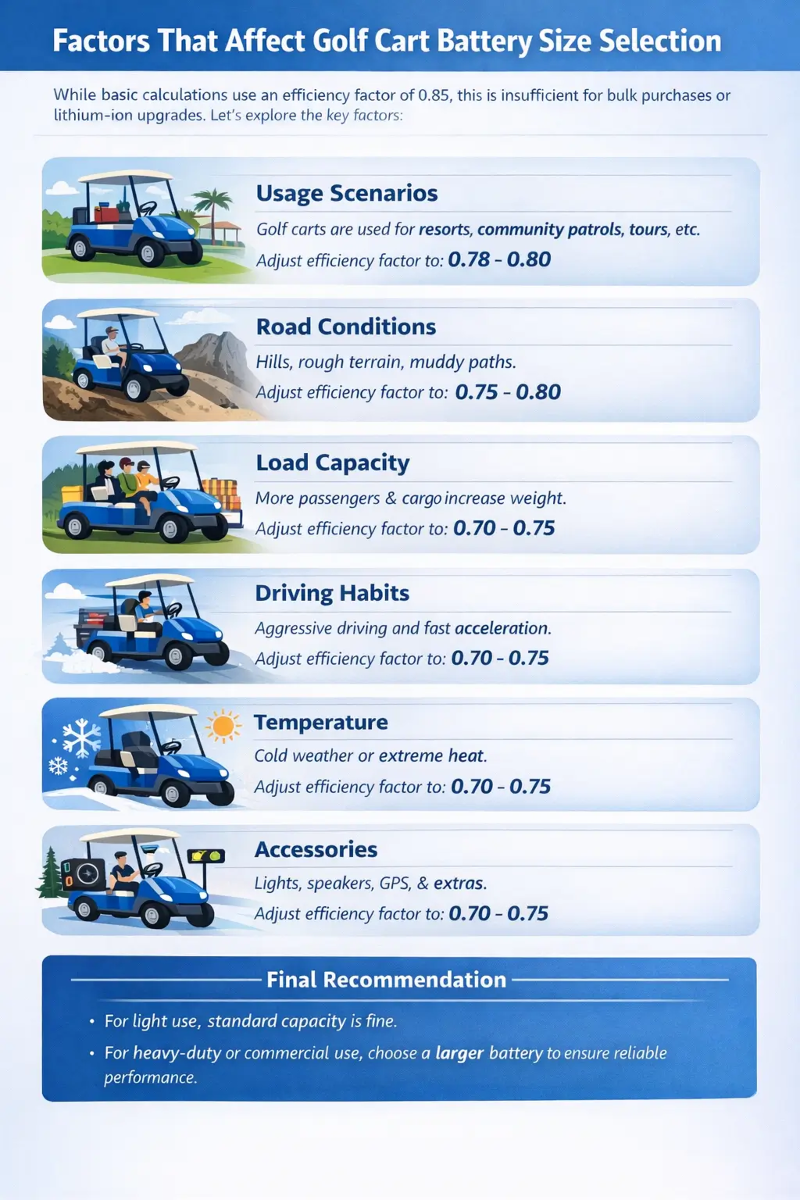
In the previous section, we mentioned that capacity and runtime are influenced by many practical factors. We primarily considered usage duration and current consumption, and referenced a relatively rough efficiency factor (0.85).
While this provides some guidance for the average consumer, it is clearly insufficient for those planning to purchase in bulk or upgrade to lithium-ion batteries.
Therefore, we have specifically listed these key influencing factors to provide you with a comprehensive reference.
Usage Scenarios
Golf carts are not limited to golf; they are also a form of recreational transportation suitable for community patrols, resort shuttle services, and sightseeing tours.
This raises a question: How much does the range of a 48V golf cart battery vary across different scenarios? If we simply apply the formula as is, the resulting deviation will be significant. Therefore, we may need to consider reducing the efficiency factor of 0.85-adjusting it to approximately 0.78 or 0.8-before substituting the values into the formula for calculation.
Road Conditions
Most manufacturers claim how far a 105Ah lithium-ion battery-powered golf cart can travel, but these figures are based on flat terrain. When driving on slopes, hills, mountainous terrain, or muddy ground, the range will be reduced accordingly. To calculate the actual range, the efficiency coefficient (η) should be adjusted downward from 0.85 to a value between 0.75 and 0.80.
Load Capacity
Not all golf carts are two-seaters; there are also 4-, 6-, and even 8-seaters. In resort settings, additional items such as luggage can increase the cart's load.
It sounds complicated, which is precisely why we introduced the efficiency coefficient to quantify it. Whether there are many or few passengers, a lot of luggage, uphill or downhill terrain, or any other real-world conditions, we can assess the situation using this coefficient. The efficiency coefficient typically ranges from 0.85 down to between 0.70 and 0.75.
Driving Habits
Even with the same vehicle, power consumption varies depending on the driver. We once had a customer who told us he didn't just drive his golf cart for fun-he truly enjoyed the driving experience and often treated it like a regular car.
As a result, the lead-acid battery he purchased couldn't withstand such intensive use and suffered severe degradation after just 18 months.
Of course, whether it's a lead-acid or a lithium-ion battery, such intensive use will accelerate battery life decline. η ≈ 0.70–0.75.
Air Temperature and Ambient Temperature
Among all influencing factors, we believe temperature is the primary factor affecting the range of 48V golf cart batteries, accounting for at least 20%.
In cold regions, the battery's available capacity often decreases, and charging and discharging efficiency are also affected; in high-temperature environments, while a sudden drop in range is not as direct as in low temperatures, prolonged use accelerates battery degradation, thereby affecting battery life.
Although lithium-ion batteries still offer certain advantages, we recommend selecting batteries with a larger capacity. η = 0.70–0.75.
Accessories
In Europe and the United States, especially during the Christmas season, many people enjoy decorating their golf carts. Some install sound systems, others upgrade to high-powered headlights, and some even add display screens. These accessories undoubtedly increase power consumption, with an efficiency rating of approximately 0.70-0.75.
Charging Habits and Conditions
If you maintain good charging habits-such as charging your vehicle after every drive and following the "20/80" charging rule-you generally won't encounter major issues with battery range. However, if you lead a busy lifestyle and use your vehicle frequently, sometimes charging during the day and other times at night, these irregular charging habits may result in a shorter battery range.
Recommended Battery Capacity (Ah) for Club Car, EZGO & Yamaha Golf Carts
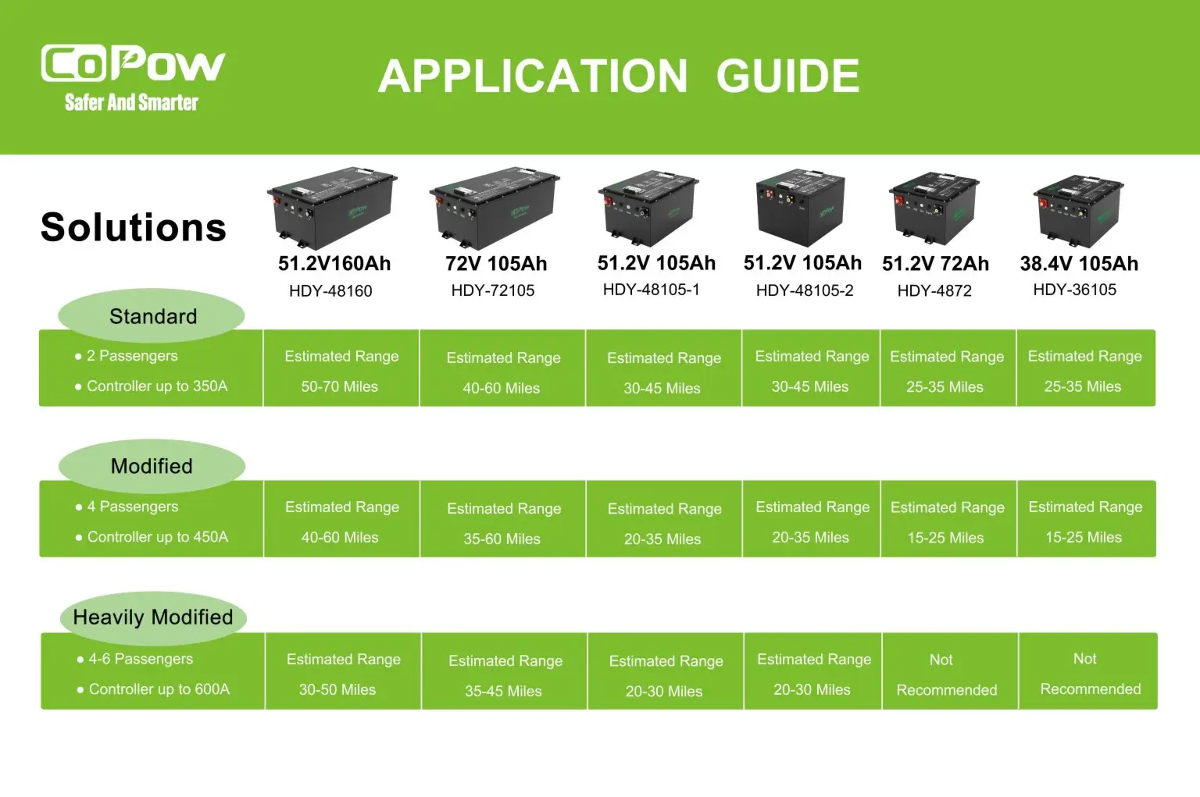
Do you drive a Club Car, EZGO, or Yamaha? Most models from these brands use 48V battery systems, so the logic behind choosing a battery capacity applies across the board. If you're unsure, it's always safer to choose the larger size.
| Application Scenario | Recommended Capacity | Compatible Brands | Recommended CoPow Solution |
|---|---|---|---|
| Light Use (Golf Course) | 48V 80–100Ah | Club Car / EZGO / Yamaha Golf-Car Company | CoPow 48V 100Ah LiFePO4 Battery |
| Daily Use (Community / Short Trips) | 48V 100–105Ah | All mainstream brands | CoPow 48V 105Ah Lithium Battery (Bluetooth + BMS) |
| Commercial Use (Resort / Patrol / Rental) | 48V 105–160Ah | Club Car Carryall / EZGO Express | CoPow 48V 120Ah–150Ah High-Performance Battery |
| Multi-Passenger (6–8 Seaters) | 48V 120–200Ah | Yamaha Concierge / EZGO Shuttle | CoPow 48V 150Ah–200Ah Heavy-Duty System |
| Modified Golf Carts (Lift Kit / Accessories) | 48V 120–150Ah+ | All modified carts | CoPow 48V 150Ah Custom Lithium Solution |
Tell us your usage scenario, and we'll recommend the exact battery size for your project.
Recommended Reading: How Long Does A 48V Lithium Golf Cart Battery Last?
What Happens If You Choose the Wrong golf cart Battery Size?
Here, we need to clarify one point: when it comes to 48V golf cart batteries, a higher capacity isn't necessarily better. The right battery for you is one that meets your needs while enhancing your driving experience.
If the battery capacity is too small, your range won't improve and will remain limited; if it's too large, not only will it exceed your power requirements, but it may also be too big to fit.
Need a Custom Battery Fit? CoPow 48V lithium batteries are designed to match your battery compartment.
Conclusion
By now, we've learned that the capacity of a 48V golf cart battery is influenced by many practical factors, but it's not impossible to determine.
We've introduced the concept of an efficiency factor, which allows us to quantify these practical factors and arrive at a general range for 48V golf cart battery capacity.
Whether you are a beginner just starting out or a seasoned buyer, you will find this article insightful.
If you need more information about customizing golf cart battery capacity, please feel free to contact CoPow at any time; we will respond to your inquiry as soon as possible.
FAQ
How Do Top LFP Battery Manufacturers Compare in Cycle Life and Total Cost of Ownership?
There is no substantial performance gap among leading LFP battery manufacturers in terms of cycle life and total cost of ownership (TCO). The current landscape shows that companies like CATL continue to lead in lower degradation rates and superior cycle stability, while manufacturers such as EVE Energy, REPT, and CALB have achieved comparable lifespan performance through more cost-efficient solutions, enhancing their competitiveness in overall TCO.
As a result, the industry is entering a new phase: with product performance increasingly converging, cost efficiency and delivery capability are becoming the key differentiating factors.