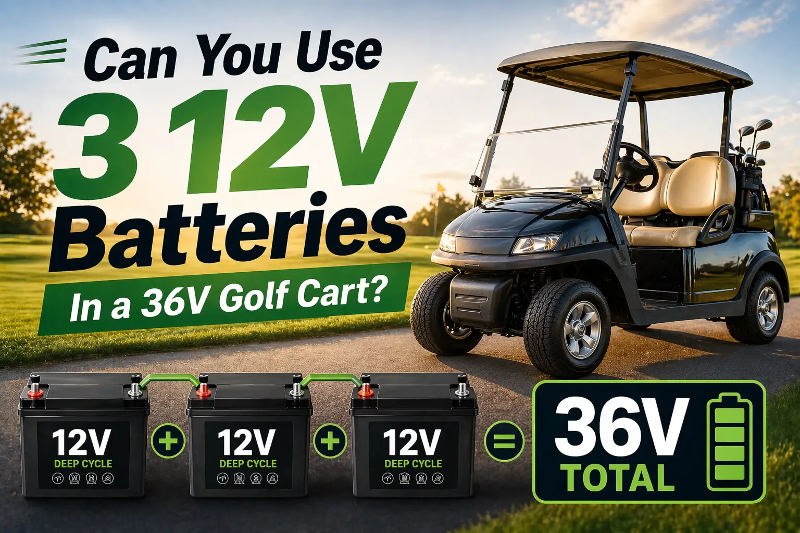
Yes, you can use three 12V batteries to power a 36V golf cart, provided they are connected in series correctly and the batteries are appropriately selected.
In principle, a golf cart does not distinguish between 6V and 12V batteries; it only "sees" the total voltage. As long as three 12V batteries are connected in series (12V + 12V + 12V = 36V), the system voltage meets the requirements, so this solution is electrically feasible.
However, it is not just voltage that affects the user experience; battery capacity (Ah) and type also play a significant role. If you use three standard 12V batteries (especially automotive starter batteries), while the cart may start, its range will be significantly reduced, and battery life will be rapidly shortened. This is because golf carts require deep-cycle batteries, not batteries designed for short bursts of high current during startup. This is the fundamental reason why many people feel that while the setup "works, it doesn't work well.
Furthermore, the total capacity of three 12V batteries equals the Ah of a single battery; the capacities do not add up. If the battery capacity is insufficient-for example, replacing a 200Ah system with 50Ah batteries-the vehicle will run out of power quickly, and its power output will diminish. This factor is more critical in practical applications than voltage.
How to Wire Three 12V Batteries for a 36V System?
Please note that when configuring a 36V system with three 12V batteries, they must be connected in series; never connect them in parallel, as this will cause issues with the battery circuit.
First, we need to connect three 12V golf cart batteries in series. Specifically, connect the positive terminal of one battery to the negative terminal of the next, continuing in sequence to form a circuit. This way, the voltages of each battery are added together-for example, 12V + 12V + 12V-resulting in a system voltage of 36V, which meets the power requirements of a golf cart.
However, there is a very critical yet easily overlooked point: the batteries must be consistent. Not only must their voltages be the same (all 12V), but their capacities (Ah) should also match. Ideally, the brand, model, and condition should be as uniform as possible.
If there are discrepancies among the batteries-for example, if one battery has a lower capacity or is more degraded-it will be depleted first during use. This could even lead to over-discharge or reverse charging. Not only will this affect the performance of the entire battery pack, but it may also shorten the batteries' overall service life. In severe cases, it could even cause battery damage or pose safety hazards.

Understanding Voltage (Series) vs Capacity (Parallel) in Battery Systems
When three 12V batteries are connected in series, the voltage increases from 12V to 36V, but the amp-hour (Ah) capacity remains the same.
For example, connecting three 12V 100Ah lithium batteries in series will result in a 36V 100Ah lithium battery pack for a golf cart.
However, there is a special case: if you have 12V 50Ah batteries, connecting three of them in series results in a 36V voltage but a 50Ah capacity, which does not meet the 100Ah requirement.
In this case, you cannot proceed directly with the series connection. Instead, you should first connect two sets of 12V 50Ah batteries in parallel to achieve a total capacity of 100Ah, and then connect three of these sets in series to obtain a 36V 100Ah battery pack.
Therefore, you will need at least six 12V 50Ah batteries to meet the requirement.

Wiring Sequence and Operational Safety
Connecting batteries in series may seem simple, but in practice, we often overlook key points that can lead to failure.
We recommend connecting the intermediate series wires first, and then connecting the main positive and negative terminals last.
Before installation, make sure the power is disconnected. Wear gloves and use insulated tools when working.

Wire Specifications
Be sure to use cable that is thick enough (e.g., 4 AWG or 2 AWG). If the wire is too thin, it may cause the cable to burn out.
Terminal Quality
All terminals must be securely fastened; it is recommended to follow torque specifications.

Polarity Check (Check for Reversed Connections)
After connecting the components in series, be sure to use a multimeter to verify that the output voltage is 36V.
Do you need a fuse or circuit breaker?
If reliability is a priority, you can install a fuse or circuit breaker on the main positive terminal to effectively prevent short circuits.

Recommendations for Use After Wiring
We recommend charging and discharging the entire battery pack together; avoid using individual cells separately.
Pros and Cons of Using 12V Batteries Instead of 6V
From a practical standpoint, the 12V setup is simpler and more straightforward: it requires only three batteries to build a 36V system, which means fewer wires, faster installation, and easier maintenance. If a single battery fails, it's simpler to locate and replace, which is why many beginners or DIY enthusiasts prefer the 12V setup.
However, this simplicity comes at a cost: 12V batteries typically have fewer cells, placing a heavier load on each cell. Under conditions of sustained high-current discharge-such as climbing hills, carrying heavy loads, or frequent stop-and-go driving-voltage drop is more pronounced, and overall stability is inferior to that of the 6V solution.
The logic behind 6V batteries is exactly the opposite: six cells are required to achieve 36V. The wiring is more complex and takes up more space, so it doesn't look as neat and tidy as 12V batteries.
However, the internal structure of each cell is designed primarily for deep-cycle use, allowing it to better handle discharge stress. As a result, the voltage is more stable, and the batteries degrade more slowly over the long term.
Consequently, within the traditional lead-acid battery system, 6V batteries have long been regarded as a more durable and stable solution, particularly suited to frequent use or to high demands for runtime and longevity.
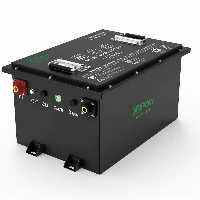
Compared to 12V or 6V batteries, this 36V lithium-ion battery for golf carts overcomes their shortcomings and features a simpler, more user-friendly wiring configuration.

6V vs 12V Batteries: Do They Really Impact Performance and Range?
Whether a battery is 12V or 6V is not, in itself, the fundamental factor determining battery performance and range; what truly makes the difference is the design quality and parameter matching of the entire battery system.
If you simply switch the battery voltage from 6V to 12V while keeping the total voltage (e.g., 36V) and total capacity (Ah) unchanged, there will be no significant difference in theoretical range, because the total energy available to the vehicle remains the same.
The core formula for determining range is: Total Energy (Wh) = Voltage × Capacity, not whether a single battery cell is 6V or 12V.
However, differences arise in practice due to variations in operating conditions caused by different battery structures.
6V batteries are typically designed for deep-cycle applications, where the load is distributed more evenly across each cell. Consequently, during prolonged discharge, hill climbing, or heavy load carrying, the voltage of 6V batteries remains more stable and drops more slowly. As a result, you'll feel the vehicle has more power and offers a more reliable range. In contrast, 12V systems use fewer batteries, placing greater stress on each individual cell. Under high-load conditions, this makes them more prone to voltage drop, leading to slightly reduced power and potentially shorter range under real-world conditions.
It is important to note that this difference is primarily observed in traditional lead-acid batteries. If LiFePO4 lithium batteries are used, this difference is significantly mitigated, as they have a smoother discharge curve and superior voltage retention. Even a 12V battery pack can maintain stable output during acceleration or hill climbing, and the actual driving experience and range are often no worse than-and may even be better than-those of a 6V battery pack.

12V vs 6V Golf Cart Batteries: Which Is Better?
By now, I'm sure you've made up your mind. To be honest, whether it's 12V or 6V, the biggest difference between them is battery life. Moving from 12V to 6V and then to lithium batteries represents a gradual increase in battery life.
Is It Better to Upgrade to a Lithium Battery Instead?
In most cases, upgrading is worth it, but not everyone needs to upgrade.
If you are currently using a traditional lead-acid battery and are experiencing issues such as reduced runtime, insufficient power for climbing hills, frequent maintenance (adding water, cleaning), or the battery reaching the end of its lifespan, upgrading to a lithium iron phosphate battery will significantly improve your experience.
The most noticeable changes include: more stable voltage, more consistent power delivery, and higher effective capacity. This means that a lithium-ion battery rated at 100Ah will deliver the full 100Ah, whereas a lead-acid battery will experience a noticeable drop in power halfway through.
However, if your usage is infrequent-such as occasional use within a community or for short distances-and your current lead-acid battery is still in good condition, the cost-effectiveness of upgrading may not be as high. This is because the initial investment in a lithium-ion battery is indeed higher, and you may not be able to fully realize its benefits in the short term.
It all comes down to your specific use case. If you use the battery frequently (e.g., at sports fields, resorts, or for commercial operations), or if you require consistent runtime, efficient charging, and maintenance-free operation, then a lithium-ion battery is almost certainly the best choice. Lithium-ion batteries support faster charging speeds and are better suited for "charge as you go" usage, unlike lead-acid batteries, which require a full charge-discharge cycle. This makes a significant difference in real-world operations.
Another point deserves special attention: long-term costs. Although lithium-ion batteries are more expensive upfront, their cycle life is typically 3–5 times longer than that of lead-acid batteries, and maintenance costs are virtually zero. Over a 3–5-year usage cycle, many users actually save money in the long run.
However, when upgrading, don't overlook two practical issues: first, whether the battery's size and connectors match the original vehicle's battery compartment; and second, whether the charger is compatible or if you need to switch to a charger specifically designed for lithium-ion batteries. If these two issues aren't handled properly, they will directly impact the user experience.

Recommended Battery Setup for a 36V Golf Cart
If possible, we recommend using a single 36V lithium-ion battery system (LiFePO4) rather than connecting multiple smaller batteries in series, as this is currently the most efficient and hassle-free solution.
The entire 36V lithium-ion battery pack features a built-in BMS, eliminates complex series connections, and offers very simple wiring-in many cases, you can install it yourself in under five minutes. Additionally, upgrading to a lithium-ion battery offers numerous advantages, as we've already mentioned, and we won't repeat them here.
Common Mistakes to Avoid
The most common mistake is mixing different types of batteries. Many people assume that as long as the voltage is the same, they can be used together, but they overlook differences in capacity, brand, and even battery condition. If even one battery in the pack is underperforming, it will drag down the entire pack, drain faster than the others, and may even lead to over-discharge or reverse charging. This not only affects the battery's runtime but can also accelerate the failure of the entire pack.
Another common issue is correct wiring but poor attention to detail, such as loose terminals, thin wires or oxidized connectors. These factors can increase contact resistance and cause overheating during operation. At best, this leads to voltage drops and reduced power; at worst, it can burn out the wiring or even pose a safety hazard. Many customers mistakenly attribute these issues to battery quality, when in fact the problem often lies in the connections.
Another easily overlooked issue is reversed polarity or failure to check the total voltage. This is particularly true after connecting batteries in series: if you connect them directly to the vehicle without first using a multimeter to confirm the output voltage is 36V, a connection error could instantly damage the controller or trigger the Battery Management System (BMS) protection.
Another common mistake is focusing solely on voltage while neglecting capacity and current capacity. Even if the voltage is correct (36V), if the Ah rating is insufficient or the discharge current cannot keep up, the vehicle will still experience short driving range, insufficient power, or even sudden power loss. These issues are particularly noticeable when climbing hills or under heavy loads.
Additionally, some people overlook the charging system's compatibility, such as using the original lead-acid charger to charge lithium batteries or using a charger with an incompatible voltage. This not only prevents the battery from fully charging but can also cause long-term damage; many after-sales service issues stem from this.
The final issue is relatively subtle but crucial: failing to treat the entire battery pack as a single system. For example, removing and using a single cell separately, or replacing different cells at different times, disrupts the balance between the cells. In the long run, this will inevitably affect the battery's lifespan and stability.

Final Verdict: Should You Use 3×12V Batteries?
Overall, using three 12V batteries to build a 36V golf cart system is entirely feasible from an electrical standpoint, provided they are connected in series correctly, and the batteries are consistent in capacity, type, and condition. However, as you can see, feasibility and practicality are two different things.
The user experience depends not only on whether the voltage reaches 36V, but more critically on how well the entire battery system is matched, including capacity (Ah), discharge capability, wiring quality, and overall consistency. Some seemingly minor details, such as mixing different battery types, improper wiring, or using an incompatible charger, can significantly impact range and service life.
When choosing between 12V and 6V systems, each has its own strengths: the 12V system is simpler and easier to install and maintain; the 6V system is typically more stable and durable in traditional lead-acid battery setups. However, with technological advancements, lithium iron phosphate (LiFePO4) batteries are gradually changing this landscape. Thanks to their more stable voltage output, higher effective capacity, and maintenance-free advantages, LiFePO4 batteries are becoming the preferred choice for an increasing number of users.
If you are seeking better performance, a more hassle-free user experience, and lower long-term costs, upgrading to a 36V lithium battery system is often the wiser choice.