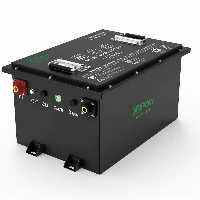
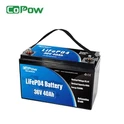
48V 100Ah lithium-ion batteries are suitable for a wide range of applications, including solar energy storage or backup power systems, electric golf carts, RVs, boats, electric forklifts, AGVs, and industrial equipment such as cleaning machines. Different applications have varying requirements for battery runtime and service life.
let's take a brief look at:
| 48V 100Ah Lithium Battery Application | Typical Equipment / Usage | Approx. Runtime / Range |
|---|---|---|
| Golf Cart Battery | Club Car Precedent, Onward, EZGO RXV/TXT, Yamaha Drive2 | 40–50 miles (65–80 km); about 30–40 miles under heavy loads or frequent hill climbing |
| Solar Energy Storage Battery | 100W low-power loads | About 40 hours |
| Solar Energy Storage Battery | 500W basic household loads | About 7–8 hours |
| Solar Energy Storage Battery | 1,000W+ high-power loads | About 3–4 hours |
| RV Battery | Lighting, refrigerator, router, TV, and other basic appliances | About 12–30 hours; typically 1–2 days |
| RV Battery | Air conditioner, induction cooker, and other high-power appliances | About 2–4 hours |
| Marine Auxiliary Battery | GPS, fish finder, lighting, refrigerator, communication equipment | About 13–40 hours |
| Marine Propulsion Battery | 500W trolling motor | About 6–7 hours |
| Marine Propulsion Battery | 1,000W marine motor | About 4 hours |
| Industrial Lithium Battery | AGVs, AMRs, industrial cleaning equipment | About 4–8 hours |
| Material Handling Battery | Electric pallet trucks and light-duty industrial vehicles | About 3–6 hours |
| Forklift Battery | 48V electric forklift | 100Ah is relatively small and generally insufficient for a full work shift |

How Far Can a 48V 100Ah Lithium Battery Go and How Long Will It Last?
Now that we have a basic understanding of the runtime and range of a 48V 100Ah lithium-ion battery, we will provide a comprehensive overview based on the typical usage scenarios for this battery specification to see exactly how long a 48V 100Ah lithium-ion battery lasts in different applications.
How Far Can a 48V 100Ah Lithium Golf Cart Battery Go on a Full Charge?
This battery is compatible with 48V golf cart models such as the Club Car Precedent, Club Car Onward, EZGO RXV, EZGO TXT, and Yamaha Drive2. Under standard driving conditions, this battery provides a range of 40–50 miles (65–80 kilometers). If the vehicle is carrying a heavy load, frequently climbing hills, or has been modified, the actual range may be reduced to 30–40 miles.
48V 100Ah Lithium Golf Cart Battery Range by Model and Driving Conditions
| Golf Cart Model | Driving Conditions | Range with 48V 100Ah Lithium Battery |
|---|---|---|
| Club Car Precedent | Standard golf course driving, flat roads | 40–50 miles (65–80 km) |
| Club Car Onward | 2–4 passengers, leisure driving | 35–50 miles (55–80 km) |
| EZGO RXV | Golf courses, community transportation | 40–50 miles (65–80 km) |
| EZGO TXT 48V | Standard use, light modification | 35–45 miles (55–70 km) |
| Yamaha Drive2 | Flat roads, normal driving | 40–50 miles (65–80 km) |
| Modified / Heavy Load Golf Carts | Larger tires, hill climbing, heavy cargo | 30–40 miles (50–65 km) |

How Long Can a 48V 100Ah Lithium Solar Battery Provide Backup Power?
The rated energy storage capacity of a 48V 100Ah lithium solar storage battery is approximately 5.12 kWh (51.2V × 100Ah). Calculated at an 80% depth of discharge, the usable energy is approximately 4 kWh. If used solely to power low-power devices such as lighting, routers, and surveillance systems (approximately 100W), a single 48V 100Ah lithium battery can operate continuously for about 40 hours.
If used for basic household electricity needs (such as a refrigerator, TV, computer, and lighting), with a total power consumption of approximately 500W, this battery can provide power for about 7–8 hours; if used to power high-power appliances such as air conditioners and electric heaters (over 1,000W), this battery will only last for about 3–4 hours.
For typical off-grid living, a 48V 100Ah battery is considered a relatively high-end option, but in many cases, we still primarily use 12V and 24V solar batteries.
48V 100Ah Lithium Solar Battery Backup Time Under Different Loads
| Load Power | Applications | Approximate Backup Time |
|---|---|---|
| 100W | LED lights, WiFi router, security cameras, small electronics | About 40 hours |
| 300W | Refrigerator, lighting, router, small household devices | About 13 hours |
| 500W | TV, computer, refrigerator, lighting, basic household loads | About 7–8 hours |
| 1,000W+ | Air conditioner, electric heater, high-power appliances | About 3–4 hours |
How Long Can a 48V 100Ah Lithium RV Battery Last on a Full Charge?
If the battery is only used to meet basic electrical needs in an RV (such as LED lighting, cell phone charging, routers, small refrigerators, etc.), with total power consumption typically ranging from 100 to 300W, a single 48V 100Ah lithium battery can provide 12–30 hours of runtime.
In a typical RV usage scenario, where the refrigerator, lighting, TV, computer, water pump, and other devices are running simultaneously-consuming about 2–3 kWh of electricity per day-this battery will last approximately 1–2 days.
If high-power devices such as air conditioners, induction cooktops, or electric kettles need to be powered-since these devices consume significant amounts of electricity-the battery may only last a few hours.
For example, a motorhome equipped with a 48V 100Ah battery connected to a 1,200W air conditioner via an inverter can theoretically run for only about 3 hours. If the air conditioner is not used and only daily-use appliances are operated, the runtime will be further extended.
48V 100Ah Lithium RV Battery Runtime Under Different Power Loads
| Usage Scenario | Loads | Power Consumption | Estimated Runtime (48V 100Ah Lithium RV Battery) |
|---|---|---|---|
| Low-power RV usage | LED lights, phone charging, router, small refrigerator, etc. | 100–300W | 12–30 hours |
| Daily RV living | Refrigerator, lighting, TV, computer, water pump, and other basic appliances | 2–3 kWh/day | About 1–2 days |
| Medium-power usage | Multiple appliances running simultaneously, occasional small appliances | 500–800W | About 5–8 hours |
| High-power appliance usage | Air conditioner, induction cooktop, electric kettle, etc. | 1,000W+ | About 2–4 hours |
| RV air conditioner example | 1,200W air conditioner powered through an inverter | 1,200W | About 3 hours |
How Long Can a 48V 100Ah Lithium Marine Battery Run on a Full Charge?
In marine applications, the service life of a 48V 100Ah lithium marine battery primarily depends on the types of electrical equipment on board and how the battery is used-that is, whether it serves as an auxiliary power source or as a propulsion battery.
When used as an auxiliary power source for navigation equipment, GPS, fish finders, lighting, communication equipment, audio systems, and refrigerators, the total power consumption is approximately 100 to 300 watts. Under these conditions, a 48V 100Ah lithium battery can provide power for 13 to 40 hours.
If multiple onboard devices are running simultaneously-such as a refrigerator, lighting, electronic devices, and small appliances-with a total power consumption of approximately 500 W, the battery can provide power for 7 to 8 hours.
If used to power the propulsion system of an electric boat or a trolling boat, the runtime will be much shorter because the power of the motor is significantly greater than that of ordinary appliances. If a 48V 100Ah lithium battery is used to power a 500W trolling motor, it will last approximately 6–7 hours; if used to power a 1000W marine motor, the runtime will be only about 4 hours.
48V 100Ah Lithium Marine Battery Runtime Under Different Applications
| Application Scenario | Loads | Power Consumption | Estimated Runtime (48V 100Ah Lithium Marine Battery) |
|---|---|---|---|
| Auxiliary power supply | GPS, fish finder, navigation equipment, lighting, communication devices, audio systems, refrigerator, etc. | 100–300W | 13–40 hours |
| Normal onboard electricity usage | Refrigerator, lighting, electronic devices, small appliances running simultaneously | Around 500W | 7–8 hours |
| Electric boat / trolling motor (light propulsion) | 500W trolling motor | 500W | 6–7 hours |
| Electric boat propulsion | 1,000W marine motor | 1,000W | About 4 hours |
How Long Can a 48V 100Ah Lithium Industrial Battery Last on a Full Charge?
When used in small- to medium-sized industrial equipment such as AGVs (Automated Guided Vehicles), AMR robots, cleaning equipment, and electric material handling equipment, it can operate continuously for 4 to 8 hours.
For example, while a 48V 100Ah battery can be used in a forklift, its capacity is relatively small; at least 300Ah is required to complete a single loading operation, whereas this 100Ah battery can only support 13 hours of operation.
48V 100Ah Lithium Industrial Battery Runtime by Application
| Industrial Application | Equipment | Typical Power Demand | Estimated Runtime |
|---|---|---|---|
| Automated logistics | AGVs / AMRs | Low to medium | 4–8 hours |
| Industrial cleaning | Floor scrubbers / sweepers | Low to medium | 4–8 hours |
| Material handling | Electric pallet trucks / stackers | Medium | 3–6 hours |
| Light industrial equipment | Mobile work platforms / utility equipment | Medium | 3–6 hours |
| Electric forklifts | Small electric forklifts | High | About 1–3 hours |

How Long Is the Service Life of a 48V 100Ah Lithium Battery?
The physical service life of a 48V 100Ah lithium-ion battery is approximately 5–10 years. The reason it can last this long is that we're talking about a LiFePO4 battery. With over 6,000 charge-discharge cycles, even 5 years is actually a conservative estimate. It can last at least 8 years-this is from a general perspective and represents the basic service life for a battery of this specification.
However, considering the different application scenarios we mentioned earlier, the actual service life will vary depending on usage patterns and habits. Some people may only use it for 5 years, while others may use it for 10 years-this is due to differences in usage patterns and habits.
Next, let's explore this further.
How Long Does a 48V 100Ah Lithium Golf Cart Battery Last?
A 48V 100Ah lithium iron phosphate battery for a golf cart has a physical service life of 6 to 10 years.
If you follow good usage practices-such as discharging the battery only 30% to 70% of its capacity each time-you can significantly extend the number of charge cycles.
The number of charge cycles is closely related to the battery's service life. Under these conditions, the battery's service life can indeed reach the 8 years-or even more than 10 years-advertised by the manufacturer.
How Long Does a 48V 100Ah Lithium Solar Battery Last?
The physical service life of a 48V 100Ah lithium-ion solar energy storage battery is approximately 8–12 years. Since solar energy storage systems generally do not undergo frequent high-current discharges like power batteries do, and their operating environments are relatively stable and less demanding, their service life is longer than that of power batteries used in golf carts and forklifts.
When used in small-scale solar backup power systems (such as those powering low-power devices like lighting, surveillance cameras, routers, and communication equipment), the battery's depth of discharge is shallow and the cycling stress is low, so its service life can even reach 10–12 years.
However, when used in off-grid residential applications that require daily power for high-power appliances such as refrigerators, air conditioners, and water pumps, the battery's actual service life is typically between 8 and 10 years.
How Long Does a 48V 100Ah Lithium RV Battery Last?
The physical service life of a 48V 100Ah lithium RV battery ranges from 8 to 12 years. Similar to solar storage batteries, it is classified as an energy storage battery and is more durable than power batteries. Under conditions of daily discharge from 0% to 80% capacity, the actual service life can reach 8 to 10 years. If you only travel seasonally, with limited usage each year, few battery cycles, and maintain an appropriate charge level during long-term storage, the battery's service life may exceed 10 years.
If you live in your motorhome and use the battery daily to power high-power equipment such as the fridge, lighting, inverter, electronic devices and air conditioning, a lithium iron phosphate battery will still last for 6–8 years.
How Long Does a 48V 100Ah Lithium Marine Battery Last?
Marine batteries have a shorter service life than other types of batteries. A 48V 100Ah lithium marine battery typically lasts between 5 and 10 years, depending on whether you have purchased a deep-cycle marine battery or a marine starter battery. If the battery is primarily used to power on-board equipment such as GPS, fishfinders, lighting, communication devices and refrigerators, it can generally last for 8 to 10 years under normal conditions, as the discharge rate is low and the cycling stress is relatively minimal.
However, if used as a power source for trolling motors or electric boat propulsion systems-involving prolonged high-current discharge and deep charge-discharge cycles after every voyage-the battery's actual service life will be reduced to 5–8 years. Furthermore, as the marine environment is particularly harsh, high humidity, salt spray, high temperatures and constant vibration can affect the service life of the battery terminals, connectors, battery management system and the enclosure's sealing structure.
Consequently, even if the consistency of the internal LiFePO4 cells remains good, it is possible that the battery will need replacing after around five years if adequate waterproofing and corrosion protection measures are not in place.
How Long does it Take to Charge 48V 100AH Lithium Battery?
The charging time for a 48V 100Ah lithium battery depends entirely on the output current (Amps, A) of the charger you are using.
The basic formula is: Charging Time (Hours) = Battery Capacity (Ah) / Charging Current (A).
Here are the estimated charging times for common charger sizes:
- Standard Charging (10A Charger): Takes about 10 to 11 hours. This is ideal for overnight charging and is very gentle on the battery's lifespan.
- Mainstream Charging (20A Charger): Takes about 5 to 6 hours. This is the most common "balanced" option for 48V system users.
- Fast Charging (50A Charger): Takes about 2 to 2.5 hours. Lithium batteries typically support high-rate charging, but you must ensure your charger and BMS (Battery Management System) are rated for this current.
Real-World Factors to Consider
In practice, charging usually takes 30 to 60 minutes longer than the theoretical calculation. This is because lithium charging occurs in two stages: the Constant Current (CC) stage covers the first 80–90% rapidly, while the final Constant Voltage (CV) stage slows down the current to safely top off the cells. Additionally, extreme cold or heat may trigger the BMS to limit charging speeds for safety.
Is 48V 100Ah Enough for Your Application?
A 48V 100Ah lithium battery theoretically stores 4.8 kWh of energy. If used solely as a home backup power source, it can easily power appliances like a refrigerator, lights, and a computer for most of the day. However, if you attempt to run high-power devices such as air conditioners or electric water heaters, this single battery might be depleted in less than two hours.
In the realm of electric vehicles, it handles daily short commutes or covering 40 to 60 kilometers on a golf course with ease.
That said, if you live in an off-grid cabin or need to withstand several consecutive days of cloudy weather, 100Ah is merely an entry-level configuration; connecting multiple batteries in parallel may be necessary for reliability. The most prudent approach is to sum up the wattage of all your appliances, reserve a 20% safety buffer, and determine whether the approximately 4 kWh of usable capacity can cover your energy deficit.
Ultimately, when it comes to batteries, bigger is better-especially when you cannot recharge at will, as extra capacity equals peace of mind.
Conclusion
From powering golf carts over hills to keeping the last light on in an off-grid cabin, the 48V 100Ah lithium battery has proven itself to be the most reliable power partner of today. In practical applications, the duration of your power supply lies entirely in how you manage your load.
Remember: by reasonably reserving a 20% capacity buffer and pairing your system with a high-efficiency charger, your energy anxiety will vanish. Now is the time to start building your own efficient 48V power system based on your actual energy consumption list.
FAQ
How Long Will a 48V 100Ah Lithium Battery Power 4 TVs?
A 48V 100Ah lithium-ion battery provides a nominal energy capacity of approximately 4.8 kWh. If four televisions each consume around 100W, the total load is about 400W, which theoretically allows for up to 12 hours of operation.
In real-world conditions, however, factors such as inverter efficiency and system losses will reduce runtime, resulting in an estimated operating time of approximately 9 to 11 hours. If the televisions consume less power, the runtime can be extended accordingly.
How Long Does a 48V Battery Last on a Full Charge?
For example, a 48V 100Ah battery pack provides approximately 4.8 kWh of energy. When connected to a 500W load, it can deliver around 9 to 10 hours of runtime; with a 1000W load, the runtime is typically about 4 to 5 hours.
How Long Will a 48V 15Ah Battery Last?
A 48V 15Ah battery provides a nominal energy capacity of approximately 0.72 kWh (720 Wh). Its runtime depends on the connected load. For example, it can power a 100W device for about 6 to 7 hours, or a 300W device for approximately 2 to 2.5 hours.
Recommended Reading: How Long Will a 100Ah Battery Run a Trolling Motor?
How Many kWh Is a 48V 100Ah Lithium Battery?
To calculate the kWh capacity of a 48V, 100Ah lithium-ion battery, use the following formula: Battery energy (kWh) = Battery voltage (V) × Battery capacity (Ah) ÷ 1000. Therefore, the kWh capacity of a 48V battery is approximately: 48V × 100Ah ÷ 1000 = 4.8 kWh.
It is important to note that for a 48V LiFePO4 battery, the voltage must be converted to 51.2V, resulting in: 51.2V × 100Ah ÷ 1000 = 5.12 kWh. Given that the actual utilization rate of lithium iron phosphate batteries ranges from 80% to 90%, their kWh capacity is approximately 4.1 to 4.6 kWh.
How Long Can a 100Ah Lithium Battery Last?
Before calculating the runtime of a 100Ah battery, you must first calculate the energy stored in the battery. The formula is: Runtime (hours) = Battery Voltage (V) × Battery Capacity (Ah) × Discharge Efficiency ÷ Load Power (W).
For example, for a 12V, 100Ah lithium iron phosphate battery, the theoretical energy storage is 12.8V × 100Ah = 1.28 kWh. If a 100W device is connected, assuming 90% usable capacity, the theoretical runtime is approximately 1.28 kWh × 90% ÷ 0.1 kW ≈ 11.5 hours; if a 500W device is connected, the theoretical runtime is approximately 1.28 kWh × 90% ÷ 0.5 kW ≈ 2.3 hours.
For a 48V, 100Ah lithium-ion battery, due to its higher voltage, the theoretical energy storage capacity is 51.2V × 100Ah = 5.12 kWh. Assuming 90% usable capacity, if a 500W load is connected, the battery can sustain operation for approximately 9 hours (5.12 kWh × 90% ÷ 0.5 kW ≈ 9 hours).