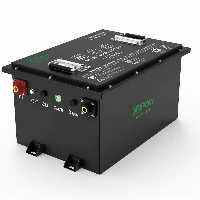
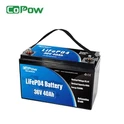
Finding the perfect trolling motor battery (100Ah) for your needs is key to keeping your boat on the water all day rather than getting stranded halfway.
But the question remains: Can 100Ah of energy sustain a full day of deep-water searching, or will it only allow for short trips near the shore? Does switching from lead-acid to LiFePO4 truly double your range?
This article unveils the secrets behind these figures. Through real-world current consumption analysis and scientific range formulas, we will guide you to the optimal matching solution for a 100Ah battery and a 55-lb thrust motor, giving you the confidence to head out on your next trip fully prepared.

What Determines How Long a 100Ah Battery Can Run a 55lb Trolling Motor?
How long a 100Ah battery can run a 55-lb thrust motor ultimately depends on your power consumption rate and the battery's usable capacity.
First, consider your throttle setting. On a 12V system, a 55-lb motor draws approximately 50 amps at full speed, but only 5–10 amps at low trolling speeds. Your throttle choice directly determines whether the battery drains in a few hours or lasts all day.
Next, factor in the battery chemistry:
- Lead-Acid: Although rated at 100Ah, you should only discharge them to 50% to avoid damage, leaving just 50Ah of usable capacity.
- Lithium-Ion: These are far more honest, allowing you to utilize nearly the full 100Ah, effectively doubling your runtime compared to lead-acid.
Environmental conditions are also critical variables. A heavily loaded boat or fighting headwinds and rough waves forces the motor to work harder, causing power consumption to spike.
Finally, consider the motor technology. Motors equipped with digital variable speed controllers are significantly more efficient at partial throttles than older resistive-speed models, helping you squeeze out extra runtime.
How Many Amps Does a 55lb Trolling Motor Draw?
The power consumption of a 55-lb thrust motor operating on a 12V system depends entirely on your throttle setting.
If you push the throttle to full speed, the current draw spikes to its maximum, typically 45-50 amps.
However, since you rarely run at full throttle continuously, dropping to a medium cruising speed usually reduces the current draw to around 15–25 amps.
When operating in low-speed mode, slowly trolling along the shoreline while fishing, the power consumption is minimal, drawing only about 5–10 amps.

Runtime Calculation Formula for a 100Ah Trolling Motor Battery
To accurately calculate how long a 100Ah battery can power a 55-lb thrust motor, first determine the motor's current draw and factor in the battery's actual usable capacity.
1. Basic Theoretical Formula
In an ideal scenario, runtime (in hours) is calculated by dividing the battery capacity by the motor's current draw:

2. Practical Formula Incorporating "Depth of Discharge" (DoD)
In reality, a battery should not be completely depleted (especially lead-acid types). To preserve battery health, we introduce a DoD coefficient:
- Lead-Acid/AGM Batteries: Recommended usage is only 50% of capacity (coefficient of 0.5).
- Lithium (LiFePO4) Batteries: Can utilize 90%–100% of capacity (coefficient of 0.9–1.0).
The Revised Practical Formula:

How Long Will a 100Ah Trolling Motor Battery Last at Different Speeds?
How long a 100Ah battery can power a 55-lb thrust motor entirely depends on how you handle the throttle. The motor's power consumption doesn't increase linearly; the higher the gear, the steeper the current spike.
In low-speed cruising mode, the motor acts like it's jogging, drawing minimal current, allowing the battery to last all day without issue. However, if you impatiently push to full speed, the current surges to its peak, placing exponential stress on the battery and slashing your runtime to a fraction of what you'd get at slower speeds.
1. Full Speed (Setting 5 / 100% Power)
At the highest setting, a 55lb motor typically hits its peak current draw of 50A.
- Lead-Acid/AGM Battery (50% DoD): Approx. 1 Hour.
- Lithium Battery (100% DoD): Approx. 2 Hours.
- Note: Continuous full-speed operation depletes power rapidly and generates significant heat, which can stress both the motor and the battery.
2. Medium Cruising (Setting 3 / 50% Power)
This is the most common setting, balancing travel speed with energy conservation. Current draw usually drops to around 15-25A.
- Lead-Acid/AGM Battery (50% DoD): Approx. 2 - 2.5 Hours.
- Lithium Battery (100% DoD): Approx. 4 - 5 Hours.
3. Low-Speed Trolling (Setting 1-2 / 10%-20% Power)
Used for precise boat positioning or slow trolling, the current draw is very low, typically around 5A.
- Lead-Acid/AGM Battery (50% DoD): Approx. 10 Hours.
- Lithium Battery (100% DoD): Approx. 20 Hours.
Runtime Comparison Table (12V 100Ah)
| Speed Setting | Est. Current Draw | Lead-Acid Runtime (Rec.) | Lithium Runtime (Max) |
| Full Speed (100%) | 50 Amps | 60 Minutes | 120 Minutes |
| Medium Speed (50%) | 20 Amps | 150 Minutes | 300 Minutes |
| Low Speed (10%) | 5 Amps | 10 Hours | 20 Hours |
Lithium vs Lead-Acid - Which Lasts Longer With a 55lb Motor?
When driving a motor with 55 lbs of thrust, lithium iron phosphate batteries indeed offer significantly better real-world range and overall performance compared to lead-acid batteries.
Although both may be rated at 100 amp-hours, their discharge mechanisms differ fundamentally: LiFePO4 batteries can utilize their stored energy much more completely, whereas lead-acid batteries often struggle under heavy loads.
1. Usable Capacity (Depth of Discharge)
This is the most critical factor determining how long your motor stays running:
- Lead-Acid Batteries: A Depth of Discharge (DoD) of only 50% is recommended. Frequent discharges beyond this significantly shorten the battery's lifespan. This means a 100Ah Lead-Acid battery effectively provides only 50Ah of real power.
- Lithium Batteries: These allow for 90%-100% depth of discharge without damage. This means a 100Ah Lithium battery provides nearly its full 100Ah capacity.
- Conclusion: At the same nominal capacity, a Lithium battery delivers nearly double the runtime of a Lead-Acid battery.
2. Voltage Stability (Thrust Performance)
- Lead-Acid Batteries: Voltage drops steadily as the battery drains. You will notice your boat slowing down; that 55lb of thrust might feel like 40lb when the battery is half empty.
- Lithium Batteries: The voltage curve is very flat. They maintain high voltage until the very last 5–10 minutes of charge, ensuring your motor maintains consistent 55lb peak thrust throughout the trip.
3. Weight's Indirect Impact on Runtime
- Lead-Acid Batteries: A 100Ah unit weighs roughly 25–30kg (55–66 lbs).
- Lithium Batteries: An equivalent Lithium unit weighs only 10–12kg (22–26 lbs).
- Conclusion: Shedding over 15kg (33 lbs) from your boat results in a shallower draft and less water resistance. This allows the motor to draw less current at the same speed, indirectly extending your runtime.
| Feature | Lead-Acid / AGM Battery | Lithium (LiFePO4) |
| Actual Usable Capacity | Approx. 50Ah | Approx. 100Ah |
| Full Speed Runtime | Approx. 1 Hour | Approx. 2 Hours |
| Thrust Degradation | Weakens significantly as battery drains | Constant powerful thrust throughout |
| Cycle Life | 300 - 500 Cycles | 3,000 - 5,000+ Cycles |
| Weight | Heavy (Approx. 28kg) | Lightweight (Approx. 11kg) |
How to Extend Runtime on a 55lb Trolling Motor?
To maximize the runtime of a 55-lb thrust motor, the most effective strategy is to avoid running at full throttle. Since current consumption spikes dramatically with speed, slightly reducing your speed can significantly extend your range. If your motor supports stepless (variable) speed control, low-speed cruising will be far more energy-efficient than with standard motors.
On the hardware side, a LiFePO4 battery is a game-changer for endurance. It allows for deeper discharge and is extremely lightweight, making the boat sit higher in the water and move more effortlessly.
Additionally, regularly clearing weeds and fishing line from the propeller reduces unnecessary strain on the motor. Combined with balanced weight distribution and navigating with the current, these practices ensure every bit of battery power is used to maximum effect.
Is 100Ah Enough for a Full Day of Fishing?
For a 55-lb thrust motor, whether a 100 amp-hours (Ah) lasts a full day depends entirely on your fishing style and battery type. If you use a LiFePO4 battery and primarily operate at low to medium speeds for positioning or short moves on calm water, running for 6 to 10 hours is typically no problem.
However, with a traditional lead-acid battery, you can only safely utilize about 50% of the capacity, leaving you with effectively only 50 Ah. In scenarios involving headwinds or long-distance travel, this might drain in just 3 to 4 hours.
In practice, if you prefer hunting for fish at full speed or battling strong winds and currents, that amount of power could be exhausted by noon. Conversely, if you spend most of your time anchored and only occasionally adjust your heading, 100 Ah will be more than sufficient.
When Should You Upgrade to a 200Ah Trolling Motor Battery?
Although 100 amp-hours (Ah) is the standard choice for many anglers, upgrading to 200 Ah shifts from being an option to a necessity in certain scenarios.
If you frequently fish on large bodies of water with strong winds and waves, or need to hold position against powerful currents all day, doubling your capacity ensures the motor won't run out of power during the most critical afternoon hours.
1. Extreme Weather and Strong Currents
If you frequently fish in high winds, heavy chop, or swift currents, your 55lb motor must constantly run at high settings just to maintain position. This high-intensity current draw (40-50A) can drain a 100 Ah battery in as little as 2 hours. Upgrading to 200Ah ensures you have a sufficient "safety reserve" to get back to the dock in rough conditions.
2. Marathon Sessions and Long-Distance Scouting
If you fish on massive reservoirs or open lakes and move frequently to find fish, a 200Ah battery provides double the cruising range. This lets you explore remote "secret spots" without the constant anxiety of checking your battery gauge.
3. Multi-Day Trips or Limited Charging Access
For multi-day camping/fishing trips where shore power isn't available, a 200Ah battery acts as a massive power station. It can support two days of moderate use or power auxiliary electronics like fish finders and mobile devices via an inverter without jeopardizing your primary propulsion.
4. Protecting Lead-Acid Longevity
If you prefer Lead-Acid/AGM batteries, remember the 50% Depth of Discharge (DoD) rule. A 100Ah Lead-Acid battery only offers 50Ah of usable power, which is tight for a full day. Stepping up to a 200Ah Lead-Acid unit gives you 100Ah of effective capacity while preventing the premature death caused by deep discharging.
100Ah vs. 200Ah Runtime Comparison (Based on Lithium)
| Operating State | 100Ah Lithium Runtime | 200Ah Lithium Runtime |
| Full Speed (High) | ~2 Hours | ~4 Hours |
| Medium Cruising | ~5 Hours | ~10 Hours |
| Low-Speed Trolling | ~20 Hours | ~40 Hours |
Conclusion
Ultimately, the performance of a trolling motor battery depends not just on its labeled capacity, but on your wisdom in power management. For a 55-lb thrust motor, a 100Ah battery can be a reliable companion lasting an entire day in calm waters at low speeds, yet it might leave you stranded within an hour if you run at full throttle against strong winds.
As our analysis reveals, while a 100Ah lead-acid battery meets basic needs, Lithium Iron Phosphate batteries have become the top choice for modern lure anglers and fishing enthusiasts thanks to their deep-discharge capabilities and lightweight design.
By understanding the non-linear relationship between current consumption and speed, and learning to make rational choices between 100Ah and 200Ah based on your frequency of outings and environmental demands, you can fully master your time on the water. We hope this guide helps you pinpoint the perfect power solution, so every cast you make is worry-free.
FAQ
Is a 100Ah Battery Enough for a Trolling Motor?
A 100Ah battery is usually enough for a trolling motor, especially at low speeds. But in rough conditions or at higher power levels, it may run out faster-so upgrading to a larger capacity is often a better choice.
What Size Battery Do You Need for a 55 lb Thrust Trolling Motor?
A 55 lb thrust trolling motor runs on 12V, and you'll need at least a 12V 50Ah deep-cycle battery-though a higher capacity is recommended for longer runtime.
Recommended Reading: How Long Will A 24V 100Ah Battery Last?