If you've ever experienced the awkward moment of a sluggish engine start in the middle of a lake or out at sea, you'll understand that a marine battery is far more than just a plastic box tucked away in the bilge.
Faced with complex technical terms, from BCI groups to lithium iron phosphate chemistry, blindly following trends often leads to waste or mismatched performance.
This guide is designed to cut through the confusion. By thoroughly analyzing battery chemistry, capacity specifications, maintenance principles, and replacement cycles, it will help you make the most informed decision from the many options available.

Where Should You Start When Choosing a Marine Battery?
Before selecting a marine battery, it is essential to fully understand your boat's specific requirements.
The safest approach is to consult the owner's manual to confirm the engine's required starting current and the dimensions of the battery compartment, as these are fundamental criteria for selection.
If your current setup is working well, the simplest solution is to replace the old battery with one of the same model.
However, if your boating needs have changed, you will need to reassess.
For example, if you've added power-hungry equipment such as a fish finder, audio system, or trolling motor, if you're looking to switch to a lighter battery to improve speed and fuel efficiency, or if you frequently navigate rough waters and require greater shock resistance, these factors all necessitate upgrading your battery specifications.
In such cases, a dual-purpose battery is an excellent choice. It can provide both the high-power surge required for starting and a continuous, stable power supply for electronic equipment, a particularly valuable feature for small boats with limited space.
However, if your system involves multiple battery banks connected in parallel or complex charging logic, it is best to have a professional marine electrician review the system to ensure proper voltage matching and circuit safety, giving you peace of mind.

Marine Battery Types: Which One Is Right for Your Boat?
When selecting the right power source, it is essential to understand the functional differences among battery types.
A vessel's electrical requirements are typically divided into two categories: starting power and continuous power. This has led to the development of three core types of batteries:
Starting Batteries
These batteries are designed for specific tasks and can deliver a massive current in a very short period of time (typically measured in CCA or MCA) to start outboard or inboard engines.
To achieve this burst of power, the batteries feature a design with large-area, thin lead plates.
However, the weakness of these batteries lies in their lack of tolerance for deep discharge. If a starter battery is used for an extended period to power lighting equipment, fish finders, or audio systems, its service life will be rapidly shortened. This is because starter batteries are designed primarily to serve as the system's "igniter."
Deep Cycle Batteries
In stark contrast, deep-cycle batteries are designed for "marathon-style" power delivery.
Featuring thicker plates and more robust internal components, they can withstand repeated deep discharges (typically down to 80% or lower) without compromising their long-term performance.
As a result, they are ideal for powering trolling motors, freshwater pumps, fish finders, and other onboard electrical systems.
Although they may not be able to deliver the high instantaneous current required to start large engines, they ensure that electronic equipment remains stable and reliable during extended voyages.
Dual-Purpose Batteries
This battery offers a compromise by balancing starting power and cycle life.
For small fishing boats or yachts with extremely limited space and no room for two separate battery banks, this type of battery is an ideal choice.
Although dual-purpose batteries cannot match the starting power of dedicated starter batteries or the exceptionally long lifespan of pure deep-cycle batteries, they remain a versatile, space-saving choice for boat owners with moderate electrical loads.

Marine Battery Chemistry Explained
The chemical properties of marine batteries determine their maintenance costs, overall service life, and performance in extreme underwater environments.
In the modern maritime sector, the following three technical approaches are primarily used:
Flooded Lead Acid (FLA)
This is the option that offers the best value for money, but it also requires the most maintenance, as these batteries need to be topped off with distilled water regularly and kept upright to prevent acid leakage.
They are sensitive to vibration, and the depth of discharge should not exceed 50%, making them best suited for recreational boaters looking to keep initial costs low.
Gel & AGM Batteries
These "maintenance-free" sealed batteries are leak-proof and highly resistant to shock and vibration.
AGM (Absorbed Glass Mat) batteries charge faster than traditional lead-acid batteries and can be installed at virtually any angle.
They are a reliable and ideal choice for powerboats and deep-sea fishing.
LiFePO4 Lithium Batteries
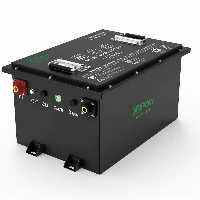
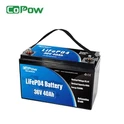
LiFePO4 batteries are the ultimate "game-changer" in modern marine applications. They are 70% lighter than lead-acid batteries, have a lifespan up to 10 times longer (with over 3,000 charge cycles), and can be safely discharged to 100%.
These batteries can deliver full power output continuously until they are completely depleted. Therefore, for serious anglers and electric trolling motor users, lithium iron phosphate batteries represent the best long-term investment.

FLA vs LiFePO4: Which One Is Better?
When comparing wet-cell lead-acid batteries and lithium iron phosphate (LiFePO₄) batteries, their distinct characteristics determine their suitability for different maritime applications.
In terms of purchase price alone, lead-acid batteries are very inexpensive, while lithium iron phosphate batteries often cost several times more.
This makes lead-acid batteries the preferred choice for boat owners on a tight budget or those who only need a short-term solution.
However, in the long run, LiFePO4 batteries can withstand 3,000 to 5,000 charge-discharge cycles-approximately ten times the lifespan of lead-acid batteries-thereby significantly reducing daily operating costs.
In terms of weight, LiFePO4 batteries also offer a significant advantage. For the same capacity, they weigh 60% to 70% less than lead-acid batteries.
This is crucial for vessels where speed, fuel efficiency, or weight control are priorities.
Regarding usable capacity, it is generally recommended that lead-acid batteries be discharged only to 50% to prevent plate damage.
In contrast, lithium iron phosphate batteries can be safely discharged to near full capacity while maintaining a stable voltage. This means their actual usable capacity is nearly double that of lead-acid batteries.
Although many standard-sized lithium batteries on the market can directly replace older batteries, boat owners should still verify charger compatibility before replacing them, as lithium batteries require specific charging curves.
Finally, regarding recycling, lead-acid batteries benefit from the world's most mature recycling infrastructure, with a recycling rate of nearly 100%.
Although lithium iron phosphate batteries do not contain heavy metals and are more environmentally friendly, their large-scale commercial recycling supply chain is still under development.

What Size Marine Battery Do You Need?
When determining battery specifications, we should first refer to the group size standards set by the Battery Council International (BCI). Common battery group sizes include 24, 27, and 31.
However, it is important to clarify a common misconception: many people believe that a larger group size indicates a higher battery capacity.
In reality, there is no direct correlation between a battery's physical size and its capacity.
This is particularly evident with lithium-ion batteries, whose high energy density largely defies this traditional rule.
Therefore, the safest approach when purchasing is to rely on the manufacturer's stated actual amp-hour (Ah) rating.
Regarding the actual installation, there are strict space limitations within the battery compartment.
Therefore, before placing an order, measure the length, width, and height of the battery compartment, and allow sufficient space for terminal connections.
As long as space permits, it is recommended to choose the largest battery size possible, as a larger power reserve provides greater peace of mind during long-distance travel.

Best Practices for Maintaining Marine Batteries
Proper maintenance extends battery life and ensures safety on the water.
- Charging Discipline: Always recharge immediately after use. Keep lead-acid batteries above 50% charge to prevent damage. For lithium batteries, avoid leaving them at 0% for long periods; a 40%–60% charge is ideal for storage.
- Smart Monitoring: Use batteries with App management or monitoring systems to track voltage and capacity in real-time. If switching to lithium, verify your charger's compatibility to ensure safe and efficient charging.
- Safety Backup: Prevention is key. Beyond routine maintenance, keep contact info for Sea Tow or emergency services handy in case of an unexpected power failure offshore.
When Should You Replace a Marine Battery?
Before deciding whether to replace the battery, check it for signs of aging.
The most obvious signs include: the engine no longer starting as smoothly as before, or the vehicle's electronic devices draining power too quickly, even though the battery appears fully charged. If these signs are present, it indicates that the battery's capacity has declined.
If you notice swelling or cracking of the battery casing, or persistent severe corrosion around the terminals, this indicates potential overheating or leakage inside the battery. For safety reasons, the battery must be replaced immediately.
For lead-acid batteries, a load test can detect potential issues.
If the battery cannot maintain its voltage under load or fails to reach the standard voltage even after a prolonged charge, it is likely at the end of its service life.
Due to the unique nature of the marine environment, even if a battery appears to be functioning normally, proactively replacing it after 3–5 years for lead-acid batteries or 8–10 years for lithium batteries remains the safest and most reliable way to ensure safety. This helps prevent situations in which the vessel becomes stranded at sea due to a sudden battery failure during navigation.
FAQ
How Do I Know What Size Lithium Marine Battery Fits My Boat?
First, the battery voltage must match the boat's electrical system-common options include 12V, 24V, and 36V. Otherwise, the onboard equipment may not operate properly.
Next, determine the required battery capacity based on the total power consumption of your devices. Battery capacity (Wh) is calculated as voltage multiplied by ampere-hours (Ah). Dividing this capacity by the total load power provides an estimate of runtime. In general, the higher the power consumption, the shorter the runtime, and the larger the required Ah capacity.
It is also important to ensure that the battery's continuous discharge current is sufficient to support high-power equipment such as trolling motors. If the discharge capability is insufficient, the battery may trigger protection and shut down.
Finally, consider practical factors such as whether the battery dimensions fit the available compartment and whether it is designed for marine environments, including waterproofing and resistance to salt spray.
Which Lithium Marine Battery Suppliers Are Not Suitable for Large Vessel Applications?
For large-scale marine applications, certain lithium-ion battery suppliers may be unsuitable. In general, these include suppliers that lack classification society certifications-such as DNV or ABS-as well as those without proven experience in high-voltage or high-capacity system integration.
Suppliers that cannot deliver stable high-current output (e.g., 300A or above), or that have insufficient thermal management and limited redundancy in their Battery Management System (BMS) design, also present significant risks. In addition, products that lack verified marine-grade protection-such as compliance with IP67 or IP68 standards for waterproofing and salt spray resistance-should be approached with caution.
Furthermore, suppliers whose solutions have not been validated under long-term high-temperature and high-humidity conditions, or who lack a track record in large-vessel projects, as well as robust after-sales service and technical support capabilities, are generally not suitable for demanding marine environments.
What Are the Most Important Criteria for Choosing a Battery Partner for Marine Electrification?
When selecting a battery partner for marine electrification, it is essential to evaluate whether the supplier has mature system integration capabilities, extensive project experience, and the ability to deliver stable, high-voltage and high-capacity solutions tailored to vessel-specific power requirements.
In addition, battery systems should be certified by recognized classification societies such as DNV and ABS, and designed with robust waterproof sealing and resistance to salt spray corrosion (e.g., IP67/IP68 ratings) to ensure durability in harsh marine environments.
The Battery Management System should incorporate comprehensive multi-layer protection mechanisms along with stable communication capabilities, while the overall thermal management design must ensure safe and reliable operation under demanding conditions, including high temperature and high humidity.
Equally important are the supplier's long-term delivery reliability, well-established technical support system, and responsive after-sales service, as these factors directly affect the safety, stability, and sustained performance of the battery system in complex marine applications.