Do you think that sailing the vast oceans is merely synonymous with romance and freedom? In reality, every roar of the engine, every light that comes on, and every piece of navigation equipment that functions properly relies on a "secret weapon"-the marine battery.
Without it, even the most idyllic voyage would descend into darkness and silence; with it, even in high winds and rough seas, you remain fully in control.
Understanding your marine battery is not just about choosing the right one; it's about ensuring safety, efficiency, and peace of mind while at sea.

What is a Marine Battery?
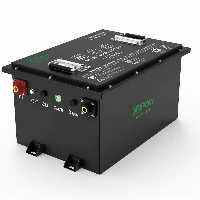
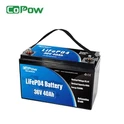
Marine batteries are specifically designed for ships, yachts, sailboats, outboard motors, and other marine equipment, primarily to provide a stable power supply for marine generators and onboard electrical appliances.
Depending on their specific application, marine batteries are mainly divided into three types: starting batteries, deep-cycle batteries, and dual-purpose batteries.
- Starting batteries: Capable of delivering high cold-cranking amperage for a short duration, they are used to start the engine.
- Deep-cycle batteries power onboard electrical equipment, such as GPS navigators, fishfinders/sonars, VHF radios, and other devices.
- Dual-purpose batteries can both start the engine and power onboard equipment.
Starter Batteries
The full name of a marine starter battery is "marine engine starter battery," and it is primarily used to power ship engines.
It can deliver an instantaneous current, known as a cold-start or high-start current, that can output a large current in an instant, thereby waking the engine from a dormant state.
First, let us understand the starting current (CA).
Starting current is used to measure the battery's ability to start the engine at low temperatures.
Its definition is as follows:
- First, place the marine battery in an environment of 0°C (32°F).
- Then, let the battery discharge continuously for 30 seconds.
- During this process, we need to observe whether the battery voltage fluctuates significantly and whether it can start the engine normally.
If the engine starts normally, it indicates the battery's performing well.
If the temperature is even lower, dropping below 0°C (32°F). In this case, the engine oil inside the engine becomes more viscous.
Under these circumstances, we need to focus on another indicator, Cold Cranking Amps (CCA). The criteria for Cold Cranking Amps are stricter than those for starting current.
Its definition is:
- Place the marine lithium battery in an environment of -18°C (0°F).
- Then, let the battery discharge continuously for 30 seconds.
- Next, check if the voltage change is stable.
- At the same time, observe how much current the battery can provide to start the engine.
If the battery can deliver a strong current in such cold conditions, it indicates that the battery is in good condition, and this marine lithium-ion battery is an excellent product.
For example, the CoPow lithium marine battery can deliver 1200 Amps of cold-cranking current in extreme cold environments down to -18°C. This ensures the engine starts smoothly and operates stably.

Deep Cycle Batteries
Deep-cycle marine batteries can provide reliable, sustained power support for various equipment and instruments on board. Whether it is the electric thruster driving the vessel or the lighting equipment inside the cabin, it can easily supply power to them.
Deep-cycle marine batteries differ fundamentally from marine starting batteries in both design and purpose; please do not confuse the two.
To enable deep-cycle lead-acid batteries to withstand multiple deep charge-discharge cycles, manufacturers specifically thicken the lead plates of deep-cycle marine batteries to enhance their durability.
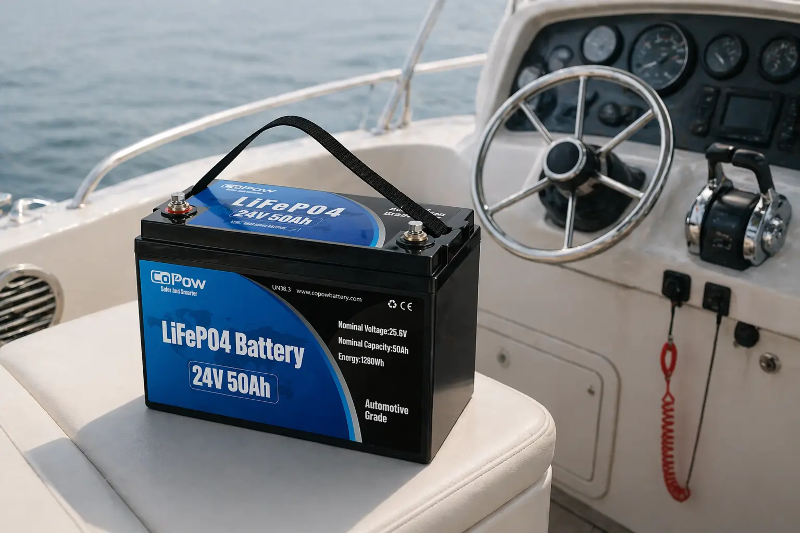
However, the unique chemical composition of deep-cycle lithium marine batteries enables them to withstand multiple charge-discharge cycles without the need for heavy lead plates. For example, the CoPow 24V LiFePO4 battery can withstand 2,000 to 6,000 charge-discharge cycles. This means its service life can reach 6 to 10 years.
For boat owners who frequently venture out to sea for extended periods, this is an indispensable piece of equipment.

Dual Purpose Batteries
Dual-purpose marine batteries combine the instantaneous power required for starting with sustained discharge capability, aiming to balance starting and energy storage in a single unit.
Since dual-purpose batteries seem to be all-in-one solutions, why do professionals still insist on designing separate starting batteries and deep-cycle batteries?
In fact, dual-purpose batteries are more of a compromise, designed for casual users who prioritize space efficiency and cost-effectiveness.
They are better suited for small coastal vessels with few electronic devices and low power demands. For boat owners who rarely go out to sea and take only short cruises, this integrated solution is indeed more economical.
However, if your sailing plans include long-distance cross-sea voyages, or if your boat is equipped with heavy-duty power-consuming devices such as large refrigerators or radar:
It is strongly recommended to adopt a dedicated battery configuration-that is, to install separate starter battery banks and deep-cycle power battery banks.
Otherwise, if excessive consumption causes the battery to run low, the engine will be unable to restart, leaving you in an extreme predicament with no power and no communication.
In the unpredictable open sea, a lack of energy redundancy often poses a significant safety risk.
Recommended Reading: How Long Does A Marine Battery Last?
Why Are Marine Batteries Different from Standard Batteries?
Marine batteries operate stably in frequently swaying, humid maritime environments thanks to their unique structures, safety designs, anti-corrosion performance, and terminal configurations.
Shock resistance
The casings and internal support structures of marine batteries are reinforced with rugged plastic or metal materials. This reinforcement prevents internal components from loosening due to vibrations or impacts.
Some marine batteries also feature additional internal support pillars or baffles. CoPow marine batteries can even be equipped with 3D mesh separators or shock-absorbing pads.
In marine lead-acid batteries, the positive and negative plates are thicker than those in standard lead-acid batteries.
As for lithium marine batteries, they utilize a naturally sealed design. Consequently, their internal structures and outer casings are more robust than those of lead-acid batteries.
Security functions
You may have heard that marine batteries require spark arrestors to prevent sparks generated during charging. However, the batteries referred to in that context are lead-acid batteries.
If you use lithium batteries, you don't have to deal with such hassles. LiFePO4 marine batteries do not produce sparks during charging, let alone pose a fire hazard.
Instead, they rely heavily on their built-in Battery Management System. With this system, you can monitor the battery status at any time.
Corrosion resistance
For lead-acid marine batteries, the casings are made of lead or lead alloys. This is an acid-resistant material. The internal terminals and connecting components are made of corrosion-resistant metals, such as lead-tin alloys or lead-plated copper.
Marine lithium batteries, however, are completely different. They are hermetically sealed.
Furthermore, their casings are primarily made of corrosion-resistant plastics or composite materials. Examples include ABS, PC, polypropylene (PP), or high-density polyethylene (HDPE), as well as less common metal casings with protective coatings.
In other words, they are much lighter than lead-acid batteries while remaining corrosion-proof.
Flexibility
Marine battery terminals generally fall into three categories: bolt-on, plug-in, and post. This variety allows you to provide power to a wide range of electrical equipment.
Some marine battery terminals are also equipped with insulating sleeves or protective covers to prevent accidental contact between cables and metal objects, which could cause a short circuit.
This is crucial for marine vessels. Due to the constant swaying at sea, there is a high risk that the battery terminals might come into contact with other conductive materials.
Additionally, marine batteries are designed to fit the battery compartments on boats. If your battery compartment has a unique configuration. You can also turn to marine battery manufacturers like CoPow to customize a battery for your specific needs.

What Size Marine Battery Do You Really Need?
A marine battery's capacity depends on your boat's total power needs. Larger group numbers offer higher capacity for demanding applications, while smaller ones suit low-power or small boats.
Assuming you have a small recreational boat, and it is equipped with the following devices:
1. List the boat equipment and power consumption
| Device | Power (W) | Daily Usage (h) | Daily Energy Consumption (Wh) |
|---|---|---|---|
| Navigation lights | 50 | 4 | 200 |
| GPS navigation | 15 | 10 | 150 |
| Refrigerator | 100 | 8 | 800 |
| Phone/Tablet Charging | 10 | 5 | 50 |
| Audio System | 30 | 3 | 90 |
Total daily energy consumption = 200 + 150 + 800 + 50 + 90 = 1290 Wh
2. Choose battery type and depth of discharge
- Using a 12V lithium marine battery
- Assume allowable depth of discharge (DoD) = 90%
3. Calculate required capacity (Ah)
Required Capacity = Battery Voltage (V) × DoD × Total Energy (Wh) = 12 × 0.9 × 1290 = 10.8 × 1290 ≈ 119.4 Ah
4. Add a safety margin
Add 20% extra capacity: 119.4 × 1.2 ≈ 143 Ah
So you need a 12V 140–150Ah lithium battery to power all the equipment on your boat for a full day.
5. Summary
Lead-acid battery: about 260Ah
Lithium battery: about 140–150Ah
Advantages of lithium: smaller size, lighter weight, higher usable capacity, and more efficient discharge.
Marine Battery Group Size Reference Chart
| Group Size | Typical Dimensions (L×W×H cm) | Voltage (V) | Capacity Range (Ah) | Typical Use / Boat Type |
|---|---|---|---|---|
| 24 | 25×17×19 | 12 | 70–85 | Small recreational boats, dinghies, deep cycle use |
| 27 | 27×17×20 | 12 | 85–100 | Small yachts, sailboats, deep cycle use |
| 31 | 33×17×22 | 12 | 100–120 | Medium-sized recreational boats, deep cycle or starter use |
| 29 | 28×17×20 | 12 | 105–125 | Medium yachts, sailboats, dual-purpose batteries |
| 34 | 33×17×22 | 12 | 115–135 | Medium boats, deep cycle or starter use |
| 78 | 38×18×22 | 12 | 130–150 | Medium to large yachts, dual-purpose or multi-device power supply |
| 4D | 51×22×24 | 12 | 200–220 | Large yachts, long trips, deep cycle batteries |
| 8D | 52×24×27 | 12 | 230–300 | Large yachts, heavy-load vessels, backup / deep cycle batteries |
Lithium vs Lead Acid Marine Batteries: Which Is Better?
In terms of performance, lithium batteries are undoubtedly superior to lead-acid batteries. They offer higher capacity, lighter weight, and a longer service life.
It is a self-contained battery pack, unlike lead-acid batteries, which consist of several bulky individual units. Both installation and maintenance are much more convenient. One could say that the only disadvantage of lithium marine batteries compared to lead-acid ones is the initial cost.
On the other hand, lead-acid batteries are not entirely useless. We know that their upfront cost is relatively low. However, they offer greater flexibility than lithium batteries.
Lithium batteries come with a Battery Management System. But lead-acid batteries do not.
So, if you aren't particularly interested in setting sail for the high seas, you can just get a lead-acid battery. With no BMS restrictions, you can use it however you please.
Regarding the market performance of lead-acid batteries in 2026, you might also want to check out the article, "Can Lead-Acid Batteries Hold Their Ground in Modern Competition?"

How Long Do Marine Batteries Last?
For marine starting batteries, their cycle life is only 50–150 cycles. This means they can last at most 2–5 years. This is the reality for most boat owners. If used improperly, they may fail within 6 months to 2 years.
Some people even replace their starting batteries after just one season, especially those who go out on the water frequently.
As for lithium marine batteries, their full name is Lithium Iron Phosphate marine batteries.
Lithium iron phosphate is an extremely durable material.
Therefore, a lithium marine battery offers 2,000–5,000+ cycle times. Under moderate usage conditions, it can last approximately 6–10 years.
Additionally, high-performance marine lithium batteries can achieve 6,000+ cycles. For example, the CoPow 24V 100Ah Lithium Marine Battery.
So, what about deep-cycle lead-acid marine batteries?
They typically offer only 300–800 cycles. Higher-quality AGM lead-acid batteries provide 500–1,000 cycles. Under moderate usage conditions, they generally last 3–5 years.
What about dual-purpose batteries?
Lead-acid dual-purpose batteries have a cycle life of 200–600 cycles and typically last 2–4 years.
Lithium dual-purpose batteries offer 2,000–5,000 cycles and generally last 6–10 years.
Best Way to Store a Marine Battery for Long-Term Use
The best way to store marine batteries long-term comes down to three key points: charging them correctly, choosing the right location, and performing regular checks.
Disconnect the battery and clean the terminals before storage. We recommend charging the marine battery to 30%–50% capacity before charging it further.
Then, choose a cool, dry, and well-ventilated place for storage. Check the power level every 1–2 months during storage.
If you find the charge has dropped below 20%, you need to recharge it to around 50%. Regardless of the battery type, it will naturally self-discharge even when not in use. You need to prevent it from self-discharging to below 20%. This is an effective way to extend your battery's lifespan.
If you would like to learn more details about storage, you can read this article.
"Preparing Your Marine Battery for Off-Season Storage"

Key Factors to Consider When Buying a Marine Battery
When you're looking to buy a marine battery, you're bound to have a lot of questions. Let's touch on a few of them briefly.
- Battery Type: Lithium (lighter, more durable, faster charging) vs Lead-acid (cheaper but shorter lifespan, heavier)
- Capacity (Ah): The larger the capacity, the longer the endurance; choose based on your electrical equipment and trip duration.
- Voltage: Commonly 12V (small boats/basic power needs) or 24V (high-power equipment).
- Depth of Discharge (DoD): Lithium can use 80–100%, lead-acid about 50–60%, directly affecting usable energy.
- BMS (Battery Management System): Essential for lithium batteries to ensure safety (prevents overcharge, over-discharge, and overheating).
- Recharge Time: Lithium charges faster, suitable for frequent use.
- Weight: Lithium is lighter, improving boat efficiency and handling.
- Warranty: Lithium typically 5–10 years, lead-acid shorter.
- Cost vs Value: Lithium is more expensive upfront but saves money in the long term, while lead-acid is cheaper but requires more frequent replacement.
conclusion
So far, we have introduced you to the various aspects of marine batteries. We trust that you now have a foundational understanding of them. This will allow you to be more confident and informed when making a selection.
However, this is only the beginning; gaining a comprehensive mastery of marine batteries requires deeper exploration.
If you would like to learn more right away, feel free to contact us directly. Wishing you a pleasant day ahead.
FAQ
Do Marine Batteries Come Charged?
Marine batteries usually come partially charged (around 30%–60%), not fully charged. It's recommended to fully charge the battery with a compatible charger before first use to ensure optimal performance.
How to Tell If a Marine Battery Is Bad?
If you notice that the battery struggles to start the vehicle, delivers significantly reduced runtime, shows abnormally low voltage, or exhibits visible damage such as swelling or corrosion, it is likely that the battery has degraded or is nearing the end of its service life and should be replaced promptly.