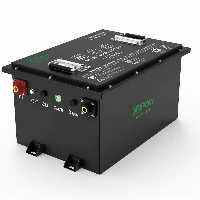
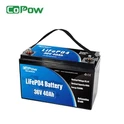
"What voltage battery does my E-Z-GO electric golf cart actually use?" This is a question many owners ask when maintaining or upgrading their batteries.
Many older TXT models use 36V lead-acid batteries, while newer TXT/RXV models typically use 48V lithium-ion batteries.
Of course, E-Z-GO golf carts aren't limited to just these two models; there are also the Freedom, Valor, Express, and Terrain series. Additionally, there are significant differences between models of the same series from different model years.
To help you better understand, this article will provide a detailed overview of the different models.
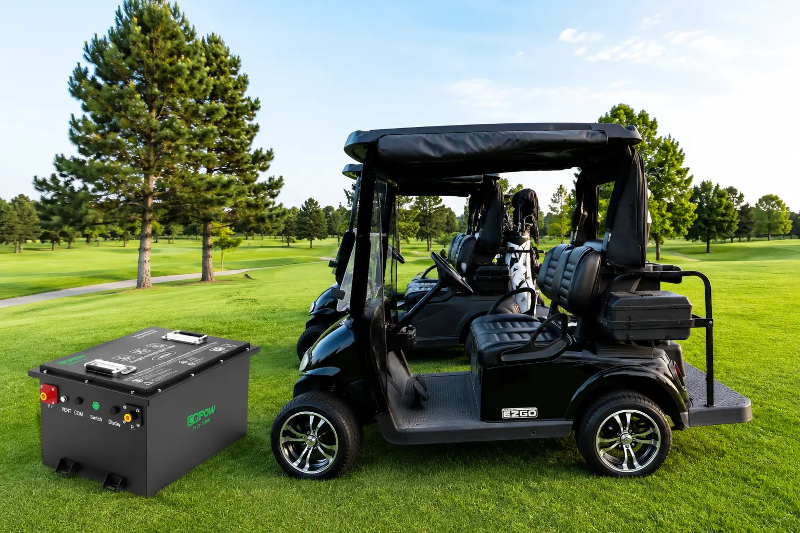
How Many Volts Is My E-Z-GO Golf Cart Battery System?
The voltage systems used in E-Z-GO golf carts vary significantly depending on the model year, series, and intended use. If you do not know the original voltage of your cart, you may encounter compatibility issues when replacing batteries, upgrading to lithium-ion batteries, purchasing a charger, or even repairing the controller.
To determine the voltage of an E-Z-GO, follow these steps:
Check the number of batteries and the voltage of each individual battery.
- 6 x 6V batteries = 36V
- 6 x 8V batteries = 48V
- 8 x 6V batteries = 48V
- 4 x 12V batteries = 48V
Check the markings.
- Charger label
- Controller nameplate
- Motor specifications
- Vehicle nameplate
- User manual
Inspect the vehicle body.
The factory specification label located under the seat, near the footwell area.
Is My Original E-Z-GO Golf Cart Battery Lead-Acid or Lithium?
The simplest way to determine this is to open the seat and check the number and appearance of the batteries in the battery compartment.
You can identify the type of battery previously used by checking the following points:
- 6, 8, or 12 small batteries connected in series
- Each battery has a water filler cap or vent hole on top
- The batteries are connected by many thick copper wires
- The battery casing is marked with lead-acid battery brands such as Trojan, US Battery, or Crown.
- The batteries are very heavy and have acid residue or corrosion marks on top.
Next, you can determine whether lithium batteries are being used by checking the following:
- Only 1 or 2 large batteries
- The battery appears more like a single, large black box.
- There is no water filling port.
- It features an LCD screen, a Bluetooth module, and an SOC (State of Charge) display;
- The label is marked with LiFePO4, Lithium, or Lithium-ion.
- The battery features CAN, RS485, or Bluetooth connectivity for app control.
- The battery compartment is much more spacious than before.
Can I Upgrade My E-Z-GO Golf Cart From Lead-Acid to Lithium Batteries?
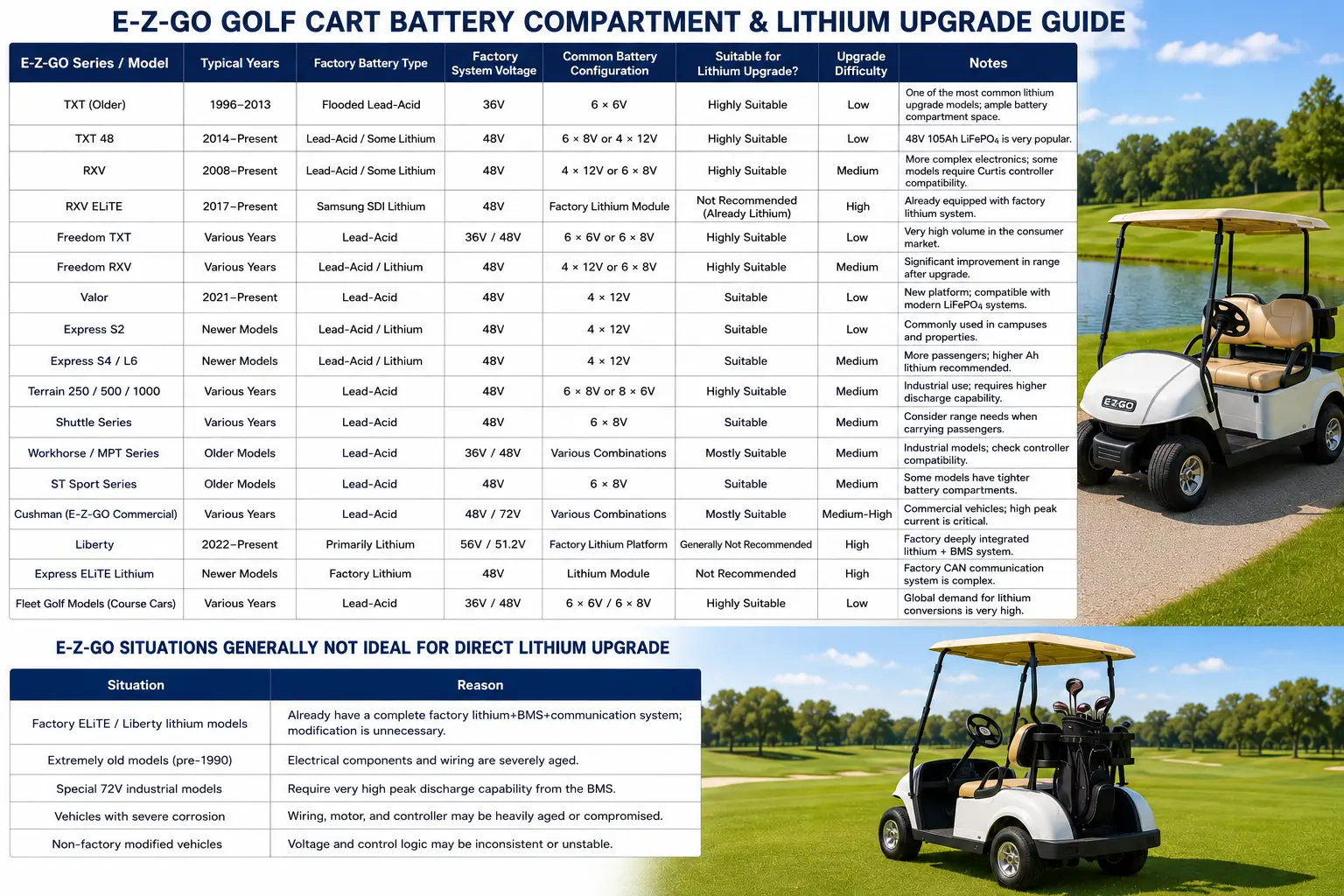
Okay, now that we know the voltage and battery type used in E-Z-GO golf carts, can we simply replace the lead-acid batteries with lithium-ion batteries? The answer is that for most models, yes, but a small number of very old models may not be compatible.
For example, models like the TXT, RXV, Freedom, and some older PDS series-if they originally had a 36V or 48V system-can all be directly upgraded to a lithium-ion battery system with the corresponding voltage.
However, there are a few points to note during the upgrade process:
- The original lead-acid charger cannot be used, as lithium-ion batteries require a dedicated LiFePO4 charger. CoPow provides a dedicated LiFePO4 charger for every golf cart battery model.
- You must verify that the motor controller, DC-DC converter, battery meter, and onboard computer are compatible with the battery, paying particular attention to the RXV model.
- The quality of the BMS is also crucial; only a high-quality battery management system can effectively protect the battery and prevent frequent power-off protection events.
Which E-Z-GO golf carts are not suitable for upgrading to lithium-ion batteries?
- Older E-Z-GO golf cart models from over a decade ago
- Models with poor controller compatibility, such as certain older RXV models, which are sensitive to voltage fluctuations; their Curtis control systems may sometimes detect abnormal voltages and trigger protective measures.
- Some older models that use series-wound motors.
How to Choose the Right Battery for Your EZ-GO Golf Cart?
When selecting a battery, first make sure the voltage and size are compatible with your EZ-GO golf cart. Then, consider your usage frequency and the terrain of the golf course when choosing between lead-acid batteries and lithium iron phosphate batteries.
You should also take into account battery quality and after-sales support. If you plan to upgrade, ensure the new battery is compatible with your cart. This approach helps balance performance, cost, and ease of use.
Ensure the Battery Is Compatible with Your EZGO Golf Cart
EZ-GO golf carts use different voltage battery systems, commonly 36V and 48V. The battery configuration varies by model:
- EZGO TXT uses six 6V lead-acid batteries connected in series to form a 36V system.
- EZGO RXV uses four 12V batteries connected to form a 48V system.
When selecting a battery, you must strictly follow the original voltage specifications to avoid damaging the cart's controller.
Select the Battery Type Based on Your Needs
Lead-Acid Batteries
- Suitable for: Users with a limited budget or carts that are used infrequently.
- Advantages: Affordable, widely compatible; AGM type requires no maintenance and is leak-resistant.
- Disadvantages: Low cycle life (300-500 cycles), short lifespan (2-4 years), heavy, which increases energy consumption.
Lithium Iron Phosphate Batteries
- Suitable for: Users who operate carts frequently and want low maintenance with long lifespan.
- Advantages: High cycle life (over 2000 cycles), long lifespan (8-10 years), fast charging (1-2 hours to reach 80%), maintenance-free.
- Disadvantages: High initial cost; upgrading older EZGO golf carts may require additional adaptation kits.
Refine Your Choice Based on Usage Scenarios
Consider the Course Terrain
- If the course has many slopes or uneven terrain, a Lithium Iron Phosphate battery is better because it can maintain stable power when more energy is required, preventing the cart from losing power on hills.
- If the course is mostly flat, a standard Lead-Acid battery is sufficient to meet basic driving needs.
Consider Usage Intensity
- If the cart is used frequently, such as in commercial operations serving many players daily, a Lithium Iron Phosphate battery is more cost-effective because it can withstand high-frequency charging and discharging, reducing replacement frequency.
- If the cart is used occasionally for personal leisure, a Lead-Acid battery offers better value, providing adequate performance at a lower cost.
Focus on Key Performance and After-Sales Support
- Capacity: Determines how far the golf cart can travel. High-capacity Lithium Iron Phosphate batteries can power the cart for many holes on a single charge.
- Discharge Stability: Choose a golf cart battery that can provide continuous power, ensuring the cart does not lose power when climbing hills or carrying heavy loads.
- Low-Temperature Performance: Crucial in cold regions. A good Lithium Iron Phosphate golf cart battery can retain most of its capacity even at -20℃, ensuring reliable operation.
- Avoid Cheap Options: Low-cost, non-branded EZGO golf cart batteries are prone to leakage and rapid performance degradation.
- Choose Batteries with Warranty: High-quality EZGO Lithium Iron Phosphate batteries typically offer at least a five-year warranty.
- Easy Installation: Batteries with brackets and connectors allow faster and more convenient installation for EZGO electric golf carts.
Balance Compatibility and Ongoing Maintenance
- Check Controller Compatibility: When upgrading older EZGO golf carts to lithium batteries, ensure the controller supports the new battery. Some models from 2016 to 2019 may require a firmware update to avoid issues with charging or power output.
- Consider Daily Maintenance: If you want to minimize upkeep, avoid flooded lead-acid batteries that require frequent water refilling.
- Improve Efficiency: If charging stations are limited, fast-charging Lithium Iron Phosphate golf cart batteries can recharge quickly, reducing downtime and increasing operational efficiency.
How Much Range Can You Expect After Switching to Lithium Golf Cart Battery?
Replacing the EZGO golf cart battery with a lithium battery can typically increase the range by about 30 percent compared to lead-acid batteries.
Under normal conditions, a single charge can cover 80 to 120 kilometers. High-capacity models, such as the 72V 100Ah lithium iron phosphate battery pack, can reach 110 kilometers on flat terrain. Some high-capacity lithium batteries designed for dual-motor setups can even exceed 130 kilometers.
Actual range is affected by several factors:
- Battery voltage and capacity are the core basis. Higher voltage, such as 72V compared to 60V, can improve efficiency and increase range by about 15 percent.
- Terrain, load, and driving style all affect power consumption. A 10 percent slope can reduce range by 40 percent, carrying four passengers can lower it by 35 percent, and frequent starts, stops, or speeding consume more power. Maintaining a steady speed of 20 kilometers per hour is more efficient.
- Ambient temperature also has a significant impact. At temperatures below 0°C, battery capacity can drop by 15 to 25 percent.
The advantage of lithium golf cart batteries is their long lifespan and stable range. Even after many charge and discharge cycles, the range decreases much slower than lead-acid batteries.
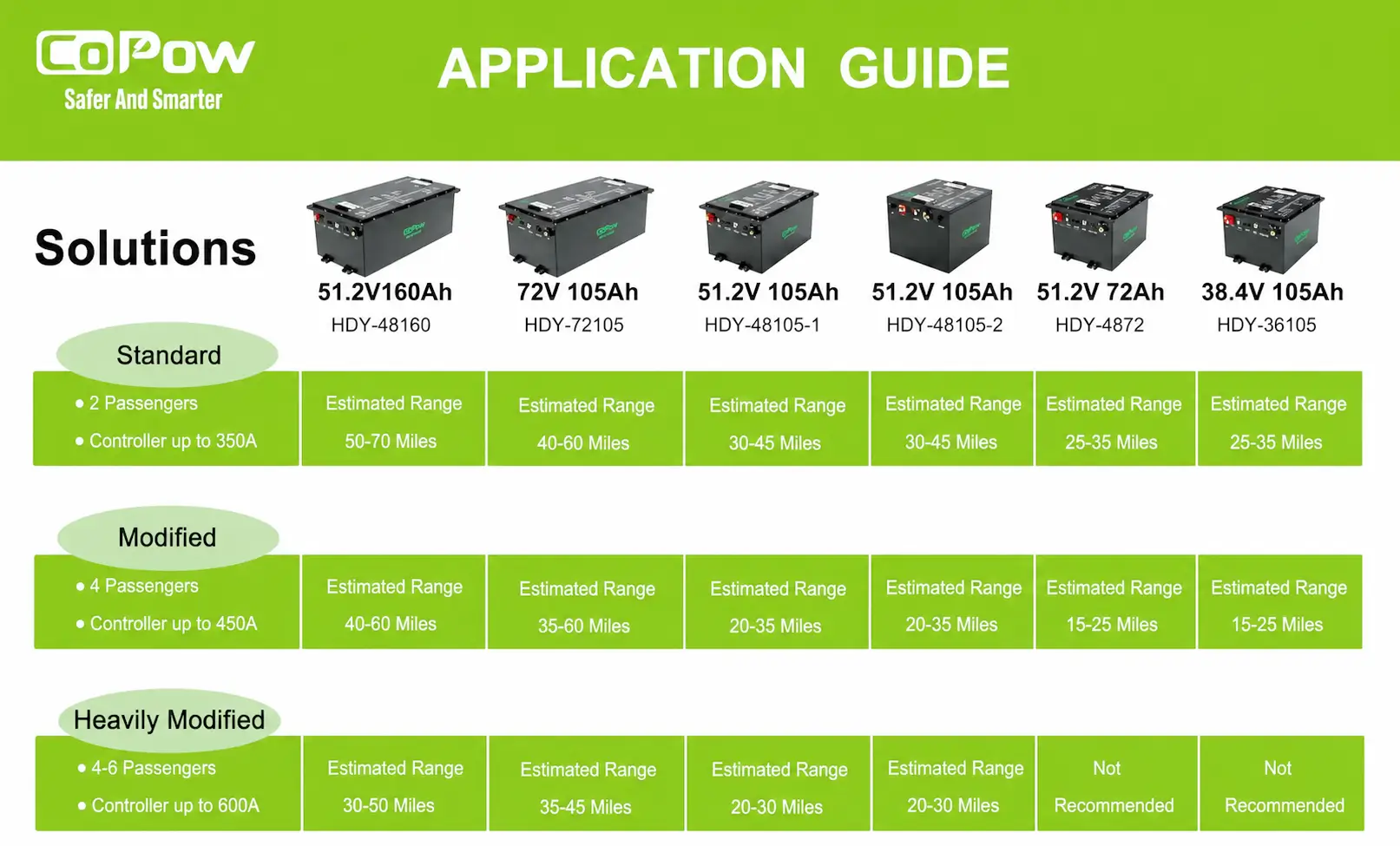
Below is a comparison table of the range for different Copow golf cart battery series.
How to Tell If Your EZGO Golf Cart Battery Needs Replacement?
To determine if your EZGO golf cart battery needs replacement, you can look at several factors. For example, shorter driving range, abnormal charging or discharging, sluggish cart performance, or visible damage to the battery.
You can also use instruments to check the battery voltage and capacity. If the battery has been in use for a long time or shows any safety risks, it should be replaced promptly.
You can determine if the battery in your EZGO golf cart needs replacement by checking its range and charging performance.
- Range has noticeably decreased: If the battery used to support an 18-hole round but now runs out of power halfway, or if the range has dropped 30% to 40% compared to a new battery, it indicates significant capacity loss. Consider replacing an lead-acid battery if the range is below 35 miles or a lithium battery if below 48 miles.
- Charging is slower or fails to reach full: A normal 48V lead-acid battery takes about 8 hours to fully charge. If it now requires 15 to 20 hours, or the charger keeps running without reaching full, it means the battery's ability to store energy has declined.
- Frequent electrolyte top-ups: If a lead-acid battery needs frequent addition of electrolyte, it also indicates rapid performance deterioration.
You can assess if the battery in your EZGO golf cart has issues by observing its performance.
- Difficulty starting: If the battery requires multiple attempts to start the cart or only makes a clicking sound without driving the vehicle, it indicates insufficient battery output.
- Poor performance while driving: Slow acceleration, weak power on slopes, or sudden voltage drops that trigger the controller to shut down or cause the cart to lose power indicate battery problems.
- Electrical issues: Dim or flickering lights, or USB ports failing to charge devices, show that the battery cannot support the electrical system.
- Low voltage warning: If the dashboard displays a low voltage alert, it is a signal that the battery needs inspection or replacement.
You can determine if the battery needs replacement by checking its physical condition.
- Terminal corrosion: If the terminals have white or green powdery corrosion that reappears after cleaning, it can affect the electrical connection and may require battery replacement.
- Casing damage: Lead-acid batteries leaking electrolyte or lithium batteries with swollen or bulging casings usually indicate internal chemical issues. This not only damages performance but can also cause short circuits, requiring immediate replacement.
- Cracks: If the EZGO battery casing has visible cracks, it should be replaced promptly to prevent further problems.
You can determine if the battery needs replacement using testing instruments.
- Voltage check: Use a multimeter to measure the voltage. If the voltage of a lead-acid or lithium battery is below the standard value, it indicates performance degradation.
- Voltage balance: After charging, let the battery sit and measure again. If the voltage difference between cells exceeds 0.3 volts, the battery is unbalanced and cannot be fixed by equalizing charge, requiring replacement.
- Load test: Use a load tester to check the battery. If the voltage drops significantly under load, the battery cannot handle working demands.
- Capacity decline: If the capacity of an old EZGO golf cart battery falls below 80% of its original rated value, even if the exterior looks fine, replacement is recommended.
You can determine if the battery needs replacement based on its service life.
- Lifespan reference: Lead-acid batteries generally last 4 to 6 years, while lithium batteries last 8 to 10 years.
- Cycle count: Lead-acid batteries show significant performance decline after about 500 charge-discharge cycles. Lithium batteries should be replaced if their capacity decreases after 2000 cycles.
- Comprehensive judgment: If the original battery of the EZGO golf cart is near or beyond its service life and shows issues such as reduced range, slow charging, or physical damage, replacing it is safer and more reliable than repairing it.
Which Lithium Colf Cart Battery Brands Are Suitable for Ezgo?
Copow lithium batteries are specially designed as an upgrade solution for EZGO golf carts. Their size, voltage and connectors match EZGO's original specifications, so they can directly replace traditional lead-acid batteries without modifying any wiring.
The product range is wide, covering 36V, 48V and 72V options, with capacities from 50Ah to 300Ah, making them suitable for popular EZGO models like the TXT and RXV, as well as customized or commercial carts.
Built with safe and long-lasting LiFePO4 cells, these batteries offer stable performance, extended lifespan, and reliable safety. Combined with international certifications and comprehensive after-sales support, they provide EZGO owners with a more secure and durable power solution.
conclusion
Choosing the right battery for your EZGO golf cart is crucial. Lead-acid batteries are inexpensive and suitable for occasional use, but lithium iron phosphate batteries offer longer lifespan, faster charging, lighter weight, and virtually no maintenance, making them ideal for frequent use or commercial operations.
High-quality lithium batteries provide stable range, reliable performance, and compatibility with various models, effectively reducing long-term maintenance and replacement costs, making them the ideal power solution for a stable and durable golf cart.
Faq
What Type of Battery Does an E-Z-GO Golf Cart Originally Use?
Most traditional models come with deep-cycle lead-acid batteries, including flooded lead-acid and AGM batteries. Newer high-performance models are factory-equipped with LiFePO₄ batteries.
Does an E-Z-GO Golf Cart Support Lithium Batteries?
Yes. Both newer models and most older versions are compatible with lithium batteries.
Can a Lithium Battery Swap Damage the Controller?
No if installed correctly. Damage may occur if the lithium battery's voltage does not match the controller's rated range or if it fails to adapt to the lithium battery's discharge characteristics.
How Many Amp-Hours Do You Need for an E-Z-GO Lithium Upgrade?
100-120Ah is sufficient for daily golf course commuting. For commercial fleet use, hilly terrain, or modified carts, 150-200Ah is recommended.
Common Issues After Installing Lithium Batteries in an E-Z-GO TXT
Common issues include voltage mismatch between battery and controller, incompatible charger with lithium batteries, BMS-triggered protection, loose wiring connections, and onboard computer error codes.
Do You Need to Modify Wiring When Converting an E-Z-GO to Lithium Golf Cart Battery?
No in most cases. High-quality lithium batteries are mostly direct replacements, matching original wiring standards. Wiring modification is only needed if there is a significant difference in battery voltage or connector type.
Why an E-Z-GO Golf Cart May Not Run After Installing a Lithium Battery?
Possible reasons include voltage mismatch, BMS-triggered protection due to overheating or other issues, incorrect or loose wiring connections, incompatible controller, and failure to use a lithium battery-specific charger.