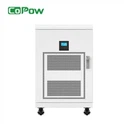
Assuming the battery type is not a factor, a 24V 200Ah battery has a total energy capacity of 4,800 watt-hours (Wh). Under ideal conditions, it can power a 100W device for approximately 48 hours, a 500W device for approximately 9.6 hours, and a 1,000W device for approximately 4.8 hours.
These are rough estimates and require further analysis.
The 4,800 Wh capacity is also merely a theoretical value. In practical use, very few 24V batteries can actually deliver 4,800 Wh. If I had to choose one, the 24V lithium iron phosphate battery has the actual usable capacity closest to 4,800 Wh, and its energy efficiency is higher than that of other lead-acid batteries and standard lithium-ion batteries.
We need to consider the actual usable capacity of different battery types, which depends largely on the battery's chemistry, depth of discharge, Battery Management System limitations, load power, temperature, and the battery's lifespan.
|
24V 200Ah Battery Type |
Theoretical Energy |
Usable Capacity |
Practical Usable Energy |
|---|---|---|---|
|
24V 200Ah Lead-Acid Battery |
4,800Wh |
50% |
≈2,400Wh |
|
24V 200Ah AGM Battery |
4,800Wh |
50–60% |
≈2,400–2,880Wh |
|
24V 200Ah Gel Battery |
4,800Wh |
50–60% |
≈2,400–2,880Wh |
|
24V 200Ah LiFePO4 Battery |
4,800Wh |
80–95% |
≈3,840–4,560Wh |
|
24V 200Ah Lithium-Ion Battery |
4,800Wh |
80–90% |
≈3,840–4,320Wh |

Calculate Your 24V 200Ah Battery Runtime
To calculate a more accurate range, you can use the following formula. Now, we need to consider two additional factors: depth of discharge and inverter efficiency. The formula is as follows:
First, calculate the actual available capacity:
Usable Capacity (Wh) = Battery Voltage × Battery Capacity (Ah) × Depth of Discharge (DoD) × System Efficiency
We then arrived at a fairly accurate estimate of the usage duration:
Runtime (hours) = Usable Capacity (Wh) ÷ Total Load Power (W)
For example, consider a 24V 200Ah LiFePO4 battery. Assuming a depth of discharge (DoD) of 100%, a system efficiency of 95%, and a total connected load of 500W,
the usable capacity is: 24 × 200 × 100% × 95% = 4,560Wh.
Divide the available capacity by the load power: 4,560 Wh ÷ 500 W ≈ 9.1 hours.
This means that, under ideal conditions, this battery can continuously power a 500 W device for approximately 9 hours.
How Long Does a 24V 200Ah Battery Last on a Single Charge?
If a 24V 200Ah LiFePO4 battery is used, its usable capacity is approximately 4,560 Wh (calculated based on 95% system efficiency). In this case, the actual runtime is as follows:
|
Device |
Typical Power Draw |
Estimated Runtime |
|---|---|---|
|
LED Lighting System |
50W |
91.2 hours |
|
Portable Refrigerator |
100W |
45.6 hours |
|
CPAP Machine |
150W |
30.4 hours |
|
TV + Wi-Fi Router |
200W |
22.8 hours |
|
Electric Cooler |
300W |
15.2 hours |
|
Small RV Appliances |
500W |
9.1 hours |
|
Trolling Motor (Medium Speed) |
600W |
7.6 hours |
|
Microwave Oven |
1,000W |
4.6 hours |
|
Coffee Maker |
1,200W |
3.8 hours |
|
Electric Kettle |
1,500W |
3.0 hours |
|
RV Air Conditioner |
2,000W |
2.3 hours |
|
Induction Cooktop |
2,500W |
1.8 hours |
|
Space Heater |
3,000W |
1.5 hours |
What Is the Lifespan of a 24V 200Ah Battery?
Before discussing the physical lifespan of a 24V 200Ah battery, we need to understand that there are six different types: flooded lead-acid batteries, sealed lead-acid batteries, gel batteries, ternary lithium batteries, lithium iron phosphate batteries, and the latest sodium-ion batteries.
Next, we will compare the differences in lifespan among these batteries.
|
Battery Type |
Lifespan |
Cycle Life |
|---|---|---|
|
Flooded Lead-Acid Battery |
3–5 years |
300–500 cycles |
|
AGM Battery |
4–7 years |
500–1,000 cycles |
|
Gel Battery |
5–8 years |
700–1,200 cycles |
|
LiFePO4 (Lithium Iron Phosphate) Battery |
8–15 years |
4,000–8,000+ cycles |
|
NMC (Lithium Nickel Manganese Cobalt Oxide) Battery |
8–12 years |
2,000–4,000 cycles |
|
NCA (Lithium Nickel Cobalt Aluminum Oxide) Battery |
8–12 years |
2,000–4,000 cycles |
|
LTO (Lithium Titanate) Battery |
15–20+ years |
10,000–20,000+ cycles |
|
Sodium-Ion Battery |
5–10 years |
2,000–6,000 cycles |
How Long Will A 24V 200Ah Battery Run A Trolling Motor?
A 24V 200Ah lithium battery can power your marine electric motor for 5 to 15 hours of continuous operation. This wide range is because 24V trolling motor batteries are power batteries, and their runtime depends largely on your cruising speed.
There is a specific formula for calculating this:
Estimated runtime (hours) = Battery capacity (Ah) ÷ Motor current (amps)
For example, a 24V 80lb thrust trolling motor draws approximately 20A of current at medium cruising speed. If using a 24V 200Ah LiFePO4 battery, the theoretical runtime is as follows:
Runtime (hours) = 200Ah ÷ 20A = 10 hours
In other words, at normal cruising speed, this 24V 200Ah battery can power the trolling motor continuously for about 10 hours.
If you slow down, the motor's current consumption can drop to around 10A, extending the runtime to over 20 hours.
However, if you cruise at full speed continuously, the motor's current will rise to around 40A, and the runtime will quickly drop to less than 5 hours.
Real-world example: How long can a 24V 200Ah lithium battery power a trolling motor?
A boat owner shared his upgrade experience on a fishing forum. He had originally been using two traditional deep-cycle lead-acid batteries to power a 24-volt trolling motor. After about five to six hours on the water, the batteries needed to be recharged immediately.
In addition, as the battery charge level dropped, the motor's thrust would decrease accordingly. Later, he upgraded to a single 100Ah 24V lithium-ion battery. After 5 to 6 hours of continuous fishing, the battery's remaining charge still remained between 65% and 70%.
Based on this real-world data, if upgraded to a 24V 200Ah lithium iron phosphate battery, the total energy capacity would reach approximately 4,800 Wh-double that of the 100Ah system.
Under the same boat, motor, and fishing conditions, the motor could theoretically run continuously for 10 to 12 hours. Even after a full day of fishing, the battery would still have a significant charge remaining upon returning home.
Another boat owner using a 24V system reported that after upgrading his trolling motor to a lithium battery, he could often fish continuously throughout the entire weekend while maintaining a battery charge of over 70%, far exceeding the endurance performance achieved with lead-acid batteries.
Conclusion: For 24-volt trolling motors with 75 to 80 pounds of thrust, a 24v 200 ah LiFePo4 battery is considered a high-capacity configuration. Under normal fishing, cruising, and Spot-Lock positioning conditions, many users can easily achieve an actual runtime of 10 to 20 hours or more. If the primary activities involve low-speed cruising and positioning, the runtime can even span multiple days of fishing.

How Long Will A 24V 200Ah Battery Run A Solar System?
Taking a 24V, 200Ah lithium iron phosphate battery as an example, the actual usable capacity is 4,332 Wh, taking into account inverter and line losses. When used in a solar system, the operating times are approximately as follows:
|
Total Power Load |
Estimated Runtime |
Examples of Devices |
|---|---|---|
|
50 Watts |
~86.6 hours |
LED lights, Wi-Fi router, security cameras |
|
100 Watts |
~43.3 hours |
Laptop, router, TV box, phone charging |
|
200 Watts |
~21.7 hours |
Small TV, mini fridge, communication equipment |
|
300 Watts |
~14.4 hours |
RV electrical system, desktop PC, fans |
|
500 Watts |
~8.7 hours |
Refrigerator, freezer, multiple household appliances |
|
800 Watts |
~5.4 hours |
Power tools, water pump, microwave (intermittent use) |
|
1,000 Watts |
~4.3 hours |
Microwave, coffee maker, small air conditioner |
|
1,500 Watts |
~2.9 hours |
Large microwave, electric kettle, portable AC |
|
2,000 Watts |
~2.2 hours |
Induction cooktop, larger air conditioner |
|
3,000 Watts |
~1.4 hours |
Off-grid cabin loads, multiple high-power appliances |

How Long Will A 24V 200Ah Battery Run An RV?
In an RV, if a 24V 200Ah battery is used solely to power everyday devices such as LED lighting, a water pump, a phone charger, a router, and a small refrigerator, the total load is generally around 200W.
Under these conditions, the battery can last for more than 20 hours; however, if high-power appliances such as air conditioners, microwaves, or induction cooktops are used in the RV, the battery life is reduced to just 1–3 hours. The exact runtime depends on the RV's total power consumption, which you can calculate using the formula mentioned at the beginning.
|
RV Equipment Usage Scenario |
Power Load |
Estimated Runtime |
|---|---|---|
|
LED lights, water pump, phone chargers, Wi-Fi router, small refrigerator |
~200W |
20+ hours |
|
Basic RV living (lights, fridge, TV, laptop, water pump) |
~500W |
8–10 hours |
|
Microwave, coffee maker, induction cooktop |
~1,000–1,500W |
3–5 hours |
|
Air conditioner, induction cooktop, multiple appliances running together |
~2,000–3,000W |
1–3 hours |

Factors That Affect 24V 200Ah Battery Runtime
The actual runtime of a 24V 200Ah battery depends on several factors, including the connected load, conversion efficiency, temperature, and the battery's health. These factors collectively influence the system's runtime, with total power consumption being the decisive factor.
Total Power Consumption
The higher the power consumption, the faster the battery drains. For example, the total power consumption of a small car refrigerator, a router, and LED lighting is only 100–200 W, while high-power devices such as air conditioners, induction cookers, or microwaves typically exceed 1,000 W. Even when using the same 24 V 200 Ah battery, the runtime can drop from over 20 hours to just a few hours.
Depth of Discharge
For LiFePO4 batteries, the depth of discharge can reach 95%. This means that out of a theoretical capacity of 4800 Wh, 4560 Wh of usable energy is available, resulting in a longer runtime compared to other battery types. On the other hand, many people may ask, "Why can't we discharge the battery from 100% all the way down to 0%?" This is because over-discharging can shorten the battery's lifespan, whereas maintaining a reasonable depth of discharge helps extend its service life.
Inverter Efficiency
Batteries store direct current (DC), while most household appliances use alternating current (AC). When an inverter is used to convert the battery's DC to AC, not all of the electrical energy is utilized. A portion of the energy is lost as heat during the conversion process, resulting in an actual runtime that is shorter than expected.
Ambient Temperature
For lead-acid batteries, capacity degrades significantly in low-temperature environments (e.g., below 10°C). A battery that previously delivered 90% of its capacity may only provide 60% in winter, resulting in a significant reduction in runtime. In contrast, LiFePO4 batteries experience virtually no capacity degradation and can operate normally within a temperature range of -20°C to 60°C, maintaining capacity levels similar to those under standard conditions.
Battery Aging and Health
Generally, lead-acid batteries experience natural capacity degradation after 2–3 years of use, with degradation becoming more pronounced over time. Lithium-ion batteries also age, but this process is much slower than that of lead-acid batteries. Although lithium-ion batteries may experience capacity degradation, it is not particularly severe.
How Does a 24V 200Ah Battery Compare to Other Common Battery Configurations?
The 24V 200Ah battery is often viewed as a compromise solution; by increasing the system voltage, it reduces current, thereby minimizing line losses and heat generation, while avoiding the potential equipment compatibility issues and higher retrofit costs associated with 48V batteries.
For most applications with power requirements ranging from 1,000W to 3,000W, a 24V 200Ah battery provides ample energy storage capacity while maintaining high energy efficiency. As a result, it is widely used in RVs, off-grid energy storage systems, and marine power systems.
|
Comparison |
24V 200Ah |
Key Difference |
|---|---|---|
|
vs. 12V 200Ah |
4,800Wh total energy |
A 12V 200Ah battery stores only 2,400Wh. The 24V version delivers twice the energy and requires only half the current for the same power output, reducing cable size, heat generation, and energy loss. |
|
vs. 24V 100Ah |
4,800Wh total energy |
A 24V 100Ah battery stores 2,400Wh. The 200Ah version provides twice the runtime under the same load and offers a larger energy reserve for overnight or off-grid use. |
|
vs. 48V 100Ah |
4,800Wh total energy |
Both store the same amount of energy. However, 48V systems draw only half the current of 24V systems, making them more efficient for loads above 3,000W. A 24V system is usually cheaper and easier to integrate into existing RV, marine, and solar setups. |
|
vs. 24V 300Ah |
4,800Wh total energy |
A 24V 300Ah battery stores 7,200Wh and offers 50% longer runtime. However, it is larger, heavier, and more expensive. The 200Ah model is often the sweet spot between capacity and cost. |
|
vs. Lead-Acid 24V 200Ah |
Up to 95% usable capacity |
A LiFePO₄ battery can provide approximately 4,560Wh of usable energy, while a comparable lead-acid battery is usually limited to about 2,400Wh due to the 50% depth-of-discharge recommendation. |
|
vs. AGM 24V 200Ah |
Higher efficiency and lifespan |
AGM batteries generally achieve 80–85% efficiency and 300–800 cycles. LiFePO₄ batteries typically exceed 95% efficiency and can last 4,000–15,000+ cycles. |
|
vs. Multiple 12V Batteries in Series |
Simpler wiring and maintenance |
A dedicated 24V battery reduces wiring complexity, minimizes connection losses, and avoids battery-balancing issues commonly found in multi-battery banks. |
Conclusion
A 24V 200Ah battery has a theoretical energy capacity of approximately 4.8 kWh, but there is no fixed answer for its actual runtime. This primarily depends on factors such as load power, battery type, depth of discharge, temperature, and system efficiency.
For applications such as RVs, solar energy storage, marine motors, and home backup power systems, a 24V 200Ah battery is considered a high-capacity configuration capable of meeting the power demands of most medium- to high-power scenarios.
To determine a more accurate runtime, the most reliable method is to calculate it based on the actual power consumption of the equipment in order to select the most suitable battery solution.
FAQs
Can a 24V 200Ah battery run a 3000W inverter?
Yes, but only if your battery can handle a sufficiently high discharge current. 3000W ÷ 24V ≈ 125A; taking into account inverter losses, the actual current is likely to be between 135A and 150A. Therefore, for a 24V 200Ah battery, if its BMS continuous discharge current is ≥150A, it can power a 3000W inverter; however, if the BMS continuous discharge current is only 100A, this is not recommended.
How long does it take to charge a 24V 200Ah battery?
A 24V 200Ah LiFePO4 battery can be fully charged in 2 to 5 hours, whereas a lead-acid battery may take 8 to 12 hours.