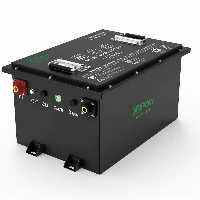
A 12V 100Ah battery and a 24V 100Ah battery store different amounts of energy. 100Ah simply refers to the capacity of these two batteries; a 12V 100Ah battery can store 1,200 Wh of energy, while a 24V 100Ah battery can store 2,400 Wh-the latter stores more than twice as much energy as the former.
The formula is:
Energy (Wh) = Voltage (V) × Capacity (Ah)
We need to understand one thing: just because batteries have the same capacity does not mean they store the same amount of electrical energy.
We often say that capacity affects runtime, but it does not determine a battery's runtime. A battery's runtime depends more on its total energy.
For example, consider a 200W electrical device using batteries with the same capacity but different energy levels; their runtimes will differ:
12V 100Ah: 1200Wh ÷ 200W ≈ 6 hours
24V 100Ah: 2400Wh ÷ 200W ≈ 12 hours
The formula is: Runtime = Total Energy ÷ Device Power
Therefore, energy capacity is the key difference between these two types of batteries. In addition, they differ significantly in terms of current, cabling requirements, voltage drop, inverter selection, and various application scenarios.
When making a purchase, it is best to consult a professional. Of course, this article will also provide the necessary information to help you quickly understand these two types of batteries.
|
Specification |
12V 100Ah Battery |
24V 100Ah Battery |
|---|---|---|
|
Nominal Voltage |
12V |
24V |
|
Capacity |
100Ah |
100Ah |
|
Total Energy |
1,200Wh (1.2kWh) |
2,400Wh (2.4kWh) |
|
Runtime (Same Load) |
Shorter |
Approximately 2× longer |
|
Current Draw at the Same Power |
Higher |
Lower |
|
Cable Size Required |
Thicker cables |
Thinner cables |
|
Heat Generation |
Higher |
Lower |
|
Voltage Drop |
More noticeable |
Less noticeable |
|
System Efficiency |
Lower |
Higher |
|
Maximum Recommended Load |
Lower |
Higher |
|
Inverter Compatibility |
12V inverter |
24V inverter |
|
Solar System Suitability |
Small systems |
Medium to large systems |
|
RV Applications |
Small RVs and camper vans |
Larger RV and off-grid systems |
|
Trolling Motor Applications |
12V trolling motors |
24V trolling motors |
|
Forklift & AGV Applications |
Less common |
More common |
|
System Expandability |
Limited |
Better scalability |
|
Initial Cost |
Lower |
Higher |
|
Installation Complexity |
Simpler |
Slightly more complex |


Does A 24V Battery System Improve Efficiency?
The improvement in efficiency is primarily reflected in the current draw; a 24V battery requires only half the current of a 12V battery.
Take a 1200W electrical device as an example: a 12V battery requires 100A of current, while a 24V battery requires only 50A. Lower current means reduced energy loss and heat generation, allowing every kilowatt-hour of electricity to be fully utilized.
Furthermore, lower current allows for thinner cables and smaller electronic components, which helps offset the energy loss associated with long cables.
Why Is A 24V 100Ah Battery More Expensive Than Two 12V 100Ah Batteries?
Many users have noticed a curious phenomenon: in theory, connecting two 12V 100Ah batteries in series should result in a 24V 100Ah battery, and the price should be the same. However, the price of a single 24V 100Ah lithium-ion battery on the market is often higher than that of two 12V 100Ah batteries.
This is not due to the battery cells themselves, as both a pair of 12V 100Ah batteries and a single 24V 100Ah battery have a total energy capacity of approximately 2.56 kWh, requiring roughly the same number of cells.
The price difference primarily stems from the battery pack's design and market positioning.
The specific reasons are as follows:
A higher-specification Battery Management System: The 24V 100Ah lithium iron phosphate battery uses an 8-cell series (8S) configuration, whereas the 12V 100Ah battery requires only a 4-cell series (4S) configuration. Consequently, the higher voltage means the BMS must monitor more cells, handle higher voltages, and incorporate more complex balancing and protection functions, thereby increasing costs.
Smaller Market Size: 12V batteries are widely used in RVs, boats, backup power systems, and automotive aftermarket applications. Market demand for 12V batteries far exceeds that for 24V batteries, allowing for larger production volumes that help spread R&D, manufacturing, and procurement costs.
Different Product Positioning: 24V 100Ah batteries are primarily targeted at specialized applications such as trolling motors, solar energy storage systems, industrial equipment, AGVs, and robots, which demand higher standards for reliability, continuous discharge capacity, water resistance, and cycle life. Consequently, manufacturers often employ more advanced product designs and configurations.
Premium Cost Due to Integrated Design: While connecting two 12V 100Ah batteries in series can achieve a 24V 100Ah output voltage, this approach requires additional wiring, installation space, and ongoing maintenance costs. In contrast, an integrated 24V battery integrates all cells and the management system into a single battery pack, resulting in simpler installation, fewer connections, and a cleaner appearance, which justifies a certain premium on the product.
Should You Use a 12V or 24V Battery for a Solar Energy Storage System?
If your power load is less than 3000W-for example, when powering an RV electrical system, a small solar storage system, a trolling motor, LED lights, a water pump, a small refrigerator, a home backup power supply, or communication equipment-a 12V battery is sufficient to meet your daily needs. It provides just enough power and is relatively inexpensive.
However, if your power requirements exceed 1,500–2,000W and you need to power high-wattage appliances such as air conditioners, microwaves, electric kettles, or induction cooktops, we recommend using 24V batteries-particularly lithium-ion batteries. This helps prevent sudden power outages or circuit trips and results in less energy loss.
* Let's look at a real-life example: A user living in an off-grid cabin posted on a well-known forum, debating whether to upgrade their battery system from 12V to 24V.
This user mentioned that he has been using a 12V solar system in his off-grid cabin for 25 years and is now ready to replace the old 2000W inverter and batteries (AGM or LiFePO4). The existing wiring, 12V charge controller, and other equipment are already in place.
An electrician strongly recommended that he take this opportunity to switch to a 24V system, but the only reason given was a single sentence: "It's more efficient"-which is exactly the same as the situation we mentioned earlier.
Such a reason was clearly insufficient to convince him. He wanted to know what practical advantages a 24V system actually offers, aside from thinner wires and lower material costs, and just how significant this efficiency improvement really is.
We analyzed his usage scenario: primarily LED lighting, charging mobile phones and power tools, with the largest load being an occasionally used 900W water pump. Most appliances run on propane gas, though he may switch to an electric refrigerator in the future.
We also considered feedback from other users and reached the following conclusions:
If your existing system is already 12V and your total load is under 3,000W, you can continue using 12V batteries-there's no need to go to all that trouble.
If you plan to add high-power appliances in the future, such as air conditioners, refrigerators, or high-power inverters, you might consider upgrading to a 24V battery system.
If you are planning a complete overhaul of your power generation system, it is more convenient to use 48V batteries from the start rather than upgrading to 24V later, as this avoids having to consider an upgrade when your batteries are no longer sufficient.
As you can see, whether you need to upgrade from 12V to 24V batteries depends primarily on the total power requirement, with 3,000W serving as a key threshold.
|
Comparison Item |
12V Battery System |
24V Battery System |
|---|---|---|
|
Recommended Load |
≤ 3,000W |
≥ 1,500–2,000W, especially for high-power appliances |
|
Typical Applications |
RVs, small solar storage systems, trolling motors, LED lighting, water pumps, small refrigerators, communication equipment |
Off-grid homes, larger solar storage systems, high-power inverters, air conditioners, microwaves, electric kettles, induction cooktops |
|
Current Draw |
Higher |
Lower (about half that of a 12V system) |
|
Cable Size |
Thicker cables required |
Thinner cables can be used |
|
Energy Loss |
Higher |
Lower |
|
System Efficiency |
Moderate |
Higher |
|
High-Power Appliance Support |
Limited |
Better suited for heavy loads |
|
Initial Cost |
Lower |
Slightly higher |
|
Upgrade Complexity |
No changes needed for existing 12V systems |
May require new inverter, charger, and other components |
|
Best For |
Existing 12V systems with moderate loads |
New installations or systems with growing power demands |
|
Overall Recommendation |
Ideal if total load remains below 3,000W |
Recommended for frequent use of high-power appliances |
Should You Choose a 12V or 24V Battery for an RV?
Smaller RVs, such as pop-up campers, camper vans, and travel trailers, are better suited for 12V batteries; whereas medium and large RVs, such as Class C RVs, large Class A RVs, and long-term off-grid RVs, are better suited for 24V batteries.
For most camping trailers, camper vans, and small-to-medium Class C RVs, a 12V system is the better choice because the RV's lighting, water pumps, exhaust fans, refrigerators, televisions, and most factory-installed equipment are designed for 12V and can be connected directly. Additionally, 12V systems are easy to install, have a wide range of available accessories, and incur lower maintenance and upgrade costs.
However, if your RV is equipped with a large inverter (over 3000 W), requires prolonged operation of high-power appliances such as air conditioners, microwaves, induction cooktops, and coffee makers, or if you plan to install a high-capacity solar system, then a 24V system will offer greater advantages.
* A Real-Life Case Study of an RV Owner Upgrading from a 12V System to a 24V Battery System
An RV owner purchased a motorhome that originally used 12V DC and 110V AC power, equipped with an 1800W inverter. Later, he bought eight EVE 304Ah battery cells, intending to assemble them into a 24V 304Ah battery pack for use with a 24V inverter.
However, before proceeding with the modification, he encountered a common issue: many of the RV's original devices are 12V DC loads, such as lights, water pumps, fans, control panels, and some onboard appliances.
If he used a 24V battery system directly, these existing 12V devices could not be connected to the battery. Consequently, he initially thought he might need to revert to a 12V system by dividing the 8 cells into two 12V 304Ah battery packs and then connecting them in parallel to form a 12V 608Ah battery pack.
Our recommendation is:
Continue using the 24V system instead of reverting to 12V. Do not use an inverter to solve the 12V circuit issue; instead, handle the AC and DC systems separately.
Specifically, connect the 24V battery pack directly to a 24V inverter to power the 110V AC devices inside the vehicle. At the same time, run a separate line from the 24V battery pack through a 24V-to-12V/13.8V DC-DC step-down converter to power the vehicle's original 12V fuse box and 12V devices.
The connection logic is roughly as follows:
24V 304Ah LiFePO4 battery pack → BMS → 24V inverter → 110V AC load
An alternative connection method is as follows:
24V 304Ah LiFePO4 battery pack → BMS → 24V to 13.8V DC-DC converter → Vehicle's original 12V fuse box → 12V devices such as lights, water pumps, and fans.
|
Item |
12V System |
24V System |
|---|---|---|
|
Best For |
Small RVs, Camper Vans, Travel Trailers |
Large RVs, Class A/C RVs, Off-Grid RVs |
|
Compatibility with Factory Equipment |
Direct Connection |
Requires DC-DC Converter |
|
Installation Complexity |
Simple |
Moderate |
|
Cable Size |
Larger |
Smaller |
|
Current Draw |
Higher |
Lower |
|
System Efficiency |
Lower |
Higher |
|
Large Inverter Support |
Up to ~3000W |
Ideal for 3000W+ |
|
Solar Expansion |
Limited |
Better for Large Solar Arrays |
|
Upgrade Cost |
Lower |
Higher |
|
Recommended Loads |
Lights, Fans, Water Pumps, TV |
Air Conditioners, Microwaves, Induction Cooktops |

Can a 24V Trolling Motor Run on a 12V Battery?
The 24V trolling motor is designed for a 24V power system; therefore, it is recommended to power it with a 24V battery rather than a 12V battery.
Voltage mismatch can cause the trolling motor to malfunction. You may encounter issues such as the control system failing to start, frequent error messages, sudden reboots, a significant drop in motor thrust, severe motor overheating, or even motor burnout.
Please note that using a low-voltage battery to power a high-voltage system, or a high-voltage battery to power a low-voltage system, will result in a voltage mismatch.
When powering equipment with a battery, it is best to use a matching voltage; never mix voltages. Even if the motor does not burn out as a result, it will shorten the service life of both the motor and the battery.
Here is a simple example:
Suppose you have a 24V trolling motor with 80 pounds (lb) of thrust and a rated power of approximately 1000 watts (W). When using a 24V battery, the current drawn can be calculated using the formula "Current = Trolling Motor Rated Power / Voltage," which is approximately 41.7 amperes (A).
However, when using a 12V battery, the current rises to 83.3A-more than double that of a 24V battery.
If you touch the motor at this point, it may feel extremely hot, and in severe cases, it could burn out.
|
Item |
24V Battery + 24V Trolling Motor |
12V Battery + 24V Trolling Motor |
|---|---|---|
|
Supply Voltage |
24V (Matched) |
12V (Mismatched) |
|
Motor Status |
Normal Operation |
May Fail to Start or Operate Abnormally |
|
Rated Power |
1000W |
1000W (Motor Demand) |
|
Current Draw |
41.7A |
83.3A |
|
Current Level |
Normal |
2× Higher |
|
Heat Generation |
Low |
High |
|
Thrust Output |
Full 80 lb Thrust |
Significantly Reduced |
|
Control System |
Stable |
Errors, Reboots, or Shutdowns Possible |
|
Energy Efficiency |
High |
Low |
|
Motor Lifespan |
Normal |
May Be Reduced |
|
Recommended? |
✔ Yes |
✘ No |
Why Are More Forklifts, AGVs, and Robots Switching to 24V Systems?
Compared to 12V batteries, 24V batteries offer greater power, lower heat generation, higher efficiency, and more precise control without increasing the size of the equipment. As a result, they have become the ideal choice for AGVs, AMRs, and other automated material handling equipment.
However, 24V batteries are still considered small-capacity batteries for these industrial applications and are typically only suitable for electric pallet trucks, walkie stackers, and small warehouse forklifts with a load capacity of less than 1.5 tons.
In fact, it is rare to see these industrial devices using 12V batteries.
Conclusion
Although 12V 100Ah batteries and 24V 100Ah batteries have the same capacity, their specifications are completely different. Therefore, there is no definitive "better" or "worse" choice between 12V and 24V.
The most important factor is to choose based on your actual load power, equipment voltage requirements, budget, and future expansion plans.
Furthermore, your options are not limited to 12V and 24V; you may also consider 36V or 48V batteries.
If you still have questions about how to configure your system, please feel free to contact us at any time. As a professional manufacturer of 24V lithium-ion batteries, CoPow has 16 years of extensive experience in the field of custom lithium-ion battery production. To date, we have provided cost-effective and practical custom solutions to 37 clients.
Need help choosing the right battery?
Contact our team for professional advice and custom solutions.