Ever wondered how far a 100Ah golf cart battery can actually take you before it leaves you stranded on the fairway? While "100Ah" represents the size of your battery's "fuel tank," the difference between a long day of cruising and a short trip back to the charger often comes down to the technology under the seat.
Whether you're looking to swap out aging lead-acid cells or curious if a lithium upgrade is worth the investment, understanding how this capacity translates to real-world miles, hill-climbing power, and overall lifespan is the key to a worry-free ride. Let's dive into what 100Ah really means for your cart's performance and range.

What Does "100Ah" Mean for a Golf Cart Battery?
In the context of commercial or residential golf cart batteries, "100Ah" refers to the battery's rated capacity, which stands for 100 Ampere-Hours. Simply put, it measures the size of the battery's "fuel tank"-in other words, the total amount of energy it can store.
From a technical perspective, 100Ah means that under theoretical conditions, the battery can provide a 1-ampere current for 100 hours, or a 10-ampere current for 10 hours. For a golf cart, a higher Ah rating generally translates to a longer driving range on a single full charge. However, the actual runtime will also be influenced by factors such as motor power, payload weight, and terrain inclines.
Typical Power Consumption of a Golf Cart
1. Typical Power Specifications
Most standard electric golf carts utilize either a 36V or 48V powertrain.
- Motor Power: Continuous power usually ranges between 2.2 kW and 3.7 kW (approx. 3–5 hp). Peak power can be significantly higher during hill climbing or rapid acceleration.
- Charging Consumption: A full charge typically consumes 5 to 8 kWh of electricity.
- Calculation: For a 48V system with a 170Ah battery pack, the total energy capacity is approximately, 48V × 170Ah = 8,160Wh (8.16 kWh). Accounting for charging efficiency losses, the actual draw from the wall will be slightly higher.
2. Range and Efficiency
- Single Charge Range: On flat terrain, a full charge generally provides 25–40 miles (40–60 km) of travel.
- Cost per Mile: Compared to traditional vehicles, the operating cost is extremely low. Depending on local electricity rates, it typically costs between $0.02 and $0.05 per mile.
On average, an electric golf cart consumes about 1.5 to 3 kWh per hour of operation. Charging one at home is roughly equivalent to running a large central air conditioning unit for a few hours.
How Long Will a 100Ah Battery Run a Golf Cart in Real Use?
How long a 100Ah battery pack actually lasts really comes down to whether your cart runs on a 36-volt or 48-volt system, and whether you're using lead-acid or lithium batteries.
1. Focus on Total Energy (Wh), Not Just Ah
Battery capacity is not determined by amp-hours (Ah) alone - voltage matters just as much.
- 36V 100Ah system: Total energy = 36V × 100Ah = 3.6 kWh
- 48V 100Ah system: Total energy = 48V × 100Ah = 4.8 kWh
This difference in total energy directly affects how long the golf cart can run and how far it can travel.
2. Real-World Runtime and Driving Range
When a golf cart is driven at a steady speed on flat terrain, the average current draw is typically between 30A and 50A.
If Using a Lithium Battery (Lithium / LiFePO4)
Lithium batteries can safely achieve 90%–100% depth of discharge (DoD) without damaging the battery.
- Runtime: Under continuous driving, the cart can operate for approximately 2 to 3 hours.
- Driving Range: A 48V 100Ah lithium battery pack typically provides a range of 45–55 km (about 30–35 miles).
- Golf Rounds: This is usually sufficient to complete 2 to 3 standard 18-hole rounds on a golf course.
If Using a Lead-Acid Battery
Lead-acid batteries follow the well-known "50% rule" - to protect battery life, only about 50% of the rated capacity is recommended for regular use.
- Runtime: The practical usable runtime is only 1 to 1.5 hours.
- Driving Range: Even with the same 100Ah rating, a lead-acid battery may only cover 20–25 km before noticeable power loss occurs due to voltage sag.
- Golf Rounds: This is typically enough for just one 18-hole round. After that, recharging becomes necessary, especially if the course includes slopes or hills.

6 Key Factors Affecting Golf Cart Runtime
1. Battery Type (DOD): Lithium supports 90%+ Depth of Discharge with consistent power; Lead-acid is best kept above 50% and suffers from "voltage sag" (slows down) as it drains.
2. Terrain & Incline: Climbing hills or driving on soft ground (grass/sand) consumes 30%–50% more power than flat pavement.
3. Payload & Weight: More passengers and heavy gear reduce range. Switching to lithium can shed about 330 lbs (150 kg), significantly boosting efficiency.
4. Driving Habits: Frequent "flooring it" (rapid acceleration) is a battery killer; smooth, steady acceleration is most efficient.
5. Tire Resistance: Low tire pressure or using aggressive off-road treads increases rolling resistance and drags down the range.
6. Battery Health: Aging cells or poorly maintained lead-acid batteries (low water levels) lead to a drastic drop in actual capacity.
How Long Does a 100Ah Battery Last in an Electric Golf Cart?
If you go with lead-acid batteries and stay on top of maintenance like adding water and avoiding total discharge, you can usually get two to five years out of them, as they're typically rated for three hundred to five hundred cycles.
Lithium batteries are a lot easier to live with and can easily last eight to ten years or even longer since they can handle three thousand to five thousand charge cycles. Ultimately, how long the battery lasts depends on your habits; if you constantly run it until it's dead, leave the cart out in extreme heat, or neglect to top off the water in a lead-acid battery, it's going to wear out much faster than expected.
How Long Will 4 Parallel 12v 100Ah Lithium Batteries Last?
When you connect four 12V 100Ah lithium batteries in parallel, you create a 12V battery bank with a total capacity of 400Ah. In real-world usage, how long this setup lasts depends entirely on the total load. For a typical 12V light-duty golf cart or low-speed vehicle drawing an average of 50A, this bank could theoretically run for about 8 hours of continuous driving.
Because Lithium batteries are highly efficient and allow for over 95% usable capacity, this setup provides an impressive range, often exceeding 60 miles (100 km) on flat terrain. Regarding lifespan, these parallel lithium packs generally offer 3,000 to 5,000 cycles, meaning they can serve you for 8 to 10 years even with daily charging. It is important to note that since parallel connections increase the current load on cabling, using identical heavy-gauge wires and ensuring all batteries are balanced is crucial to reaching the maximum possible lifespan of the array.
Is a 100Ah Battery Enough for Your Golf Cart?
For most golf cart users, a 100Ah capacity is typically the "sweet spot" or even more than enough, provided you are using lithium batteries. If your daily use is limited to a single round of 18-hole golf (about 6 miles/10 km) or short-distance commuting within a community, a 48V 100Ah lithium battery pack is perfectly adequate, generally offering a range of about 30 miles (50 km) which allows for several days of use without needing a charge.
However, if you are using 100Ah lead-acid batteries, their effective range is often only about 12–15 miles (20 km) due to the 50% depth-of-discharge limit; this can feel quite strained when facing steep hills or carrying four passengers, leading to significant range anxiety.
Furthermore, if you plan to use the cart for heavy-duty all-day rentals, long-distance commuting, or have upgraded it with power-hungry accessories like high-output stereos and spotlights, 100Ah might fall short, making a 150Ah or 200Ah configuration a safer bet. In short, a 100Ah lithium battery is currently the most cost-effective upgrade and meets the daily needs of over 90% of average users.
100Ah vs Higher Capacity Batteries for Golf Carts
| Comparison Metric | 100Ah Lithium Battery | High Capacity Lithium (150Ah - 200Ah) |
| Typical Range | Approx. 30–35 miles (45–55 km) | Approx. 50–70 miles (80–110 km) |
| Golf Rounds | 2–3 rounds (18 holes per round) | 5–7 rounds (18 holes per round) |
| Best Use Cases | Personal transport, standard golf use, gated community commuting | Commercial rentals, long-distance commuting, hilly resorts, all-day utility work |
| Charging Time | Faster (typically 3–5 hours) | Slower (typically 6–10 hours, depending on charger output) |
| Weight & Size | Lighter, more compact, flexible installation | Heavier, may require a larger battery tray or more space |
| Upfront Cost | Lower (The "value" choice) | Higher (Typically 40%–80% more expensive) |
| Long-term Lifespan | Excellent (3,000+ cycles) | Excellent (Longer theoretical life due to shallower discharge cycles) |
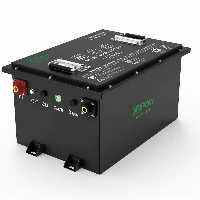
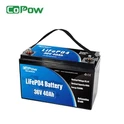
Advantages of Copow 48V 100Ah Lithium Golf Cart Battery
The reason Copow's 48-volt 100Ah lithium battery has received such consistent praise from buyers is that it truly addresses the most frustrating issues people face with golf carts, and it is worth looking at exactly what makes it so effective.
1. Superior Range and Performance
- Extended Mileage: A single charge supports 30–40 miles (50–60 km), which is more than enough for three consecutive rounds of 18-hole golf.
- Consistent Power Output: Unlike lead-acid batteries, Copow lithium batteries do not suffer from "voltage sag." Even at 10% capacity, your cart maintains full power for climbing hills and accelerating.
2. Intelligent Battery Management System
- Comprehensive Protection: The integrated advanced BMS monitors voltage, current, and temperature in real-time to prevent overcharging, over-discharging, short circuits, and overheating.
- Bluetooth Monitoring: Many Copow models feature smartphone App connectivity, allowing you to check remaining percentage, live current draw, and overall battery health directly from your phone, eliminating range anxiety.
3. Lightweight Design and Efficiency
- Significant Weight Reduction: This battery pack is approximately 250–330 lbs (120–150 kg) lighter than a traditional lead-acid set. This results in faster acceleration, shorter braking distances, and less wear on the golf course turf.
- Rapid Charging: It supports high-current fast charging, typically reaching a full charge in 3–5 hours, compared to the 8–10 hours required for lead-acid batteries.
4. Cost-Effectiveness and Longevity
- Ultra-Long Lifespan: With over 2000-6000 deep cycles, this battery can last 8 to 10 years with proper care, whereas lead-acid batteries usually need replacement every 2–3 years.
- Zero Maintenance: There is no need for watering or cleaning acid corrosion-it is a true "plug-and-play" solution.
5. Environmental Adaptability
- Temperature Resilience: Utilizing LiFePO4 cells, it is safer than standard lithium ions in high heat and maintains better discharge performance in cold weather compared to lead-acid alternatives.
Who Should Choose a 100Ah Golf Cart Battery?
- Standard Golfers - If you primarily use your cart for golf and play a maximum of 1 to 2 rounds (18–36 holes) per day, 100Ah is the ideal choice. The approximately 30-mile (50 km) range is more than enough, and the reduced weight minimizes pressure and damage to the course turf.
- Community Commuters - If you live in a gated community, retirement village, or resort and use your cart for grocery runs, picking up kids, or visiting the clubhouse, 100Ah provides enough power for several days of short trips without needing a daily charge.
- Value-Focused Upgraders - If you are looking to switch from old lead-acid batteries to lithium on a budget, 100Ah is usually the most affordable entry point. It is significantly cheaper than 160Ah or 200Ah high-capacity batteries while still vastly outperforming lead-acid batteries of the same rating.
- Performance & Agility Seekers - 100Ah lithium batteries are compact and lightweight, which is a major advantage for users who want to improve speed and handling. A lighter chassis means the motor doesn't have to work as hard, resulting in snappier acceleration.
- Users on Relatively Flat Terrain - If your driving routes consist mainly of flat asphalt roads or well-manicured grass without extreme or continuous steep inclines, the energy reserves provided by a 100Ah battery are perfectly sufficient for daily cruising.
conclusion
The runtime of a 100Ah battery can vary significantly depending on actual usage conditions. By choosing the right voltage system, maintaining efficient driving habits, and performing regular maintenance, you can significantly extend battery life and enhance overall golf cart performance.
Whether using lead-acid or lithium golf cart batteries, understanding these key factors ensures a more reliable, efficient, and enjoyable driving experience.
related article