Even though a forklift battery is clearly labeled as 200Ah, its capacity drops to 80%-or even as low as 60%-when used in cold environments.
Furthermore, the battery feels sluggish during operation in cold conditions, and upon returning to normal temperatures, moisture may even be found inside the battery.
So, how should we choose a forklift battery suitable for cold storage facilities? This article will provide you with an in-depth analysis.
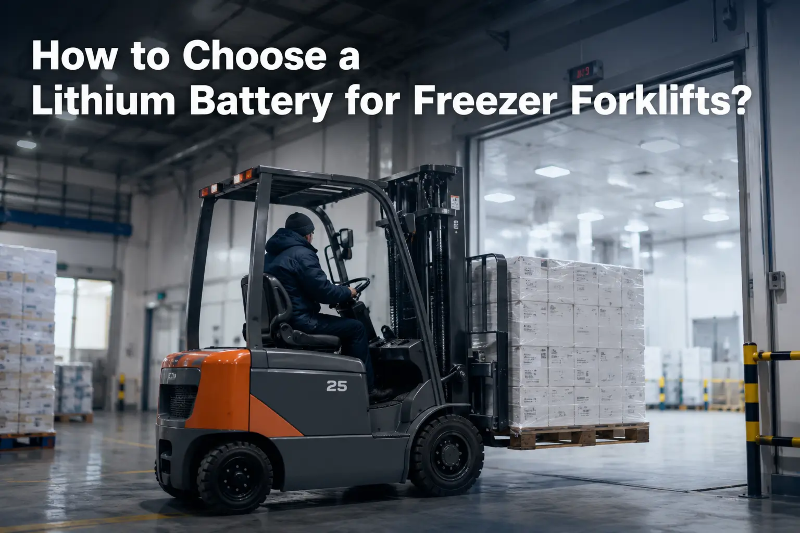
Why Freezer Forklifts Need Specialized Batteries?
The battery of an electric forklift can deliver nearly 100% of its performance at normal temperatures, but once exposed to cold conditions, performance drops significantly. Whether you use a Toyota or a KION forklift, this issue cannot be completely avoided.
The root cause of this problem lies in the batteries used in forklifts.
Forklifts primarily use lead-acid and lithium-ion batteries, both of which are affected to some extent by cold temperatures, though the degree of impact varies.
In cold environments, forklift batteries face the following four core issues: reduced range due to decreased battery capacity, diminished power performance, a loss of power, slower or problematic charging, and frost buildup or water ingress.
So, which batteries can best overcome these challenges? Let's continue reading to find out.
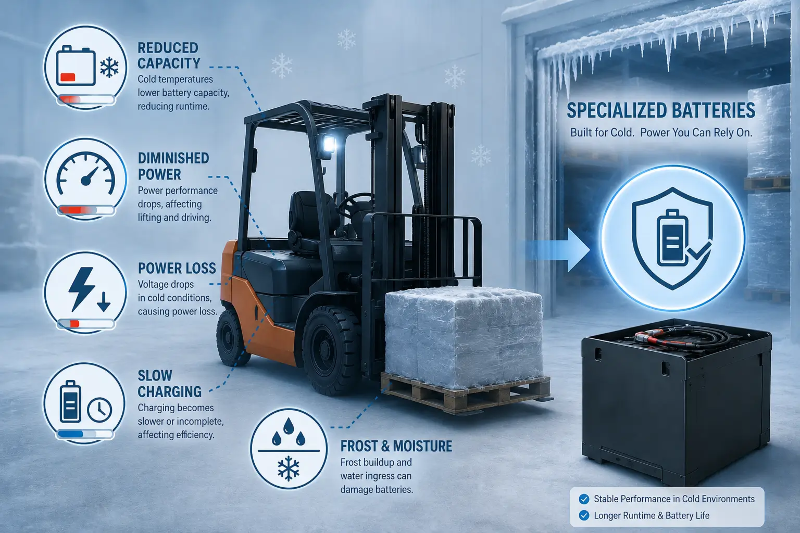
How Low Temperatures Affect Forklift Battery Performance?
So, how exactly do low temperatures affect the performance of forklift batteries? We can understand this by looking at the following factors:
Decrease in capacity
For example, a 200Ah forklift battery can only utilize 60% to 80% of its capacity under low-temperature conditions.
This is because as temperatures drop, the activity of the lithium ions or electrolyte inside the battery decreases, slowing down the movement of ions and preventing the battery from discharging energy normally as it does at room temperature.
In terms of runtime, this 200Ah forklift battery can operate for 8 hours at room temperature, but only 4–6 hours in a cold storage facility.
Recommended Operating Temperature for Freezer Forklift Batteries
| Ambient Temperature | Lead-Acid Forklift Battery Available Capacity | LiFePO4 Forklift Battery Available Capacity | Battery Performance Characteristics |
|---|---|---|---|
| 25°C (77°F) | 100% | 100% | Optimal operating condition with full capacity output |
| 15°C (59°F) | 90%–95% | 95%–98% | Stable performance with minimal impact |
| 5°C (41°F) | 80%–90% | 90%–95% | Runtime begins to decrease |
| 0°C (32°F) | 70%–85% | 80%–90% | Common cold storage temperature; slight power reduction |
| -10°C (14°F) | 50%–70% | 60%–75% | Noticeable drop in discharge performance and acceleration |
| -20°C (-4°F) | 30%–50% | 40%–60% | Significant runtime reduction; some forklifts may trigger low-voltage alarms |
| -30°C (-22°F) | 20%–40% | 25%–45% | Extremely cold environment; standard batteries struggle to operate normally |
| -40°C (-40°F) | Almost unusable | 10%–30% (Low-temperature models only) | Requires battery heating systems or specialized low-temperature batteries |
Lack of Power
This is a power deficiency issue caused by a drop in voltage output, which is particularly noticeable when lifting loads at temperatures below 0°C.
This can cause lead-acid batteries to suddenly shut down, while lithium-ion batteries will shut down due to the battery management system triggering low-voltage protection.
This is why operators may find that their forklifts fail to operate normally even though they have just been fully charged.
Slower Charging Speed
It's not just aging batteries that cause slower charging speeds; low temperatures can also lead to slower charging.
In fact, we recommend against charging batteries at temperatures below 0 degrees Celsius, whether they are lead-acid or lithium-ion batteries.
This is because doing so can cause varying degrees of damage to the battery.
In cold environments, the advantage of lithium-ion batteries over lead-acid batteries is that they are equipped with self-heating modules, which can preheat the battery before charging.
Inaccurate Battery Level Display
Have you ever encountered this situation: while driving an electric vehicle in winter, the battery level suddenly drops from 100% to 50%, forcing you to cancel your planned trip and rush to recharge the battery?
This can also happen with forklift batteries.
In cold temperatures, the battery level of many forklifts can become inaccurate. This is because the capacity of lead-acid batteries drops significantly, whereas for lithium-ion forklifts, the issue isn't a drop in capacity but rather the sampling method.
Low temperatures affect three key metrics for lithium-ion batteries: voltage sampling, current detection, and coulomb meter accuracy. If the collected data is off, the entire charge level display may be inaccurate. This does not mean that the battery's capacity has significantly degraded.
This issue currently represents a technical bottleneck for the entire battery industry, and solutions are actively being sought.
Related articles: How Accurate Is LiFePO4 SOC in Real-World Applications?
Battery Moisture
When a forklift battery is moved from a cold environment to a room-temperature environment, the frost on its surface gradually melts into water droplets.
This causes moisture to penetrate the battery's internal components. What happens if the battery isn't properly sealed?
It's easy to see: metal parts will rust, the BMS protection will fail, communication will be disrupted, and there may even be electrical leakage.
That said, we believe that the most significant impact of low temperatures on forklift batteries is the sharp decline in battery life.
Whether it's charging issues, moisture exposure, or capacity loss, all of these factors ultimately affect the battery's lifespan. A lead-acid battery that should last three years may become unusable after just a year and a half.
Therefore, it is essential to maintain forklift batteries properly.
Why Lithium Batteries Are Better Than Lead-Acid in Freezer Warehouses?
Before discussing how lithium-ion batteries maintain stability in low-temperature environments, let's first analyze why lead-acid batteries have been replaced by lithium-ion batteries. We have identified the following issues:
- Significant reduction in range in low-temperature environments
- Noticeable loss of power in low-temperature environments
- Requires frequent charging
- Various problems arise shortly after use, leading to frequent replacements
- Cumbersome maintenance procedures and high costs
Their only advantage is their low initial purchase price.
Each of these issues, when considered individually, poses a serious challenge for warehouse managers.
why do we have to choose lithium-ion batteries? They're so expensive!
In addition to overcoming the shortcomings of lead-acid batteries, the advantages of lithium-ion batteries are primarily reflected in operational efficiency.
The most highly praised benefits of lithium-ion batteries are their short charging times, stable power output, easy maintenance, and long service life.
Take a simple example: even for a single-shift logistics warehouse, the manager spent a fortune upgrading the forklift batteries from lead-acid to lithium-ion, which initially made him wince at the cost.
But as time went on, a year later he found that lithium-ion batteries were incredibly convenient and saved a significant amount on electricity bills.
Previously, they needed to purchase two sets of lead-acid batteries to use in rotation; now, a single set of lithium-ion batteries is sufficient.
Of course, they also mentioned that the lithium-ion battery's Battery Management System is somewhat complex, but overall it's useful-it allows them to monitor the battery's performance at any time and trace the cause of any issues that arise.
Related articles: Forklift Battery Types: Which One Is the Best Value?
What Features Should a Freezer Forklift Lithium Battery Have?
What Kind of Forklift Battery Can Withstand Extreme Cold?
It's truly frustrating when a forklift battery stops working in the dead of winter. Why do batteries seem to take a winter break just like students?
Therefore, to avoid this embarrassing situation, we need to check whether a forklift battery has the necessary features when selecting one for use in cold storage facilities. If these features aren't listed in the product specifications, we should ask the manufacturer for detailed information.
Low-Temperature Discharge Capability
At the very least, the battery's capacity should not decline too rapidly in low-temperature environments.
Heating Module
In low-temperature environments, this is arguably an essential feature.
BMS Low-Temperature Protection
In addition to basic overcharge protection, over-discharge protection, overcurrent protection, short-circuit protection, cell balancing, and fault logging functions, it should also include low-temperature discharge protection, temperature sensing, and precise SOC calculation capabilities for low-temperature environments.
IP67 Water Resistance
Although forklift batteries are primarily used on land, they may still be exposed to moisture.
Powerful and Stable Performance
To achieve this, lithium-ion forklift batteries must be prioritized, and the quality of their internal cells must be evaluated. For example, CoPow lithium-ion forklift batteries use CATL Grade A lithium iron phosphate cells, delivering powerful performance.
Compatibility
When upgrading from lead-acid to lithium-ion forklift batteries, you should pay special attention to whether the lithium-ion battery includes the following features or accessories: CAN communication, RS485 communication, SOC display, dedicated charger, and dedicated controller.
Battery Weight
While lead-acid batteries are heavy, lithium-ion batteries are lightweight. This does not mean that lithium-ion batteries cannot balance the forklift's center of gravity. You can customize counterweights, but you should confirm with the forklift battery supplier whether the counterweight placement is appropriate and how much additional weight is required.
Related articles: How Much Does A Forklift Battery Weigh?
Robust Internal and External Structure
Forklifts require frequent starting and stopping; a battery with a loose structure will certainly not withstand this, and internal components may become loose.
Remote Monitoring and Fault Diagnosis
Over the course of extended use, forklift batteries are bound to encounter various issues, particularly the more sophisticated lithium-ion batteries. Sometimes the battery is not actually damaged but has triggered certain protective mechanisms, requiring remote troubleshooting by a professional.
Safety Certifications
Actions speak louder than words; a reputable forklift battery supplier should be able to provide relevant documentation proving the quality of its batteries. Suppliers should be able to provide documents such as UN38.3, MSDS, CE, IEC 62619, cell test reports, BMS parameter sheets, and factory test reports.
Customization Options
Anyone can handle simple customizations like dimensions, casings, or counterweights. However, when dealing with extreme low-temperature environments, such as sub-zero degrees Celsius, we cannot approach the matter with a casual mindset.
We must assess whether to customize the forklift battery's BMS mechanism, waterproof rating, and heating module precision based on temperature, environment, and usage conditions.
Best Applications for Freezer Forklift Lithium Batteries
This cold-weather forklift battery is designed for use in low-temperature environments, but in which specific low-temperature scenarios is it suitable?
Who needs to use this battery?
We have compiled this information into a reference table for your convenience:
| Application Scenario | Typical Temperature | Why Lithium Batteries Are Suitable |
|---|---|---|
| Frozen Food Warehouses | -18°C to -25°C | More stable runtime and stronger power output in low temperatures |
| Cold Chain Logistics Centers | -5°C to 5°C | Fast charging supports high-frequency operations |
| Fresh Food Distribution Warehouses | 0°C to 5°C | Opportunity charging reduces battery swapping |
| Pharmaceutical Cold Storage | 2°C to 8°C | Cleaner, maintenance-free, and safer operation |
| Automated Cold Warehouses (AGV/AMR) | -20°C to 5°C | Supports CAN communication and remote monitoring |
| Port Cold Chain Logistics | Around -20°C | Better anti-corrosion, moisture-proof, and anti-condensation performance |
| Multi-Shift Warehouses | Ambient to freezer conditions | High charging efficiency for 24/7 operations |
| Heavy-Duty Freezer Forklifts | -20°C to 0°C | More stable high-current output under heavy loads |
| Food Processing Cold Rooms | 0°C to -18°C | IP67 protection is ideal for wet environments |
| Export Cold Chain Projects | Various low-temperature environments | Better meets European and North American environmental standards |
Related articles: How To Choose The Right Forklift Battery?
How to Maintain Cold Storage Forklift Batteries?
Why do we maintain forklift batteries? The goal is to extend their service life and prevent moisture damage. The maintenance methods for lead-acid batteries and lithium-ion batteries are completely different.
Let's take a look at how each type requires maintenance.
First, whether you have lead-acid or lithium batteries, they require the following maintenance:
- Avoid charging in cold environments; ensure the battery temperature returns to normal before charging.
- Avoid over-discharging, especially during long-term storage. Check the remaining charge regularly and follow the "20/80" rule.
- Wipe any water off the battery surface after each use.
- Regularly check the terminals and connecting cables for looseness or rust.
- Use a dedicated charger. Lead-acid and lithium batteries must never be mixed.
Special maintenance considerations for lead-acid batteries:
- Top up with distilled water regularly.
- Check the electrolyte level.
- Perform equalization charging.
- Clean corrosion from the terminals.
- Check for acid leaks.
Special maintenance considerations for lithium-ion batteries:
- Regularly review BMS alarm logs.
- Regularly inspect terminals and connectors.
- Check the heating system for issues.
- Perform SOC calibration regularly.
How Long Can a Lithium Freezer Forklift Battery Last?
A fully charged lithium-ion battery in a cold storage forklift can last between 6 and 10 hours, based on the most conservative estimate.
Even under the most demanding conditions, it can still operate for at least 4 hours.
In terms of service life, under normal conditions, lithium-ion forklift batteries used in cold storage facilities typically last 5 to 10 years, as they have a charge-discharge cycle life of over 6,000 cycles.
This may sound a bit vague, so let's compare the figures in a table:
| Battery Voltage | Battery Capacity | Typical Forklift Type | Typical Freezer Temperature | Typical Runtime In Freezer Warehouses |
|---|---|---|---|---|
| 24V | 100Ah | Electric Pallet Truck | 0°C to -10°C | 3–5 Hours |
| 24V | 200Ah | Walkie Stacker / Pallet Jack | 0°C to -20°C | 4–6 Hours |
| 24V | 300Ah | Small Electric Forklift | 0°C to -20°C | 5–7 Hours |
| 36V | 300Ah | Stand-Up Forklift | -10°C to -20°C | 5–8 Hours |
| 48V | 300Ah | Reach Truck | -10°C to -20°C | 5–8 Hours |
| 48V | 400Ah | Counterbalance Forklift | -10°C to -25°C | 6–10 Hours |
| 48V | 560Ah | Heavy-Duty Reach Truck | -20°C to -25°C | 7–11 Hours |
| 72V | 400Ah | Large Warehouse Forklift | -10°C to -25°C | 6–9 Hours |
| 72V | 600Ah | Heavy-Duty Forklift | -20°C to -30°C | 8–12 Hours |
| 80V | 560Ah | High-Capacity Counterbalance Forklift | -20°C to -30°C | 8–12 Hours |
| 80V | 700Ah | Port / Heavy Industrial Forklift | -20°C to -30°C | 10–14 Hours |
Related articles: How Long Do Forklift Batteries Last?
Keep Your Freezer Forklifts Running Without Worry!
So, why can CoPow's lithium-ion forklift batteries operate reliably in 0°C environments?
Features Grade A liFePo4 Cells
CoPow's LFP technology delivers outstanding performance in low-temperature environments, and all cells are sourced from renowned manufacturers such as CATL, EVE Energy, and BYD.
High-Quality BMS
CoPow sources basic BMS kits from specialized manufacturers such as JABDA, Dali, and Ginkgo, then performs localized adaptation. Through a model combining "core technology and in-house R&D," the system achieves full compatibility with low-temperature environments.
Low-Temperature-Optimized Discharge Parameters
Continuous discharge current, peak discharge current, overcurrent protection time, and low-temperature protection thresholds have all been optimized for cold environments.
Powerful and Stable Performance
This is an advantage provided by high-quality lithium iron phosphate cells.
Excellent Sealing
Waterproof rating up to IP68, with a tight, seamless installation.
More Sensitive Heating Modules
CoPow offers customized self-heating modules tailored to different cold conditions (0°C, -10°C, -20°C).
Remote Diagnostics Support
CoPow's BMS can retrieve battery data via Bluetooth, CAN, RS485, or cloud platforms, enabling rapid identification of the root cause of issues and providing on-site assistance when necessary.
If you are interested in CoPow forklift batteries, please feel free to contact us at any time. We would be happy to discuss all aspects of forklift batteries suitable for cold storage facilities with you.
FAQ
Can Lithium Forklift Batteries Be Charged Inside a Freezer?
In theory, lithium-ion forklifts can be charged anywhere and at any time, provided the battery temperature is maintained at room temperature.
This does not mean that charging is impossible at temperatures below 0°C. It's like eating in the winter: just as food needs to be heated before it can be eaten, forklift batteries can be charged once they have been warmed to room temperature.