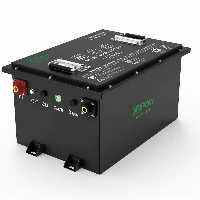
In 2026, as the technical architecture of electric vehicles continues to evolve, the CAN bus protocol has become the core communication standard for lithium battery golf carts. With growing market demands for smarter systems and more precise range management, traditional point-to-point wiring can no longer support the level of interaction required by modern vehicle systems.
Through the CAN bus, lithium battery packs can establish high-frequency data communication with the motor controller, charger, and dashboard. This integrated approach replaces complex physical wiring, enabling all components to exchange operating parameters in real time.
The following content will analyze the working principles of the CAN bus, compare the practical differences between J1939 and CANopen, and explain how data transparency improves vehicle operation and maintenance efficiency.

What Is the CAN Bus Protocol and How Does It Work?
The CAN Bus (Controller Area Network) is a robust vehicle bus standard designed to allow microcontrollers and devices to communicate with each other's applications without a host computer.
In the context of 2026 lithium golf cart systems, it acts as the central nervous system, enabling seamless dialogue between the BMS, motor controller, charger, and dashboard.

How CAN Bus Protocol Works?
The operational efficiency of CAN Bus is built on four core technical principles:
Broadcast Communication
Unlike point-to-point wiring, CAN Bus operates on a broadcast networking model. The BMS sends data packets-such as State of Charge or temperature-onto the main bus lines. Every connected node on the network receives this information and decides whether to process it based on its relevance.
Priority-Based Arbitration
CAN Bus utilizes a process called non-destructive bitwise arbitration. Each message is assigned a unique identifier that determines its priority. If the BMS sends a critical over-temperature alert at the same millisecond the dashboard sends a mileage update, the safety-critical alert wins immediate access to the bus while the lower-priority data waits.
Differential Signaling
To ensure reliability in the electrically noisy environment of a golf cart motor, CAN Bus utilizes two wires known as CAN-High and CAN-Low. The system reads the voltage difference between these two lines rather than their absolute voltage. This differential approach allows the protocol to cancel out electromagnetic interference, ensuring data integrity during high-speed operation.
Error Management and Fault Confinement
The protocol includes built-in error detection mechanisms such as cyclic redundancy checks and frame checks. If a device consistently produces errors, the network can logically disconnect that faulty node to prevent it from paralyzing the entire communication system.
Why It Is Essential for 2026 Integration?
| Feature | Standard Lithium Battery | CAN-Integrated Lithium System |
| Data Precision | Estimated voltage levels | Real-time 1% SOC and SOH accuracy |
| System Diagnostics | Manual hardware testing | Instant digital error code reporting |
| Operational Safety | Reactive hardware cut-offs | Proactive power limiting via controller |
| Fleet Scalability | Isolated standalone units | Interconnected cloud-monitored assets |
"The CAN bus protocol is more than just two copper wires - it is the 'nervous system' of lithium batteries, transforming a once silent battery pack into an intelligent asset that can think and communicate."
Key Communication Protocols: J1939 vs. CANopen in BMS?
In the lithium battery integration landscape of 2026, choosing a communication protocol is essentially about defining a product's application positioning. Although J1939 and CANopen both operate on the CAN bus foundation, their design philosophies and intended use cases differ significantly.
J1939 is widely used in commercial vehicles and heavy construction machinery, with a strong emphasis on standardization and compatibility with heavy-duty equipment. CANopen, by contrast, is more commonly found in industrial automation and precision medical devices. It offers greater flexibility and is better suited to systems that require a high level of customization.
Because these two protocols are built on different underlying logic, the choice of protocol has a direct impact on subsequent hardware selection and the overall direction of software development.
1. SAE J1939: The Heavy-Duty Industry Standard
Originally developed for trucks and buses, J1939 is the dominant protocol for commercial vehicle integration.
- Characteristics: It is highly structured and standardized. Parameters such as voltage, current, and temperature are pre-defined using PGN (Parameter Group Numbers).
- Strengths: High Compatibility. Leading golf cart controllers, such as those from Curtis or SME, typically come with pre-installed J1939 libraries. By following the standard PGNs, your BMS ensures immediate recognition by the vehicle's system.
- Best Use Case: Standardized golf cart fleet conversions and commercial applications where safety and "plug-and-play" reliability are paramount.
2. CANopen: The Flexible Industrial Powerhouse
Originating from industrial automation and robotics, CANopen offers a more modular approach.
- Characteristics: It relies on an Object Dictionary (OD). Instead of pre-defined global parameters, it provides a framework that allows manufacturers to define their own data structures.
- Strengths: Extreme Flexibility. If your BMS includes proprietary features-such as advanced balancing algorithms or custom anti-theft logic-CANopen allows you to map these unique data points easily via EDS (Electronic Data Sheet) files.
- Best Use Case: High-end custom golf carts or specialized utility vehicles that require integration with complex industrial sensors or automated systems.
3. Core Comparison
| Feature | SAE J1939 | CANopen |
| Origin | Commercial Vehicles / Heavy Machinery | Industrial Automation / Robotics |
| Configuration | Low Complexity (Ready to use) | High Complexity (Requires OD/EDS setup) |
| Data Handling | Supports long, multi-frame messages | Optimized for short, 8-byte PDO transfers |
| Market Presence | Standard for North American golf carts | Common in European high-end machinery |
| Learning Curve | Straightforward (Table-based) | Steep (Protocol stack expertise required) |
4. Making the Choice for 2026
For BMS manufacturers and system integrators, the decision hinges on your target market:
- Choose J1939 if you are targeting the mass aftermarket. It ensures your battery can replace a lead-acid unit and communicate with existing dashboards and controllers with zero extra programming.
- Choose CANopen if you are developing vertically integrated, proprietary platforms. This is ideal for manufacturers building "Smart Carts" that require high-frequency coordination with complex peripherals.
Expert Insight: "In 2026, premium BMS solutions often feature Dual-Protocol Auto-Detection. By analyzing bus traffic at startup, the firmware automatically switches between J1939 and CANopen, offering the ultimate integration experience."

Data Transparency: What You Can Read via CAN-bus Integration?
By 2026, it is no longer sufficient for BMS manufacturers to simply claim "communication support." Today's technology buyers place far greater value on the depth of data accessibility.
Through CAN bus integration, a battery evolves from a closed piece of hardware into a transparent digital node. Via standardized protocols, buyers can access data across the following four layers:
1. Real-Time Vital Signs
These are the essential metrics required for daily vehicle operation and basic monitoring.
- Precision SOC (State of Charge): Unlike inaccurate voltage-based estimates, CAN-bus provides 1% accuracy derived from coulombs counting and sophisticated algorithms.
- Total Voltage & Real-Time Current: Monitors energy flow intensity to prevent motor controller overload.
- Temperature Extremes: Tracks the highest and lowest temperature points within the pack in real-time.
2. Cell-Level Granularity
This is the benchmark for "Deep Integration" in 2026. Professional buyers use this to audit battery quality.
- Cell Voltage Differential: Accesses the voltage of every individual cell to monitor balance and identify weak cells before they fail.
- Balancing Status: Observes which specific cells are undergoing active or passive balancing at any given moment.
- Internal Impedance: Monitors changes in cell resistance-a critical leading indicator for aging and thermal runaway risks.
3. Health & Lifecycle Analytics (SOH)
For fleet operators and leasing companies, this data is the core of asset management and resale value.
- SOH (State of Health): The current health percentage relative to the original factory capacity.
- Cycle Count: The number of full charge/discharge cycles completed.
- Energy Throughput: The total cumulative kilowatt-hours (kWh) the battery has delivered over its lifetime.
4. Diagnostics & "Black Box" Logs
CAN-bus integration turns troubleshooting from guesswork into a data-driven process.
- Protection Trigger Counters: Records exactly how many times the battery has hit over-current, over-voltage, or high-temperature limits.
- Diagnostic Trouble Codes (DTC): Standardized error codes that tell the dashboard immediately if the issue is a "Cell 5 Under-voltage" or a "Communication Timeout."
- Historical Extremes: Logs the absolute highest temperature and peak discharge current the battery has ever experienced.
Why Data Transparency Drives ROI in 2026?
| Data Value | Standard Battery (No Comms) | CAN-Integrated Battery |
| Resale Value | Estimated based on age; high risk. | Certified data reports; 20-30% premium. |
| Maintenance | Replace the entire pack on failure. | Pinpoint and repair specific cell/wiring issues. |
| User Experience | Sudden power loss mid-fairway. | Proactive "Limp Mode" alerts 15 mins prior. |
"In the 2026 market, data is the new currency. A battery with a verifiable CAN-bus history isn't just a power source; it's a bankable asset with a transparent lifecycle."
Troubleshooting & Predictive Maintenance via CAN-bus?
The core commercial value of CAN bus integration lies in reducing equipment downtime. In traditional systems, once a lithium battery fails, maintenance personnel often have to rely on physical disassembly to identify the root cause.
In CAN-enabled systems, the battery continuously outputs real-time operating data. Through the communication protocol, technicians can directly pinpoint the exact location and cause of a fault-such as cell voltage imbalance or a communication link interruption.
This level of data transparency shifts maintenance from blind troubleshooting to targeted repairs, significantly improving after-sales service efficiency.
1. From Reactive Repair to Predictive Maintenance
This is the most sought-after feature for fleet managers in 2026. By analyzing subtle fluctuations in CAN-bus data, systems can issue warnings weeks before a failure occurs:
- Impedance Drift Detection: If CAN data reveals a steady rise in the internal resistance of a specific cell string-even if the voltage remains normal-the algorithm predicts a failure within months, triggering a preemptive maintenance alert.
- Thermal Delta Analysis: The system monitors the rate of temperature rise rather than just the limit. If a module heats up faster than the historical baseline, the CAN-bus triggers a warning to prevent potential thermal runaway.
- Capacity Degradation Trending: By comparing charge/discharge curves over time, the SOH (State of Health) data informs operators exactly how much longer the fleet can sustain a full day's operation.
2. Digital Troubleshooting: No More Guesswork
When a golf cart stops unexpectedly on the green, CAN-bus integration makes the repair process as simple as reading a computer error code:
- Pinpoint Accuracy: Diagnostics move from a vague "battery failure" to a specific "Loose communication cable on Module 3" or "Over-discharge on Cell String 8."
- Freeze Frame Data: At the exact moment a protection is triggered, the BMS locks a snapshot of the current, voltage, and temperature across the CAN-bus. Technicians can "see the scene of the accident" even after the fault has cleared.
- Remote Diagnostics: Combined with 2026 IoT gateways, experts can analyze CAN message logs via the cloud, guiding on-site staff to the exact component that needs attention without ever traveling to the site.
3. Comparison of Maintenance Workflows
| Scenario | Traditional Maintenance | CAN-bus Predictive Maintenance |
| Emergency Breakdown | Cart is towed; hours of manual testing required. | Dashboard displays: "Maintenance required in 3 days" before breakdown occurs. |
| Warranty Disputes | Subjective arguments between user and manufacturer. | Objective "Black Box" CAN logs show historical temp and discharge violations. |
| Mass Inspections | Manual voltage checks for 100+ carts. | One-click cloud scan generates a health report for the entire 100-cart fleet. |
"Troubleshooting via CAN-bus moves maintenance from 'fixing what's broken' to 'managing what's aging.' It significantly reduces the Total Cost of Ownership (TCO) by transforming unplanned downtime into scheduled, 15-minute interventions."
Implementation Checklist for Seamless System Integration
To ensure reliable operation of a lithium battery system within 2026 golf cart architectures, the following five core factors must be verified before integration:
1. Physical Layer Integrity
- Termination Resistors: Ensure a 120Ω resistor is installed at each of the two extreme ends of the CAN bus (typically at the BMS and the Motor Controller). Missing resistors cause signal reflection and data corruption.
- Shielded Twisted Pair (STP): Given the high electromagnetic interference (EMI) from the motor, STP cabling is mandatory. Ensure the shield is grounded at a single point to prevent ground loops.
- Baud Rate Synchronization: Confirm all nodes (BMS, Charger, Display) are set to the same speed. In 2026, the industry standards are typically 250 kbps or 500 kbps.
2. Protocol Handshake & Timing
- Identifier (ID) Conflict Check: Verify that no two devices on the bus share the same CAN ID to prevent message collisions.
- Heartbeat/Broadcast Frequency: Ensure the BMS transmission rate (e.g., 100ms per frame) aligns with the controller's expectations. If the message frequency is too slow, the controller may trigger a safety "comm-loss" fault.
3. Data Mapping & Parsing
- EDS/DBC Alignment: For CANopen systems, ensure you have the correct EDS (Electronic Data Sheet). For J1939, use the correct DBC file to define bit offsets and scaling for parameters like Voltage and SOC.
- Endianness Confirmation: Verify if the system uses Big-endian or Little-endian byte order. Incorrect mapping will result in nonsensical data readings (e.g., a current of 10A appearing as 2560A).
4. Fail-Safe & Error Logic
- Communication Timeout Strategy: Define what happens if the bus goes silent. A "Seamless Integration" should trigger a Limp Mode (reduced power) rather than an abrupt, dangerous shutdown in the middle of a fairway.
- Bus-Off Management: The BMS should be configured to isolate itself if it detects it is producing excessive error frames, preventing a single faulty node from paralyzing the entire vehicle.
5. Remote Connectivity Ready
- IoT Gateway Compatibility: Ensure the CAN interface is accessible for IoT telematics. In 2026, being "Integration Ready" means the bus data must be easily bridgeable to the cloud for remote predictive maintenance.
Summary Checklist for Technicians
| Step | Action Item | Verified? |
| 1 | 120Ω Resistors at both ends | [ ] |
| 2 | Baud Rate matched across all devices | [ ] |
| 3 | DBC/EDS file mapping validated | [ ] |
| 4 | Fail-safe "Limp Mode" tested | [ ] |
| 5 | Shielded cabling grounded correctly | [ ] |
Conclusion
The CAN bus protocol is the core engine driving the intelligence of lithium battery golf carts in 2026. It not only ensures communication reliability in complex electrical environments through differential signaling and priority-based arbitration but also transforms the battery from a "black box" into a predictable, manageable digital asset through full-spectrum data transparency.
Whether pursuing the standardized compatibility of SAE J1939 or the highly customizable flexibility of CANopen, this protocol significantly reduces the vehicle's total cost of ownership (TCO).
For electric golf cart manufacturers and fleet operators, mastering CAN bus integration and diagnostics is not only key to enhancing the user experience but also the essential pathway to enabling predictive maintenance and cloud-based asset management.
related article: Real-time SOC & SOH Monitoring Via RS485