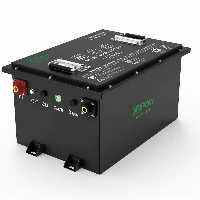
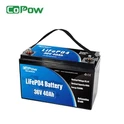
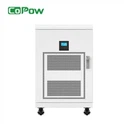
A complete lithium-ion battery upgrade kit for golf carts includes a lithium-ion battery, a battery management system (BMS, built into the battery), a dedicated lithium-ion battery charger, mounting brackets, an SOC (State of Charge) indicator, and an optional DC-DC step-down converter depending on the vehicle's configuration.
If the upgrade involves a voltage change, electrical components such as the controller and solenoid switch must also be upgraded.
It seems like quite a few parts are needed, so let's take a closer look.

Complete Golf Cart Lithium Battery Upgrade Checklist
| Component | Required? | When Is It Needed? |
|---|---|---|
| Lithium Battery | Required | All lithium battery upgrades |
| Lithium Charger | Required | All lithium battery upgrades |
| Battery Mounting Hardware | Required | Most upgrades |
| Battery Cables | Depends | Existing cables are worn, damaged, or too short |
| Main Fuse | Strongly Recommended | All lithium battery upgrades |
| Disconnect Switch | Recommended | All lithium battery upgrades |
| SOC Meter | Recommended | The factory gauge cannot accurately display the battery's state of charge (SOC) |
| LCD Display | Recommended | When you want to display SOC and battery information (a separate SOC meter is unnecessary if the LCD already provides this function) |
| Bluetooth Monitoring | Recommended | When the battery is equipped with a Bluetooth-enabled BMS |
| DC-DC Converter | As Needed | The golf cart has 12V accessories such as lights, audio systems, USB ports, or other 12V loads |
| Controller | As Needed | Upgrading the system voltage (e.g., 36V to 48V) |
| Solenoid | As Needed | Upgrading the system voltage |
| Motor | As Needed | Increasing performance or significantly increasing the system voltage |
| Accelerator / MCOR | As Needed | The existing accelerator or MCOR is incompatible with the new controller |
| Heavy-Duty Battery Cables | As Needed | High-current or high-performance upgrade applications |
| CAN Bus Adapter | As Needed | Certain vehicle models requiring communication between the battery and the vehicle |
| Battery Tray Adapter | As Needed | The new battery dimensions do not match the original battery compartment |
| Basic Installation Tools | Required | During the battery installation process |

Essential Items for a Golf Cart Lithium Battery Upgrade
Replacing the lithium-ion battery in a golf cart is much like modifying a car: some parts are essential, while others-though not strictly necessary-can enhance your experience. First, let's take a look at the essentials.
A Matching Lithium Battery Pack
Lithium-ion batteries are at the heart of the entire upgrade project and are the first components that need to be selected.
If you're simply replacing the original lead-acid batteries with lithium-ion batteries, the safest and quickest approach is to maintain the same system voltage-that is, 36V for 36V, 48V for 48V, and 72V for 72V. This allows you to continue using the vehicle's original controller and motor, thereby lowering upgrade costs and reducing the risks associated with the modification.
However, if you wish to upgrade from 36V to 48V or even 72V, this is no longer a simple battery replacement but involves an upgrade of the entire electrical system. Components that need to be replaced simultaneously include the controller, solenoid switch, lithium-ion battery charger, DC-DC step-down converter, as well as some wiring harnesses and fuse protection devices.
Otherwise, even if the battery itself is in good condition, issues such as controller error messages, burnt-out solenoid switches, voltage mismatches with accessories, or even motor overheating may occur.
In addition, you'll need to select the appropriate battery capacity. There are three popular voltage options for golf cart lithium-ion batteries: 36V, 48V, and 72V; the most common capacity options are 100Ah, 105Ah, 150Ah, and 160Ah.
Of course, lithium-ion batteries for golf carts can be customized and offer more customization options than lead-acid batteries. You can choose a professional lithium-ion golf cart battery manufacturer like CoPow.
They have customized exclusive lithium-ion battery packs for over 100 owners worldwide, covering various aspects such as capacity, dimensions, casing color, and mounting interfaces. A full range of features is available, including BMS functionality, Bluetooth, LCD displays, CAN communication, GPS positioning, and self-heating.

A Lithium-Compatible Charger
It is very important to use a dedicated lithium-ion battery charger, as lead-acid chargers cannot be used directly to charge newly installed lithium-ion batteries. This is because the charging logic for lead-acid batteries and LiFePO4 batteries is completely different; forcing their use will not only damage the charger but also harm the battery.
Lead-acid batteries are charged using float and equalization modes, which involve a lengthy recharge process; lithium-ion batteries, on the other hand, use a constant current/constant voltage (CC/CV) charging method. This mode automatically stops charging when the battery is nearly full and does not enter a float charge phase, thereby providing better protection for the battery.
Many people may wonder what would happen if they used a lead-acid charger to charge a lithium-ion golf cart battery.
You'll find that even after charging for a long time, the battery won't reach full capacity. Once the battery management system detects this abnormal charging condition, it will immediately activate the charging protection mechanism and cut off the power supply.
When selecting a lithium-ion battery charger, don't just look at the nominal voltage of 36V or 48V; instead, check whether its actual output voltage matches the battery (manufacturers typically provide a charger).
For example, although a 48V LiFePO4 battery has a nominal voltage of 48V, it actually belongs to a 51.2V battery system, and its fully charged voltage must reach 58.4V.
If the charging voltage of a lithium-ion charger you purchase on your own is significantly lower than this value, the charger will be unusable, and you'll encounter a situation where the battery remains uncharged even after prolonged charging.
In addition, charging current is another important consideration. If the current is too low, charging will take a long time; if it is too high, it may trigger the battery management system's maximum charging current limit, causing the power to be cut off and an alarm to sound.
For golf cart lithium-ion batteries, common charging currents typically range from 15A to 20A, 25A, or 30A. The specific current should be determined based on the battery capacity and the specifications of the battery management system.

A Truly Effective Battery Management System
As we know, the lithium-ion batteries in today's golf carts are equipped with protection boards, also known as battery management systems.
This system primarily provides comprehensive protection for the battery, including overcharge protection, over-discharge protection, overcurrent protection, short-circuit protection, high- and low-temperature protection, cell balancing, and SOC estimation.
We have received numerous reports from customers stating that the lithium-ion batteries they purchased frequently trigger various protection mechanisms, rendering the protection system ineffective and severely impacting the user experience.
This is because golf cart batteries on the market are standardized products, and all BMS parameters are set according to general industry standards. For example, a 48V 100Ah lithium-ion golf cart battery has a continuous discharge current protection threshold of 100A–120A, but its peak discharge current protection is only 200A.
In such situations, if the golf cart is loaded with a large amount of luggage or is traveling on a steep incline-requiring the release of more kinetic energy-the discharge current can easily exceed 200A, triggering the BMS's overcurrent protection mechanism and causing the vehicle to suddenly shut down.
Therefore, when purchasing lithium-ion batteries for golf carts, be sure to verify all parameters to avoid buying products that appear to work well but actually have underlying issues.

Battery Hold-Down Brackets or Spacers
As everyone knows, lithium-ion batteries are much lighter and smaller than lead-acid batteries.
You might be concerned that such a small battery will rattle around once installed in the battery compartment. After all, the original lead-acid battery was roughly the same size as the compartment, leaving little extra space.
To address this issue, manufacturers of lithium-ion golf carts equip the batteries with mounting brackets, retaining plates, and anti-slip pads.
These components secure the battery in place, ensuring it does not shift while the vehicle is in motion. However, some suppliers may not include these accessories, so you should read the product description carefully.

Battery Wires
Regardless of whether the original wires are in good condition, we recommend replacing them as well. These wires are typically included in the golf cart lithium-ion battery conversion kit, so there's no need to purchase them separately-you can use them right away.

Main Fuse
Although the fuse does not directly participate in battery power supply, it plays a crucial role as a safety component.
Its core function is to immediately cut off power to the entire vehicle in the event of an overcurrent, short circuit, or serious system failure, thereby preventing further damage to the battery, controller, motor, and the vehicle's wiring harness.
Lithium-ion batteries have a higher discharge capacity; in the event of a short circuit, the instantaneous current is far higher than that of a lead-acid battery system, posing a greater safety risk.
Therefore, in lithium-ion battery upgrade projects, a main fuse is typically installed in series within the battery's positive terminal main circuit to form the first line of defense.
Common fuse configurations include high-breaking-capacity DC fuses, such as MEGA Fuse and ANL Fuse, whose rated current must be appropriately matched to the maximum current of the vehicle's electrical system.
As a side note, many people may wonder: Since the Battery Management System provides comprehensive protection, why are fuses still necessary?
This is because the Battery Management System primarily protects the battery cells and the battery pack itself, while fuses protect the vehicle's high-voltage main circuit and external power circuits, such as the controller, motor, and vehicle wiring harness.

Basic Installation Tools
Many brands of lithium-ion golf cart batteries claim their products are "plug-and-play" and very easy to install. However, this does not mean you can simply place the battery in the battery compartment and connect it to the power supply.
"Plug-and-play" refers to the fact that the battery's voltage, connectors, and installation logic have been optimized to match the original vehicle system as closely as possible; however, during the actual installation, you will still need to use the included toolkit to complete the steps of removal, wiring, securing, testing, and tidying up on your own.
If you need to replace the battery yourself, you'll need to use a socket wrench to remove the battery terminals and secure clamps when removing the old lead-acid battery.
During installation, you'll need to use zip ties, wire harness protectors, battery mounts, and clamps, and have a multimeter on hand to verify the total battery voltage, the polarity of the positive and negative terminals, the DC-DC input and output voltages, and whether the wiring connections are correct.

Recommended Accessories for a Golf Cart Lithium Battery Upgrade
Although the basic accessories are ready to use right out of the box, if you want to further enhance your user experience, you can also add the following accessories:
Standard Power Disconnect Switch
This seemingly unremarkable little component plays a crucial role when repairing or modifying the electrical system of a golf cart.
For example, when servicing the vehicle, replacing the controller, inspecting wiring, or installing other electrical accessories, simply turning off the power disconnect switch cuts off the main power supply, eliminating the hassle of repeatedly disconnecting the battery terminals.
If an abnormal situation occurs (such as a controller failure, smoking wires, or an electrical system malfunction), the power disconnect switch also serves as an emergency power-off device, allowing users to quickly cut off power to the entire vehicle and prevent the fault from escalating.
It is important to note that the power disconnect switch cannot replace the main fuse or the battery management system. Its function is to manually control the connection and disconnection of the power supply, while the main fuse provides protection against severe faults, and the BMS handles the intelligent management of the battery's internal operations.
Each component fulfills its specific role, collectively forming a safer and more reliable lithium-ion battery system.

SOC Meter or LCD Display
In many golf carts, the factory-installed instrument panel serves primarily as a voltmeter, allowing drivers to roughly estimate the remaining battery charge based on the battery voltage.
This method is still somewhat usable with lead-acid batteries, as their voltage drops significantly during discharge.
However, lithium-ion golf cart batteries-primarily LiFePO4 batteries-are entirely different. Their discharge curve is very flat, making it impossible for the golf cart's gauge to accurately determine the remaining charge. This is why, after upgrading to lithium-ion batteries, many users find that their original charge gauges are inaccurate.
For example, the charge level might suddenly drop from 100% to 10% or even 0%. In such cases, you may not even realize that the battery has triggered the Battery Management System's low-voltage protection mechanism due to over-discharge.
Therefore, you may need to purchase an additional SOC Meter or LCD Display.
The SOC Meter accurately displays the remaining battery charge and is relatively inexpensive, making it suitable for casual golf cart owners; the LCD Display, on the other hand, not only shows battery charge but also displays voltage (total voltage), current (charging/discharging), temperature, fault alerts (OVP/UVP/OTP, etc.), cycle count (on some systems), and CAN status-much like a smartphone.
Of course, this may require an additional purchase and is better suited for professional owners.
Another benefit of choosing these two accessories is that you can view the battery's operating status directly on the cart's dashboard, without having to open the Bluetooth app in the background to check the data.

GPS Tracking Module
The GPS tracking module is designed to facilitate fleet management and theft prevention. Its core function is to use GPS and mobile networks (4G/5G/LTE) to upload vehicle location data in real time, allowing users to view the vehicle's operational status and geographic location at any time on their mobile phones or computers.

Accessories Needed for Special Golf Cart Lithium Battery Upgrade Scenarios
There are certain accessories that are required for specific modifications, so you should be aware of the following:
A DC-DC Voltage Reducer
If your golf cart is used for more than just transportation-and is equipped with a stylish 12V lighting system, a sound system that plays entertaining content, or even other electrical devices like a small fan-then you need to consider not only the battery's capacity but also voltage compatibility.
A 48V battery cannot directly power loads with a rated voltage lower than 48V. If you want to operate a 12V lighting system properly-or charge your phone while you're at it-you'll need one or more DC-DC voltage converters. Only by using a step-down converter can you convert the 48V high voltage to 12V DC, ensuring proper power supply to various devices.

Controller and Solenoid (Only for Voltage Upgrades)
If you simply replace a lead-acid battery with a lithium-ion battery of the same voltage (for example, replacing a 36V lead-acid battery with a 36V lithium-ion battery, or a 48V lead-acid battery with a 48V lithium-ion battery), the vehicle's original controller and solenoid should continue to function properly. This is because the voltages match.
For any device, it is best to maintain voltage compatibility during both discharge and charge cycles.
Therefore, for owners looking to upgrade their 36V golf cart battery to 48V, the considerations become a bit more complex: the controller, solenoid switch, and motor-which were originally designed for a 36V load-all need to be replaced with components compatible with a 48V battery.
Why is this? Failure to make these replacements can lead to serious consequences.
Take the controller, for example-it is the core component responsible for regulating the motor's output. If a 48V golf cart battery is used to power a 36V controller, it can cause error messages on the instrument panel, severe overheating, damage to the MOSFETs, and may even burn out the controller entirely. As for the solenoid switch and the motor, the consequences can be even more severe.
Motor
As we've mentioned, if you're upgrading from a 36V to a 48V lithium-ion battery, all of your existing electrical components-including the motor-will need to be adapted.
If the voltage of the old battery matches that of the new one, you can continue using the old motor, but it will only perform as it did when you first bought it. If you want higher speed, torque, or hill-climbing capability, you'll need to replace the motor as well.
Accelerator/MCOR
After replacing the controller, you may also need to add a new accelerator, as the original accelerator may not be compatible with the new controller.
You may encounter issues such as inconsistent signal voltage ranges, differing linear output curves, or incompatible communication protocols, which could result in a less-than-smooth acceleration process.
Heavy-Duty Cables
Similarly, if you plan to upgrade the voltage from 36V to 48V or higher, you'll also need to replace the wiring harness.
If your 48V lithium battery uses wiring designed for 36V, the wire gauge will be too small to handle such a high current, which can cause overheating and even burn out the battery terminals. In this case, we recommend using 2 AWG or even 1/0 AWG wiring.
CAN Communication Adapter
Many electric golf carts today rely on the CAN bus for data exchange, including SOC display, battery status reading, fault code display, and charge/discharge control logic-all of which depend on communication protocols to function.
Therefore, simply replacing the lithium-ion battery with one that has a CAN communication interface is not sufficient. A BMS with a CAN interface merely indicates that it is capable of outputting data (such as SOC, voltage, current, etc.), but this does not guarantee that the data will be successfully transmitted.
For example, the instrument cluster may only recognize the protocol of a specific BMS brand, the controller may only accept specific data structures, or the OEM system may have locked down the communication rules.
In such cases, a CAN adapter is required for protocol conversion-the same principle applies as ensuring that the battery voltage meets the aforementioned requirements.
Battery Heating System
Whether it's a lead-acid battery or a lithium-ion battery, their performance and capacity are affected in low-temperature environments, and in some cases, they may even be unable to charge.
The purpose of a battery heating system is to automatically preheat the battery pack before or during charging, raising the cell temperature to a safe operating range (above 0°C), and then proceeding with normal charging.
This ensures that the battery can still function normally in cold environments. Therefore, such systems are primarily suitable for regions where winter temperatures consistently remain below 0°C, as well as golf courses in North America, Northern Europe, and high-altitude areas.
Conclusion
This article categorizes the components required for upgrading lithium-ion batteries in golf carts into three main groups: essentials, optional items, and essentials for special circumstances.
The basic essential configuration determines whether the system can operate normally and includes the battery itself, the charger, and basic installation and protection components. The functional optimization configuration is primarily used to enhance the user experience and safety, while the extended configuration is designed for specific application scenarios to address more advanced compatibility issues.
You can select components based on your specific needs; there is no need to choose everything.
Finally, if you'd like to customize a lithium-ion battery for your golf cart, please feel free to contact us. We'll provide you with a tailor-made, reasonable, and cost-effective lithium-ion battery upgrade solution for your golf cart, so you won't have to worry about which components to choose.