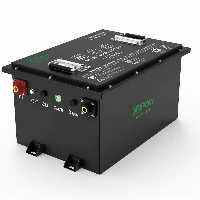
Whether you're upgrading a fleet or simply replacing the battery in your own cart, understanding the difference between 48V and 51.2V batteries is crucial, as it directly affects how the cart drives and how long it will last.
Although people often refer to both as "48-volt systems," in reality, they represent two completely different technological eras-essentially a leap from old lead-acid technology to LiFePO4 systems.
Choosing the right voltage isn't just about the number on the label. It directly impacts whether your cart has enough power on hills, how much maintenance you'll need to worry about, and whether the investment makes sense over the next ten years.
Here, we'll explore exactly why the extra voltage in a 51.2V system matters from a technical standpoint, and why the 16-series configuration has become the new standard for high-performance golf carts.

What Are 48V and 51.2V Golf Cart Batteries?
Although both 48V and 51.2V batteries are commonly referred to as "48-volt systems" in the community, they actually represent two completely different technological eras.
The 48V batteries that were widely used in the past were mostly lead-acid batteries or 15-series lithium batteries. The most noticeable issue with these batteries is their lack of endurance.
Once the charge drops to half, you'll notice the golf cart slows down significantly, and climbing hills becomes a struggle. On top of that, lead-acid batteries are very heavy and require regular water maintenance-neglecting this can easily ruin the battery.
In contrast, the 51.2V battery is now the standard specification for mainstream LiFePO4 batteries. Its internal structure includes an extra cell compared to systems, and it's precisely this additional voltage that allows the cart to deliver stable power when carrying passengers or climbing slopes, without slowing down as the charge decreases.
These batteries are lightweight, reducing the load on the vehicle, and require no maintenance. Their lifespan can often exceed ten years.

Why Are Some LiFePO4 Golf Cart Batteries Still Labeled 48V?
Although many LFP batteries on the market are technically rated at 51.2V, manufacturers often still label them as 48V. This is mainly to accommodate user habits and ensure market compatibility.
In the golf cart industry, 48V has long been the standard term from the lead-acid battery era. When replacing a battery, users feel more familiar and reassured seeing the 48V label, without worrying about voltage mismatches or system incompatibility.
From a technical perspective, 51.2V is the precise nominal voltage achieved by connecting 16 cells in series, whereas 48V generally represents a voltage class.
Of course, there are also lithium batteries on the market with only 15 cells, whose nominal voltage is indeed 48V. Overall, LifePo4 manufacturers continue to use the 48V designation both to align with the traditional lead-acid systems and to make it more intuitive for buyers when selecting compatible accessories, reducing potential communication issues.

What's the Benefit of the Extra 3.2V in a 51.2V Golf Cart Battery?
The extra 3.2V in a 51.2V battery compared to a 48V battery comes from one additional cell connected in series inside the battery. This extra voltage directly boosts the golf cart's torque and acceleration.
You'll particularly notice the difference when climbing hills, carrying a full load of passengers, or driving on muddy or grassy terrain-the cart feels noticeably stronger, with a power increase typically around 10% to 15%.
In terms of operating efficiency, the higher voltage means that for the same power output, the current is lower. This not only reduces heat generation in the wiring but also decreases energy loss, extending the driving range on a single charge. More importantly, the output of a 51.2V battery remains very stable.
Even after consuming most of the charge, the voltage in a 51.2V system stays high, ensuring the golf cart can maintain top speed from start to finish-unlike traditional batteries, which slow down as the charge drops.
| Comparison Aspect | Other 48V Battery | 51.2V LiFePO4 Battery (Extra 3.2V / 16S) | Key Benefit of the Extra 3.2V |
|---|---|---|---|
| Power Performance | Moderate torque and acceleration; struggles on hills or with full load | Increased torque and acceleration | Power boost of ~10%-15%; easier climbing and carrying |
| Current Draw | Higher current required for same power output | Lower current for same power output | Reduces wiring heat and energy loss; improves efficiency |
| Range / Endurance | Range drops noticeably as battery depletes | Higher voltage maintains stronger energy output | Longer driving range per charge |
| Voltage Stability | Voltage drops significantly as charge decreases | Voltage platform remains stable even at low charge | Maintains consistent top speed; no slowdown |
| Overall Driving Experience | Noticeable slowdown when battery is half-empty | Stable and continuous power delivery | Smoother and more reliable ride |

48V vs 51.2V Golf Cart Batteries Comparison: Key Differences
When choosing a golf cart battery, you'll often see both 48V and 51.2V labels. Although both are categorized under "48-volt systems," the technology behind them is quite different. The 48V label usually refers to older lead-acid battery technology, while 51.2V represents the actual specification of today's mainstream LiFePO4 batteries.
To match common naming habits, many manufacturers still label LiFePO4 batteries as 48V, making it easy for users to recognize that the battery is compatible with existing golf cart systems. Even though the naming follows traditional conventions, 51.2V batteries are far more advanced than older 48V batteries in terms of performance and internal design.
| Comparison Aspect | 48V System (Lead-Acid / Older Lithium) | 51.2V System (LiFePO₄) | Key Advantages / Differences |
|---|---|---|---|
| Technical Specs | Cell configuration: 4×12V or 6×8V seriesNominal voltage: 48VFull charge voltage: 54–57VCut-off voltage: 42VLow energy density, heavy | Cell configuration: 16S 3.2V LiFePO4 seriesNominal voltage: 51.2VFull charge voltage: 58.4VCut-off voltage: 40–44.8VHigh energy density, lightweight | Advanced internal structure, higher capacity, lighter weight |
| Power Performance | Moderate torque and hill-climbing; voltage drops as battery depletes; slower acceleration | Higher torque and hill-climbing performance; stable voltage platform; speed and acceleration remain consistent | 10–15% more power; smoother acceleration and climbing |
| Range & Weight | Battery weight: 130–180kg; only 50% depth of discharge recommended | Battery weight: 35–45kg; supports 100% depth of discharge | 70%+ weight reduction, range usually 2× lead-acid, improved handling |
| Lifespan & Maintenance | 300–500 cycles; requires water topping, terminal cleaning, avoiding deep discharge | 3500–5000+ cycles (>10 years); maintenance-free, built-in BMS for automatic protection | Longer lifespan, zero maintenance, automatic protection |
| Charging & Compatibility | Charge time: 8–10 hours; controller generally compatible; not suitable for fast charging | Charge time: 2–5 hours; most 48V controllers compatible; must use dedicated LiFePO4 charger | Fast charging, efficient, safe, controller compatible |
| Discharge Curve & Energy Utilization | Sloped discharge curve; voltage drops quickly; noticeable slowdown when half empty | Very flat discharge curve; voltage remains near 51V from 90%–10% | Stable power delivery; consistent driving experience |
| Charging Efficiency & Heat | 70–85% efficiency; heat loss at end of charge; gas release, ventilation needed | 95–98% efficiency; minimal heat loss; low environmental requirements | Energy-efficient, safer, less heat, cost-saving |
| Safety & BMS | Passive safety; acid corrosion risk; over-discharge may damage battery | Active safety; built-in BMS monitors and protects against overcharge, over-discharge, overcurrent, short circuit, high temperature | Active protection, much safer |
| Vehicle Chassis Protection | Heavy battery (~150kg) stresses frame; suspension and brakes wear faster | Lightweight battery reduces load; less wear on tires and suspension | Protects chassis, prolongs suspension and tire life |
| Environmental Friendliness | Contains lead and sulfuric acid; production and recycling can be polluting | LiFePO4 is non-toxic, cobalt/nickel-free, eco-friendly | Green, environmentally safe, supports sustainable mobility |
Can I Convert a 48V Golf Cart Battery to Lithium Battery?
Upgrading a 48V golf cart battery to a lithium battery has now become a very common and mature practice. As long as your cart is a brand model produced after 2008, the original controller and motor can fully accommodate a 51.2V LiFePO4 battery, since this voltage is essentially the lithium standard for 48V.
The upgrade process is not complicated. You simply remove the bulky old lead-acid batteries, clean the battery tray, and install the new lithium battery pack. One important point: you must also replace the charger with a dedicated lithium charger. Old lead-acid chargers cannot properly charge lithium batteries, and forcing their use may damage the battery.
After the upgrade, the cart's weight can drop by roughly 100 kg, giving it noticeably better performance and faster charging. On top of that, you won't need to worry about maintenance for the next ten years-making this a one-time investment that provides long-term peace of mind.

How to Choose Between a 48V and 51.2V Golf Cart Battery?
Choosing between a 48V and a 51.2V golf cart battery mainly depends on how you plan to spend your money and how much power you expect from your cart.
- If you don't want to invest too much and mostly drive short distances on flat terrain, the old 48V lead-acid battery will save you some cash-but you'll have to deal with its heavy weight and the regular water maintenance it requires.
- If you care more about long-term convenience and a stronger driving experience, the 51.2V LiFePO4 battery is definitely the better choice. Although it costs more upfront, the extra voltage gives your cart more power on hills, keeps it moving even when the charge is low, and requires virtually no maintenance for the next ten years.
It also charges faster and is much lighter, making it overall a more cost-effective option. Unless you plan to replace your cart within the next couple of years, going straight for a 51.2V lithium battery is the smarter investment.
Stalling Point Delay Differences Between 51.2V and 48V Batteries on Slopes Above 15°
When a golf cart faces steep slopes of over 15 degrees, the difference between a 51.2V lithium battery and a 48V lead-acid battery at the stall point becomes very clear.
48V lead-acid batteries experience a significant voltage drop under high-load conditions like steep inclines-sometimes falling below 40V instantly. This causes the motor to lack sufficient torque, and the cart can stall halfway up the slope.
In contrast, a 51.2V LiFePO4 battery, with its 16-cell configuration and very low internal resistance, can maintain a voltage above 50V even under heavy load on steep hills. This ensures the motor consistently has enough power to keep the cart moving, making stalls much less likely.
Additionally, the built-in battery management system in lithium batteries can support large instantaneous currents. During hill starts or bursts, it can deliver stronger sustained current to overcome resistance.
By comparison, 48V lead-acid systems often cannot handle high current draws, causing voltage to drop sharply and the motor to lose power prematurely. As a result, carts equipped with a 51.2V system perform more reliably and steadily on steep inclines.
Steep Slopes (>15°): 51.2V Lithium vs. 48V Lead-Acid Comparison
| Comparison Dimension | 48V Lead-Acid System | 51.2V LiFePO4 System | Driving Experience Difference |
| Voltage Under Heavy Load | Voltage Sag: Drops instantly to ~40V or lower | Voltage Stability: Remains steady above 50V | Lithium provides higher power to the motor. |
| Stalling Point Delay | Early Stalling: Power fades quickly mid-climb | Significant Delay: Sustains torque to reach the top | Lithium climbs steeper and longer paths. |
| Instantaneous Current | Low (High internal resistance limits output) | Very High (Low resistance allows 3-5x bursts) | Lithium starts on inclines without struggling. |
| Vehicle Dead Weight | Heavy: Adds ~330 lbs (150kg) of burden | Lightweight: Reduces weight by ~220 lbs (100kg) | Lithium feels like a "lightweight athlete." |
| Motor Efficiency | High risk of overheating due to low voltage | High efficiency; BMS protects against overcurrent | Lithium is much healthier for your motor. |

Upgrading from 48V to 51.2V: 2026 BMS Compatibility Risks and Pitfall Avoidance Guide
Upgrading from a 48V system to a 51.2V system essentially means moving from a 15-series LiFePO4 configuration to the standard 16-series configuration. Although the nominal voltage only increases by 3.2V, in today's energy storage technology, this small difference places higher demands on the system.
If you overlook the compatibility of the battery management system and existing equipment during the upgrade, it's easy to trigger system shutdowns or even damage components.
Therefore, this upgrade is not just a matter of adding one more cell-you must ensure that your entire electrical system can handle the additional voltage stress.
1. The Core Difference: 15S vs. 16S

2. Major Compatibility Risks
- Inverter Voltage Thresholds: Older 48V inverters may have a DC overvoltage protection limit set at 56V or 58V. A 51.2V battery at full charge (57.6V) can easily trigger a High Voltage Disconnect (HVD) or alarm, causing the system to shut down.
- BMS Communication Protocol Mismatch: Modern 2026 BMS units rely heavily on CAN bus communication. If your legacy inverter does not recognize the 16S profile, the BMS won't be able to dynamically request charging current reductions, often leading to cell imbalance alarms at the end of the charge cycle.
- Parallel Connection Risk (Critical): Never connect a 48V (15S) battery pack in parallel with a 51.2V (16S) pack. The voltage gap will cause massive instantaneous cross-currents that can blow fuses, destroy BMS MOSFETs, or even cause a thermal event.
3. 2026 Pitfall Avoidance Guide
- Verify Inverter Charging Range: Check if your inverter's "Bulk/Absorption" settings can reach 58V or higher. If the limit is capped at 54-55V, your 51.2V battery will never reach 100% SoC, and the BMS will be unable to perform cell balancing.
- BMS Firmware Check: Ensure the new 51.2V battery's BMS is compatible with your specific inverter brand (e.g., Victron, Pylontech, Growatt). In 2026, many BMS units allow for selectable protocol firmware.
- Adjust Charging Logic: For older inverters, manually set the charge limit to 56.8V - 57.0V. This sacrifices a tiny bit of capacity but provides a "safety buffer" to prevent nuisance tripping of the inverter's overvoltage alarm.
- DC Breaker Rating: Ensure your DC circuit breakers are rated for at least 60VDC or higher to handle the increased voltage and potential surges of a 16S system.
Summary: Moving to 51.2V is the right move as it is the industry standard for efficiency. However, you must ensure your inverter supports 58V charging and that you do not mix old and new battery voltages in the same bank.

Active Balancing vs. Passive Balancing: Why 51.2V High-Voltage Systems Rely More on Intelligent Active Balancing Technology.
The 51.2V system relies more heavily on intelligent active balancing technology compared to a 48V system, mainly because the number of cells in series has increased to 16. This amplifies the potential for imbalance between cells.
In a LiFePO4 battery pack, each cell may have slight differences in internal resistance or capacity, and these differences accumulate over repeated charge and discharge cycles.
Since the 16-series system operates at a higher voltage with a tighter working range, traditional passive balancing-which relies on resistive heating to dissipate excess energy-is inefficient, generates heat, and only works effectively near full charge. It cannot handle the dynamic imbalances caused by high current in and out of the battery.
Modern intelligent active balancing, on the other hand, does not simply waste excess energy. Instead, it transfers energy in real time from high-charge cells to low-charge cells.
With this bidirectional energy flow, the system not only effectively controls heat generation but also continuously corrects deviations between cells throughout the charge and discharge process.
This prevents individual cells from overcharging or over-discharging, which could trigger a sudden shutdown of the entire 51.2V battery pack. As a result, the battery can store more energy and maintain longer overall lifespan.

Ending Charging Anxiety: How 51.2V Lithium Fast-Charging Strategies Solve Rental Depot Turnover Challenges
For rental centers, the ability to quickly turn over equipment directly affects business performance. The 51.2V LiFePO4 battery, combined with fast-charging technology, addresses slow charging and improves operational efficiency in three main ways.
1. Eliminating Downtime: Opportunity Charging
Traditional lead-acid batteries require 8–10 hours to charge and must be fully charged in one sitting to prevent damage.
- The Lithium Advantage: 51.2V lithium systems support "plug-and-play" charging. Staff can top up the battery during 20-minute lunch breaks or during brief equipment handovers.
- The Result: Equipment no longer needs to be sidelined for a full night; the workflow shifts from "stopping to charge" to "charging while stopped."
2. Maximizing Turnover: High Charge/Discharge Rates
51.2V is the standard high-efficiency voltage for industrial equipment like scissor lifts and golf carts.
- Rapid Recovery: With high-power chargers, lithium batteries can typically reach 80% charge within 1–2 hours.
- Constant Power: Unlike lead-acid batteries that lose power as voltage drops, 51.2V lithium batteries provide full performance until the battery is depleted.
- The Result: Once equipment returns to the depot, it can be rapidly recharged and rented out again immediately.
3. Reducing Operational Costs: Zero Maintenance
Rental equipment is often subjected to heavy use and neglect.
- Maintenance-Free: Lithium batteries require no water topping, no venting, and pose no risk of acid corrosion.
- Extended Lifespan: They typically last 3–5 times longer than lead-acid counterparts.
- The Result: Depots save significantly on labor and replacement costs, leading to a much lower Total Cost of Ownership (TCO).

51.2V Battery Commercial Fleet ROI Analysis: Residual Value and Worth Assessment After 10,000 Cycles
For commercial fleets, discussing the return on investment and residual value of a 51.2V battery after 10,000 cycles essentially touches the limits of the battery's lifespan.
Under normal conditions, a LiFePO4 battery's capacity drops to around 80% of its original level after 3,000 to 6,000 cycles, which is generally considered the point of retirement. If pushed to 10,000 cycles, the battery's health is likely below 50%, and its performance has been heavily overextended.
From an accounting perspective, such a battery can no longer be used in a cart. Its residual value is basically limited to the material value recovered from disassembly or possibly repurposed for non-critical backup power applications that have minimal performance requirements.
As the internal resistance increases, heat generated during charging and discharging cannot dissipate efficiently, creating potential safety risks. Even using it in energy storage boxes is extremely limited. When calculating ROI, repair costs rise and energy losses increase, effectively rendering the asset worthless, with additional provisions needed for disposal.
For fleet owners aiming to recoup their investment over such a long cycle count, the only way is to purchase the battery very cheaply upfront and perform deep maintenance halfway through its life.
In summary, a battery that has been cycled 10,000 times has effectively transformed from a profit-generating asset into waste. When evaluating its value, it is safest to account for it as zero or even negative value.
Conclusion
For golf cart owners or fleet managers, understanding the difference between 48V and 51.2V batteries is crucial. While 48V is a legacy term from the lead-acid era, 51.2V represents the true standard for LiFePO4 batteries.
By adding an extra cell, the 51.2V system solves the common problem of losing power as the charge drops, significantly improving hill-climbing performance, energy efficiency, and overall battery lifespan.
In the long run, upgrading to a 51.2V lithium battery is a highly worthwhile investment. It eliminates the hassle of water maintenance, delivers smooth and consistent power, and protects the system for a better driving experience.
Whether your goal is to reduce fleet operating costs or simply enjoy a more responsive and powerful ride, choosing a 51.2V LiFePO4 battery is the best way to keep up with the latest energy technology trends.