The applications of 31 group batteries span boats, RVs, off-grid systems, golf carts, trucks, and small forklifts. However, many people don't know what a 31 group battery is. Why is it called that? What makes it special? How does it compare to other battery groups?
We will provide clear and concise answers to all these questions in this article.
Here are the key points of this article:
- Group 31 Battery Explained
- Group 31 Battery Dimensions
- Group 31 Battery Types
- What Are Group 31 Batteries Used For?
- What Are Group 31 Batteries Not Suitable For?
- Group 27 vs. Group 31 Batteries
- Choose the Best Group 31 Battery
- What Is the Difference Between Cheap and Premium Group 31 Batteries?
- New Developments for Group 31 Batteries in 2026
- Top Group 31 Battery Recommendations

What is A Group 31 Battery?
The 31-series battery is a standard battery size specification established by the International Battery Committee, where "31" refers to the battery's physical dimensions, not its capacity or voltage. This type of battery is typically used for 12V applications and is commonly found in boats, RVs, trucks, and energy storage systems.
What Are the Standard Dimensions of a Group 31 Battery?
The standard dimensions for a Group 31 battery are as follows:
- Length: 330 mm (approx. 13 inches)
- Width: 173 mm (approx. 6.8 inches)
- Height: 240 mm (approx. 9.4 inches)
Dimensions may vary by a few millimeters among different battery brands, but all are designed in accordance with the BCI Group 31 standard.

What Types of Group 31 Batteries Are Available?
There are four main types of battery packs: flooded lead-acid batteries, batteries with glass-fiber-reinforced separators, gel batteries, and the most popular type, lithium iron phosphate batteries. Among these, lead-acid batteries are gradually being replaced by lithium-ion batteries.
Let's take a look at the differences between these batteries.
1. Group 31 Flooded Lead-Acid Batteries
This is the most commonly used type of Group 31 lead-acid battery.
As an inexpensive battery, it not only requires frequent electrolyte top-ups but also needs protection against terminal corrosion.
Even with proper maintenance, its service life remains short.
Furthermore, it has two critical drawbacks: capacity drops significantly in cold temperatures, and power output plummets when the charge level falls below 50%.
Its only advantage is its low price, making it suitable for users with a 1–3 year usage cycle who do not use the battery frequently.
Advantages:
Affordable
Disadvantages:
- Requires frequent maintenance
- Fire hazard
- Toxic
- Short service life
- Heavy weight
- Unstable power output
- Unstable capacity
- Poor performance at low temperatures
2. Group 31 AGM Battery
This is an upgraded version of a lead-acid battery. Unlike standard lead-acid batteries, it traps the electrolyte within glass fiber separators rather than allowing the acid to flow freely. It has a charge/discharge cycle life of approximately 500–1,000 cycles and a service life of 5–6 years.
Advantages:
- Maintenance-free; no need to add distilled water.
- Sealed design; no leakage under normal use.
- Better shock resistance than standard lead-acid batteries.
- Supports higher instantaneous discharge currents.
- Charges faster than standard lead-acid batteries.
- Low self-discharge rate, making it more stable during long-term storage.
Disadvantages:
- Higher price than standard lead-acid batteries.
- Still quite heavy.
- Cycle life is still lower than that of LiFePO4 batteries.
- Limited deep discharge capability.
3. Group 31 gel battery
Gel batteries are a type of lead-acid battery and represent an upgraded version of AGM batteries; both fall under the category of VRLA (Valve-Regulated Lead-Acid) batteries.
The main difference between gel batteries and AGM batteries is that gel batteries incorporate silica into the sulfuric acid electrolyte, transforming the electrolyte into a gel-like substance. This allows gel batteries to perform better than AGM batteries at high temperatures, resulting in a longer service life.
Advantages:
- The electrolyte is less prone to leakage.
- Can withstand more intense deep-cycle discharges
- Good high-temperature performance
- Stable power supply
- Robust construction, capable of withstanding impacts and vibrations
Disadvantages:
- Charges more slowly than AGM batteries
- High-current discharge capacity is inferior to AGM batteries
- Sensitive to charging voltage.
- Higher price than standard AGM batteries.
- Still quite heavy
- Cycle life remains lower than that of LFP batteries.
4. Group 31 Lithium Batteries
Lithium-ion batteries based on LiFePO4 technology have become the mainstream choice in the 31st Group battery market. The greatest advantage of these batteries lies in their long service life; a standard 31st Group lithium-ion battery pack can undergo 3,000–5,000 charge-discharge cycles, corresponding to a physical service life of approximately 8 years-and this is not even the upper limit of their lifespan.
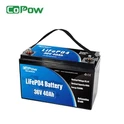
If high-quality cells are used, the service life can even reach 10 years. For example, the CoPow 12V 100Ah Group 31 lithium-ion battery uses CATL Grade A lithium iron phosphate cells. Under 80% DOD operating conditions, it can withstand over 6,000 charge-discharge cycles, with a service life exceeding 8 years.

Advantages:
- Long service life
- Lightweight
- High energy density
- Fast charging
- No need to add electrolyte or clean up corrosion.
- Good performance in high and low temperatures
- Equipped with a smart battery management system for comprehensive protection.
- Low self-discharge rate.
- Stable power output, maintaining strong performance even at low charge levels.
- Complete set of accessories.
- Easy installation.
- High-end customization available.
- Robust internal and external design.
Disadvantages:
Higher price.
Suggest reading: What Is a LiFePO4 Battery?
Best Applications for Group 31 Batteries
Group 31 batteries, known for their high capacity and strong continuous discharge capability, are commonly used in equipment that consumes a lot of power, operates for extended periods, and functions under harsh conditions. Common applications include:
RV: Powering refrigerators, lights, air conditioners, water pumps, coffee makers, and other equipment.
Boats/Yachts: Including starting engines, fish finders, navigation systems, 24V trolling motors, and other equipment.
Golf Carts: Used in 36V, 48V, and 72V electric golf carts.
Forklifts and Industrial Equipment: Some light-duty electric forklifts, AGVs, floor cleaning equipment, and aerial work platforms use Group 31 lithium-ion batteries.
Semi-Trailers/Commercial Trucks: Used for engine starting and powering onboard electrical systems.
Solar Energy Storage Systems: Commonly found in off-grid solar and wind energy storage systems, as well as small-scale home energy storage systems.
Emergency Backup Power: Power backup during outages, telecom base stations, UPS systems, and power backup systems.
Off-Road Vehicles/Construction Vehicles: All-terrain utility vehicles, ATVs, off-road modified pickup trucks, Jeep off-road vehicles, off-road RVs, etc.
Agricultural Equipment: Farm machinery, sprinkler systems, mobile power supply units, etc.
Medical and Security Equipment: Mobile medical carts, portable ultrasound devices, mobile X-ray equipment, medical UPS backup batteries, backup power for CCTV surveillance systems, solar-powered surveillance systems, backup power for communication base stations, etc.

When Is a Group 31 Battery Not the Right Choice?
However, Group 31 batteries are not suitable for all applications. In some cases, they may be too large, too heavy, too expensive, or simply unnecessary. Common scenarios where Group 31 batteries are not suitable include:
Small, low-power devices: Small fish finders, portable power banks, small mobility scooters, low-power trolling motors, and similar devices do not require such a large battery capacity.
Devices with limited installation space: Some small boats, motorcycles, compact RVs, and light utility vehicles may not have enough room for the larger dimensions of a Group 31 battery.
Vehicles that cannot handle excessive weight: Race cars, lightweight off-road vehicles, and unmanned vehicles prioritize weight reduction over massive capacity.
Charging in extremely cold environments: Standard Group 31 LiFePO4 batteries cannot be charged directly below 0°C unless they have a self-heating function.
High-voltage large-scale systems: Some large forklifts, industrial equipment, and commercial/industrial energy storage systems require 48V, 72V, or even higher voltage systems, rather than a single 12V Group 31 battery.
Scenarios requiring only short-term backup power: For temporary backup during power outages lasting just a few dozen minutes, the capacity of a Group 31 battery is significantly excessive.
High-power continuous discharge scenarios: Certain high-power inverters, heavy-duty winches, and large motor equipment require specialized high-rate batteries, which Group 31 batteries cannot provide.
Incompatibility with the original vehicle or equipment dimensions: Some equipment is specifically designed for Group 24, Group 27, GC2, and other specifications, making it impossible to install Group 31 batteries.

Group 31 vs Group 27 Battery
Both Group 31 and Group 27 are common BCI battery specifications, but Group 31 batteries are larger, heavier, and have a higher capacity than Group 27 batteries. The main differences between them lie in their dimensions, capacity, weight, and applications.

How to Choose the Best Group 31 Battery for Your Needs?
How can you choose the right Group 31 battery for your needs? This is an open-ended question that requires careful consideration.
Here, we can only offer some guidelines to help you make an informed decision:
1. First, determine the intended use
- RV: Prioritize cycle life and energy storage capacity
- Marine/Fishing Boats: Require waterproofing, salt fog resistance, and shock resistance;
- Golf Carts: Focus on continuous discharge capability and range.
- Truck Starting - Focus on Cold Cranking Amps (CCA).
- Solar Energy Storage - Focus on cycle count and stability.
2. Choose the Right Battery Type
3. Capacity
Capacity determines runtime:
- 50Ah–75Ah: Suitable for light-duty applications
- 100Ah: The most common and well-rounded option
- 125Ah–150Ah: Supports extended power supply
- 200Ah: For heavy-duty, high-power equipment.
4. Check that the dimensions match
Although they are all Group 31 batteries, the height varies by brand.
Before installation, verify the following:
- Battery compartment length
- Width
- Height
- Terminal orientation
5. Consider Weight
6. Check the cycle life
7. Check the BMS (very important for lithium-ion batteries)
8. Check for low-temperature compatibility
9. Check charging compatibility
It is best to confirm the charging voltage and current before purchasing.
10. Don't just look at the price.
Cheap batteries may have a range of issues, such as falsely labeled capacity, the use of second-hand cells, poor-quality BMS, low cycle life, and poor after-sales service.
11. Choose certified products.
Batteries must have certifications such as CE, UN38.3, MSDS, IEC, and UL.
2026 Trends in Group 31 Battery Technology
By 2026, the biggest change in Group 31 batteries will no longer be limited to increased capacity; instead, they will evolve toward being smarter, lighter, more cost-effective, and better suited for energy storage and mobile devices.
LiFePO4 has become the mainstream trend.
In the past, Group 31 batteries included many AGM, GEL, and lead-acid products, but by 2026, the market will continue to shift toward LiFePO4.
Smart BMS Becomes Standard
The protection board in Group 31 batteries can no longer be simply called a protection board; it is a smart battery management system. In addition to basic protection functions, it features special capabilities such as Bluetooth monitoring, precise SOC algorithms, cloud monitoring, CAN communication, and RS485 communication. Furthermore, you can customize it according to your specific usage needs.
Self-heating Features Are Becoming Increasingly Common
Now, many high-end Group 31 batteries come with built-in self-heating films or low-temperature preheating systems, which have become standard in cold-weather regions such as Canada and Northern Europe.
Higher Capacity
Today's Group 31 batteries are available not only in 100Ah but also in higher-capacity versions such as 125Ah, 150Ah, and 200Ah. This is the result of competition among suppliers and a response to users' growing demand for longer range.
Batteries Are Becoming Lighter
In 2026, many brands began emphasizing lightweight casings, aluminum alloy structures, and modular internal designs; some ultra-lightweight Group 31 LiFePO4 batteries weigh as little as 10 to 12 kilograms.
Enhanced Modularity and Parallel Connection Capabilities
Many users who have relied on Group 31 lead-acid batteries for years now have a need to expand their capacity. Due to the limitations of lead-acid batteries, this is not feasible, but lithium-ion batteries make it possible.
Therefore, when purchasing, users can not only meet current needs but also plan for the future, as many Group 31 batteries now support 4-cell, 8-cell, and even 16-cell parallel configurations.
Best Group 31 Batteries for Marine, RV, and Off-Grid Use
1. CoPow 12V 100Ah 31-cell lithium-ion battery pack with smart BMS
The CoPow 12V 100Ah 31-cell lithium iron phosphate battery is specifically designed for marine, RV, off-grid energy storage, and deep-cycle applications. Featuring high-quality Grade A lithium iron phosphate cells and an intelligent BMS (Battery Management System), this battery offers enhanced safety, more stable output performance, and a longer cycle life, enabling it to easily handle complex and demanding operating environments.
For marine and outdoor applications, CoPow has optimized the battery's moisture, shock, salt fog, and dust resistance, making it suitable for trolling motors, fishing boats, yachts, electric boats, and various onboard power systems.
With a cycle life of over 4,000–6,000 cycles and stable high-current discharge capability, the CoPow Group 31 lithium battery provides continuous, reliable power for fish finders, marine refrigerators, lighting systems, water pumps, audio systems, and various marine electronic devices.

2. CoPow 12V 150Ah Deep Cycle Group 31 Battery
The primary advantage of the CoPow 12V 150Ah Deep Cycle Group 31 Battery is its combination of high-capacity deep-cycle performance with reliability and lightweight design for marine environments.
Utilizing LiFePO4 lithium iron phosphate technology, this battery offers a high capacity of 150Ah while weighing only about 20kg, making it ideal for installation on vessels with limited space, such as fishing boats, bass boats, sailboats, yachts, and electric boats.

3. CoPow 12V 200Ah Group 31 Battery
The greatest advantage of the CoPow 12V 200Ah Group 31 Deep Cycle Battery is that it offers greater energy storage capacity and longer runtime within the relatively compact Group 31 form factor.
For users who frequently use trolling motors, fish finders, GPS, marine refrigerators, lighting systems, and inverters, the 200Ah high capacity significantly reduces the hassle of frequent recharging, making it particularly suitable for all-day deep-sea fishing, long-distance cruising, or overnight anchoring.

Frequently Asked Questions About Group 31 Batteries
1. How Many Ah Is A Group 31 Battery?
The capacity of a 31-cell battery pack ranges from 75Ah to 200Ah, with lithium-ion batteries typically ranging from 100Ah to 200Ah. For example, CoPow offers 12V 31-cell battery packs with capacities up to 200Ah.
2. How Much Does a Group 31 Battery Weigh?
The weight of Group 31 batteries varies depending on the battery type and capacity. Specifically, lead-acid Group 31 batteries weigh approximately 25 to 35 kilograms; AGM batteries weigh approximately 27 to 38 kilograms; and LiFePO4 lithium iron phosphate batteries are lighter, with a common 100Ah model weighing only 10 to 15 kilograms.
3. How Long Does A Group 31 Battery Last?
The service life of Group 31 batteries depends primarily on the battery type, frequency of use, depth of charge and discharge, and maintenance. Standard lead-acid Group 31 batteries typically last 2 to 4 years, AGM batteries generally last 3 to 5 years, while lithium-ion batteries can last 8 to 10 years or even longer.
4.Can I Replace Group 27 With Group 31?
Group 27 batteries can be upgraded to Group 31 batteries. Generally speaking, Group 31 batteries offer greater capacity, longer runtime, and stronger continuous power delivery, but they are also larger and heavier.
Therefore, you must verify that the device's battery compartment, mounting brackets, and cable routing are compatible. Additionally, check that the charger and voltage are compatible. In particular, when upgrading from a lead-acid battery to a LiFePO4 battery, it is recommended to use a dedicated lithium-ion battery charger.